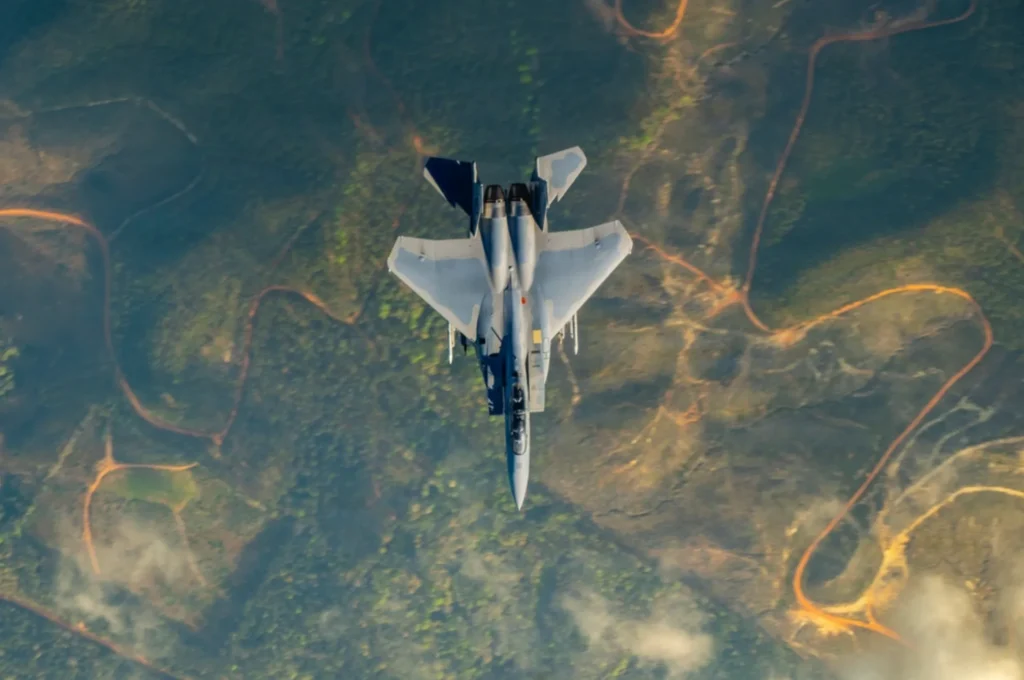
According to recent reports, a single U.S. Air Force F-15E Strike Eagle pilot was shot down not once, but twice during combat operations against Iran in Operation Epic Fury, first by a friendly Kuwaiti F/A-18 Hornet, and then again, about five weeks later, by an Iranian surface-to-air missile.
Since this story broke, a lot attention has been paid to how these shoot-downs actually occurred. Regarding the first incident, concerns have been raised about whether the Kuwaiti F/A-18 pilot had a malicious intent (thus far, there is no evidence to suggest that was the case). And about the second shoot-down, questions have arisen about why the F-15E was flying low enough to be in Iranian MANPAD range, which tends to top out at around 13,000 feet, in the first place.
And while these are worthy lines of discussion, we shouldn’t lose sight of the fact that just getting back into the cockpit that quickly – as this F-15E pilot did – after an ejection is something of a feat in itself. After all, there is an old pilot joke that says that ejection seats save your life by trying to kill you.
The F-15E Strike Eagle carries ACES II, short for Advanced Concept Ejection Seat II, systems for both the pilot and the Weapon Systems Officer, or WSO.
The seats are ejected at a slightly staggered pace, with the WSO going first, followed by the pilot; a smaller divergence rocket is fired from one of the seats to create separation between them thus preventing them from colliding with each other.
The ACES II system, while among the safest ejection seats in the world, still relies on a 21-pound solid-propellant rocket motor that ignites as the seat is catapulted from the aircraft. That rocket is powerful enough to launch a relatively light pilot 200 feet into the air from a dead stop on the ground, while subjecting that pilot’s spine to roughly 12 Gs worth of compression forces in the process.
The whole event, from sitting in the cockpit and pulling the ejection lever, to becoming a human-shaped ballistic missile, to finding yourself under a fully-deployed parachute, can take less than two seconds, depending on the ejection altitude and airspeed.
In a real way, this experience is like getting into three car accidents in very short order: the first is when the missile hits the aircraft; the second when you are thrust out of the aircraft under rocket power; and the third is when hitting the ground, which, even under a full parachute, can still be at speeds approaching 20 miles per hour.
This process has been known to break limbs and cause compression fractures of vertebrae. Some pilots have reported losing more than an inch in height after being forced to eject, while others, maybe you might call them the lucky ones, manage to escape unscathed and healthy enough to get right back into the fight. And it appears that’s exactly what the F-15E pilot at the center of this story managed to do.
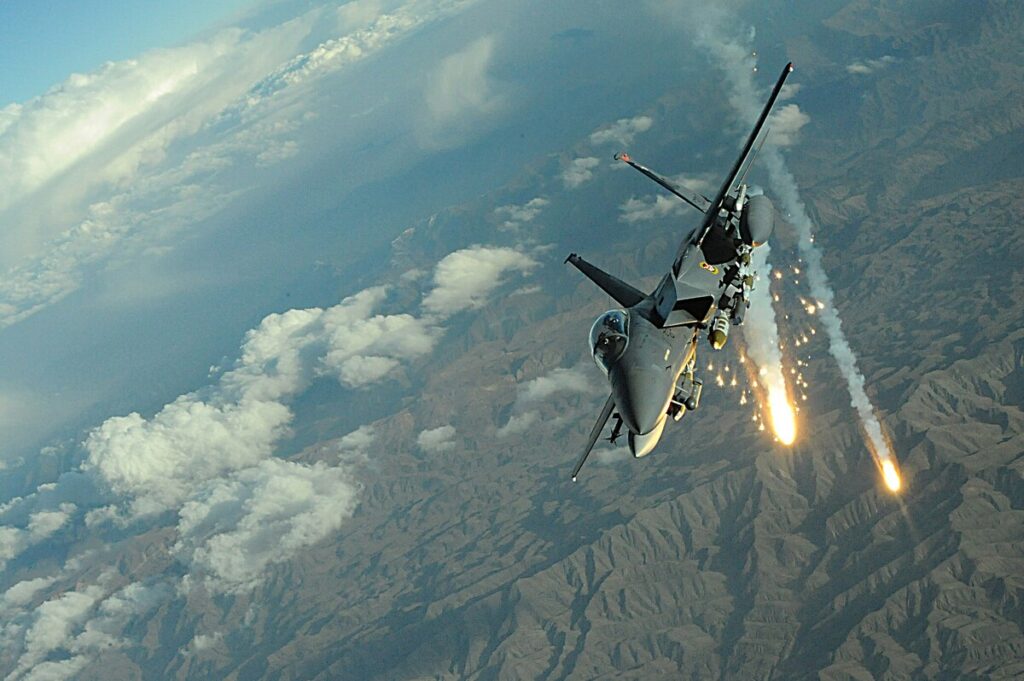
Feature Image: A U.S. Air Force F-15EX Eagle II assigned to Eglin Air Force Base, Florida, flies a training mission over southeast United States, March 23, 2026. The 96th Test Wing and 53rd Wing perform developmental and operational test series on the platform including next-generation survivability, radars, sensors and networking capabilities. (U.S. Air Force photo by Staff Sgt. Blake Wiles)