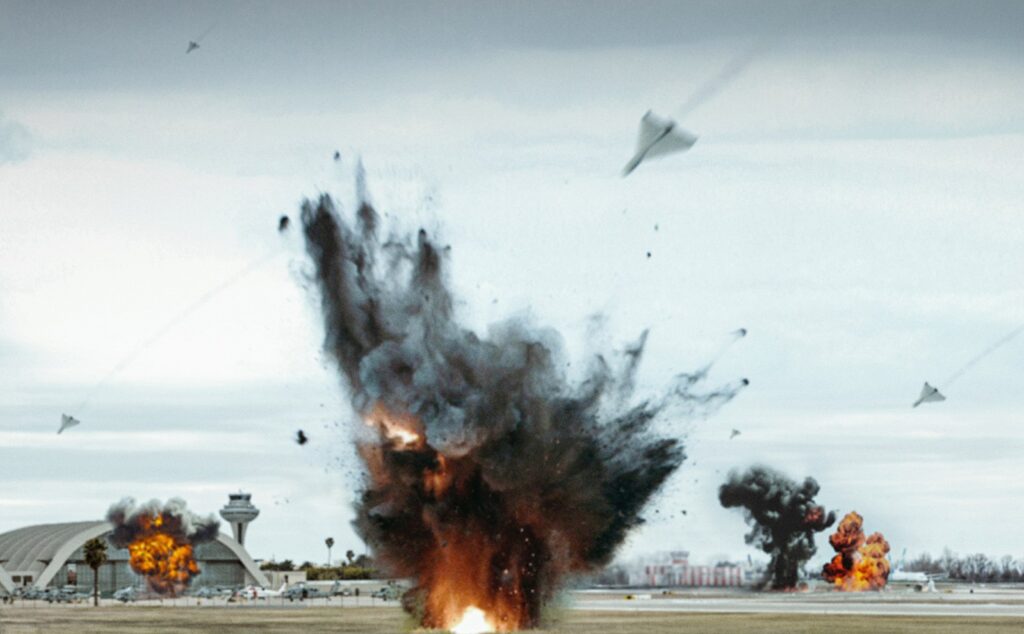
Sometimes, a good-enough option beats the best tech and the highest budget – and the Shahed 136 is a perfect example of a good-enough option. Iran’s cheap kamikaze drone is changing the face of warfare and creating the potential for airborne munitions on a cash-strapped budget.
Its use by Russia – in the form of Geran-2 – in the war in Ukraine, and by Iranian forces across the Middle East has proven that the Shahed 136 will undoubtedly change the nature of warfare by just being good enough.
The Shahed 136 is an Iranian kamikaze drone often called the “moped of the sky” due to the look and placement of its single engine.
It is a remarkably simple weapon often labeled as a drone, but it falls into the category of loitering munitions.
Loitering munitions are airborne munitions that deploy as a kamikaze-style attack vessel. Their strength is their relative low cost, simplicity, ease of deployment, and effectiveness.
The Shahed 136 is about 11.5 feet long and capable of deploying a warhead of over 100 pounds. It has an estimated effective range of 600 to 1,600 miles. It relies on a combination of Inertial Navigation and civilian GPS to strike its target and has been found to include SIM cards for advanced navigation.
With an estimated cost of between $20,000 and 80,000 to produce, it’s creating a significant problem for even the most advanced military forces, because missiles designed to intercept the Shahed cost between $100,000 and three million.
Aside from the cost, these loitering munitions can be produced extremely quickly, whereas interceptor missiles take more time and effort to produce resulting in an economic mismatch of production.
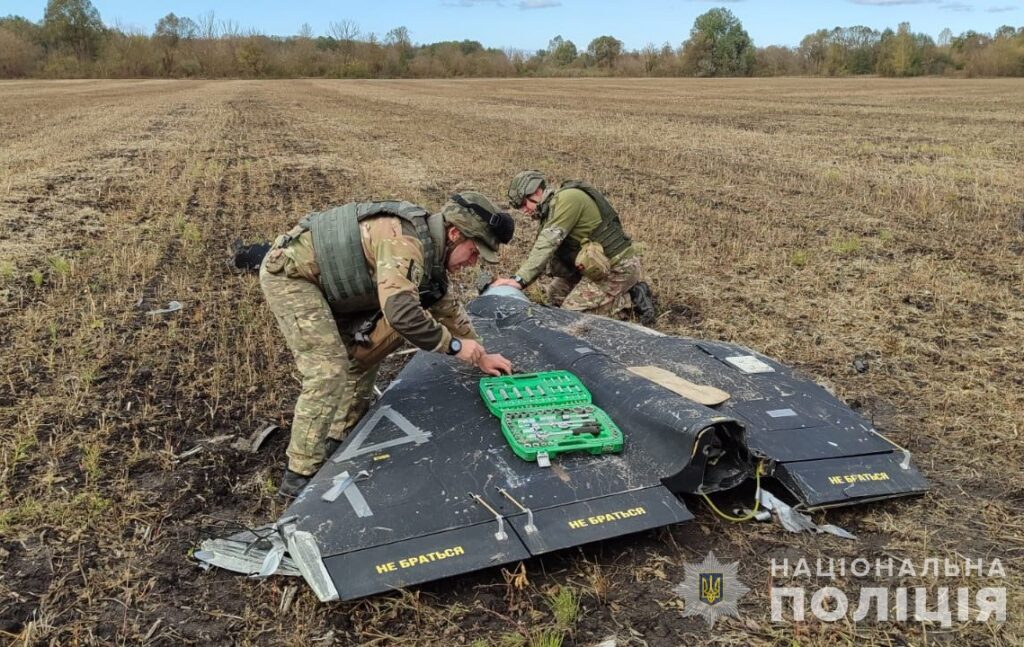
Thousands of Geran-2s have been deployed throughout Ukraine. Not only are they causing massive casualties, but also deplete expensive counter-munitions forcing Ukraine to device low-cost solutions to counter them.
Meanwhile, the Houthis have used the Shahed to target trade vessels. A drone that costs at most $80,000 can bring billions of dollars of global trade to a halt with clever use. The Houthis also used Shaheds to target Saudi oil facilities, causing massive damage to oil supplies.
Across the Middle East, the Shahed has become a common threat used to terrorize population centers, military bases, and other installations.
Shaheds often are deployed en masse to increase the likelihood that one will make it through air defenses and hit its target. Even if only a few make it through, their damage potential is significant. Quantity becomes a quality of its own.
Launching the Shahed isn’t difficult and doesn’t require a concrete runway or a complicated launching system. Instead, launch racks are used to deploy multiple Shaheds via a rocket assist. Once the rocket reaches a high-enough altitude, the drone’s engine kicks on and carries the Shahed to its final target.
These units are capable enough that the U.S. took notice and began producing its own low-cost alternative known as the Low-Cost Unmanned Combat Attack System, or LUCAS.
Related: New frontiers in anti-drone munitions were on display at SHOT Show 2026
A weakness of the Shahed is its relative slow speed: it flies at only around 115 miles per hour making it vulnerable. Iran recognized that and started producing a faster version known as the Shahed 238. (Russia is also using its own version of the 238, known as the Geran-3, in the war in Ukraine.)
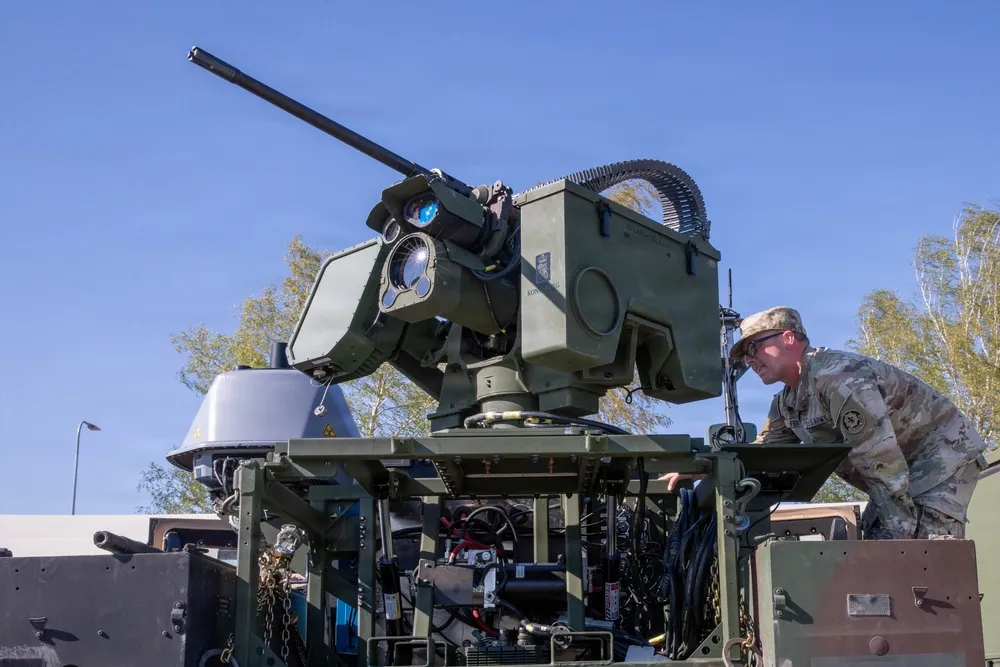
Due to its low speed, the Shahed 136, itself, can be countered with machine gun fire; it also caused the resurgence of flak-cannon-style ground-to-air defenses. Sometimes simple can beat simple.
Airpower is no longer exclusively the domain of well-equipped, well-funded military forces. Instead, it’s been democratized to be affordable, effective, and deadly.
While asymmetric economics remain in play, the jet-powered Shahed will have a place it warfare.
Weapons like the Shahed 136 are more than just basic attack drones – they are an effective economic and psychological tool that has created a ripple in modern warfare that might become a tsunami.
Feature Image: Artist’s impression of Shahed 136 drones striking an airport. (Khamenei.ir/Wikimedia Commons)
Read more from Sandboxx News
- Long-distance targeting is much harder than people think – and that’s bad news for China
- The F-14 Tomcat fighter wasn’t the US Navy’s first choice
- America’s LUCAS kamikaze drones will get a lot scarier thanks to Hivemind AI
- A Green Beret remembers his favorite foreign weapons
- OA-1K Skyraider II aircraft revealed its impressive capabilities during SOF Week