With Hermeus back in the news last week with its effort to field the world’s first fully reusable hypersonic jet, it is a good time to discuss why we don’t already have hypersonic planes zooming across the sky, because the real reasons almost certainly aren’t what you think.
Most people assume the constrains are scientific or technological, like finding materials that can withstand the heat, but the real roadblock lies elsewhere.
In scientific terms, hypersonic flight begins when you’re flying so fast that the air you’re passing through superheats to the point where air molecules form a sheath of electrically charged plasma around the aircraft. This tends to happen at speeds around Mach 5, so Mach 5 became the speed over which you’re considered to be hypersonic.
At such speeds maintaining control of an aircraft can be difficult, because the air flowing over the aircraft behaves so strangely that control inputs can produce unpredictable and sometimes even opposite results. Further, if the aircraft is also flying at very high altitudes, the air there is so thin that standard control surfaces are sometimes nearly useless.
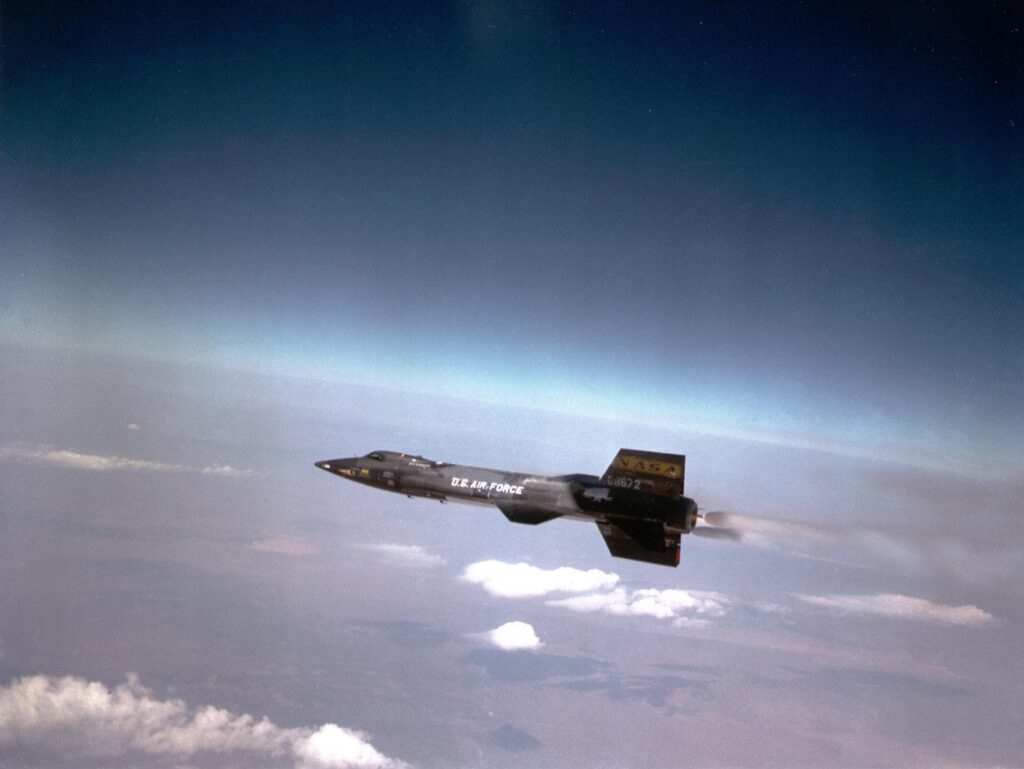
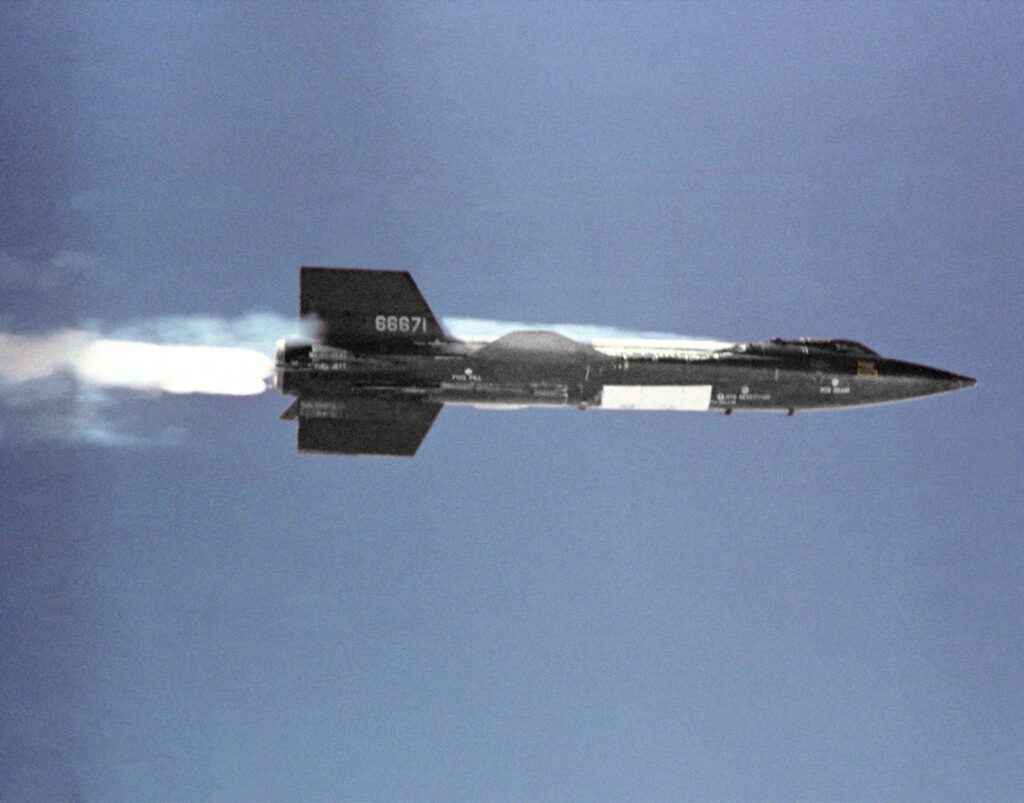
This is why the rocket-powered and manned X-15 that reached Mach 6.7 in 1967 didn’t just rely on standard control surfaces like most aircraft, but also boasted hydrogen peroxide reaction control thrusters on the nose to control pitch and yaw, and on the wings for roll control at high altitudes.
As challenging as the aerodynamics and material sciences required to sustain speeds in excess of Mach 5 may be, they haven’t really been the limiting factor in making hypersonic aviation viable.
After all, the United States already has a long history of controlled hypersonic flight to pull from. These range from the aforementioned Mach 6.7 X-15; to the space shuttle that would regularly exceed Mach 25 during reentry starting in the 1980s; through scramjet demonstrators that flew as fast as Mach 9.6 in the early 2000s; and right up through the Artemis II mission from a month ago that saw its Orion Capsule reach Mach 32 after it reentered the atmosphere.
Instead, the real barrier to building hypersonic aircraft is finances.
Each of the aforementioned hypersonic platforms relied on a variety of other platforms and rockets – many of which could not be reused – just to get off the ground.
This makes hypersonic flight financially prohibitive for purposes other than gathering scientific data or delivering a warhead – which is why most hypersonic platforms in development today are designed to do one of those two things.
Nevertheless, there’s a good reason for this reliance on bombers and rockets: air-breathing hypersonic jet engines, like scramjets, work great at speeds above Mach 3 and might even be able to accelerate beyond Mach 10, but they’re wildly inefficient at lower supersonic speeds. and can’t work at all from a dead stop on the runway.
So, companies like Hermeus are taking a new approach, effectively using a turbofan engine to propel an aircraft to high enough speeds and altitudes to then turn the jet over to ramjet power and keep accelerating past Mach 3 and maybe even Mach 5. But just as importantly, you can work that process in reverse, and return to turbofan power again to fly slow enough to come in for a safe landing and do it all again tomorrow.
According to Hermeus, its hypersonic jet, called Quarterhorse, will only cost about as much as an F-35, meaning you could buy seven of them for the price of a single B-21 Raider. So, it’s safe to say there could be a real use case for that.
Feature Image: The X-15A-3 rocket plane flies over Edwards Air Force Base during a mission in the 1960s. (U.S. Air Force)
Read more from Sandboxx News
- The Vz. 61 Skorpion submachine gun will be remembered for its uniqueness
- Ukraine’s air force will get a big boost thanks to Sweden and a powerful European missile
- Son Tay Raid: One of the most daring special operations in US history
- SR-71 Blackbird is considered the fastest piloted jet in history – but there was an even faster jet
- A history of American Squad Automatic Weapons