When comparing fighter jets, afterburning thrust isn’t a very meaningful metric. Instead, a much better metric for comparison is thrust versus weight, or the thrust-to-weight ratio, because performance is ultimately dictated by how well you can move your heft around.
An easy way to understand the importance of the thrust-to-weight ratio for fighters is to relate it to the more familiar concept of horsepower.
For example, an Audi RS7 and a tractor-trailer can both come equipped with 600-horsepower engines, but the Audi offers significant more acceleration and maneuverability. This is because it weighs less than 5,000 pounds, while a fully loaded tractor-trailer might weight 80,000 pounds.
Of course, fighter jets aren’t in a drag race, so the benefits of a better thrust-to-weight ratio in the sky come down to being able to quickly gain or recover airspeed (kinetic energy) or altitude (potential energy) during or after maneuvers.
Kinetic and potential energy are the currency you pay to make your fighter change course; in other words, to take a hard turn, you trade some of your fighter’s kinetic energy (airspeed) and some of its potential energy (altitude) to point the jet in a new direction. If you do too much of that, you’ll run out of one or both and find yourself standing still in a smoldering crater on the ground.
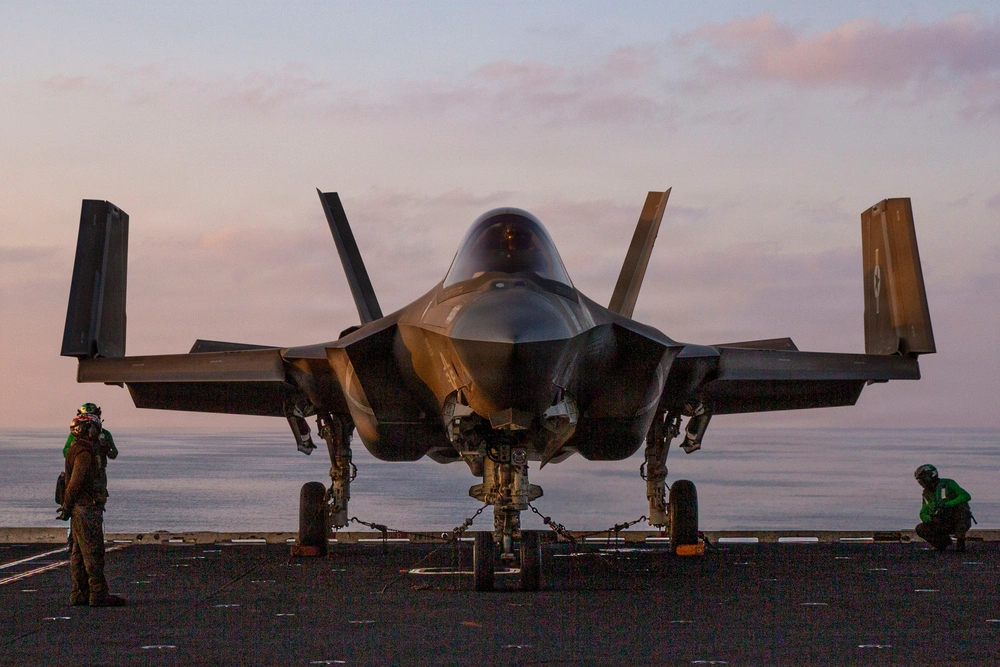
But if you have a high thrust-to-weight ratio, you can regain that speed or altitude more quickly, giving you a better ability to maneuver and an advantage in a close-range dogfight.
To calculate the thrust-to-weight ratio of America’s fighters, we need to make an assumption for what they’ll be carrying.
We’re going to include 50% of the fighter’s internal fuel, four AMRAAMs, two Sidewinders, and an extra 1,000 pounds to very roughly account for things like the pilot, gun ammunition, pylons, chaff, and flares. And we will be focusing squarely on the air-to-air fight.
(The ratio can be calculated with full fuel weight or different loadouts, so it’s not uncommon to come across different figures.)
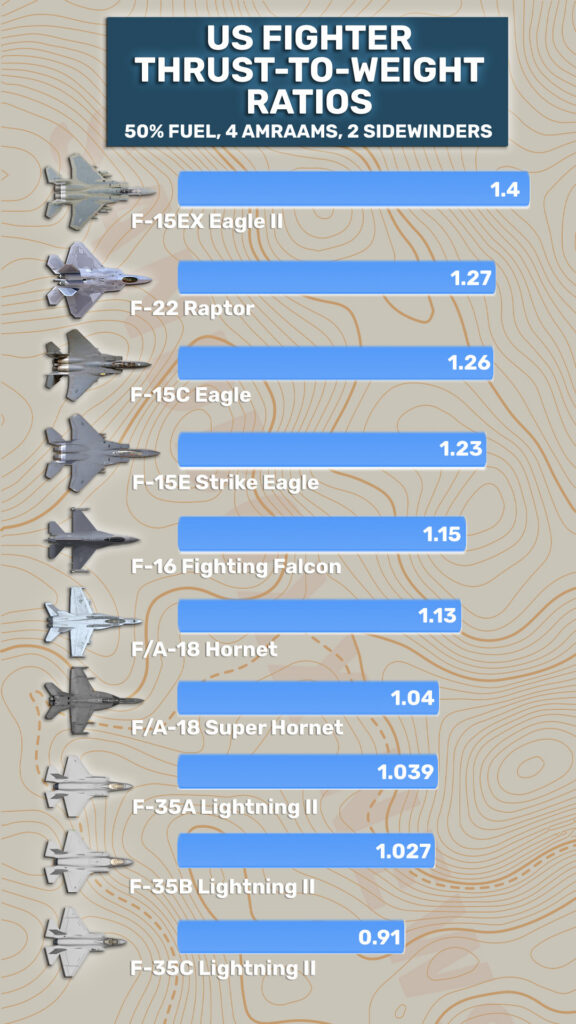
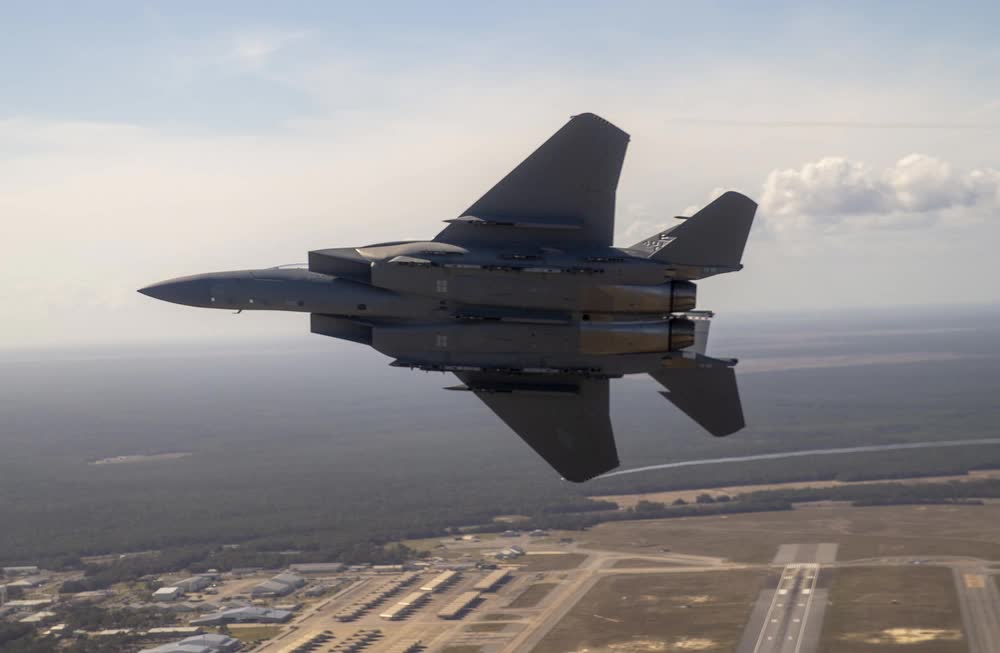
And with that in mind, it should come as no surprise that the latest iteration of the legendary F-15, the F-15EX Eagle II, leads the pack, with a thrust-to-weight ratio of roughly 1.4, meaning the jet pumps out about 1.4 pounds of thrust for every one pound the aircraft weighs.
In second place is the wildly powerful F-22 Raptor, with a thrust-to-weight ratio of roughly 1.27, followed by the original F-15C Eagle at 1.26, and the more air-to-ground-focused F-15E Strike Eagle at around 1.23.
From there, we have the small and nimble Viper, or F-16 Fighting Falcon, at around 1.15, followed by the Marines’ legacy Hornets at around 1.13, and the Navy’s more modern and broadly capable Super Hornets at around 1.04.
Finally, the three variants of the F-35 sit at the rear of the pack, with the runway queen F-35A boasting a ratio of around 1.04, and the vertical landing F-35B a ratio just under 1.03; the carrier-launched F-35C is the only active fighter in Uncle Sam’s inventory with a thrust-to-weight ratio of below 1:1 at around 0.91 with this loadout.
In other configurations, of course, this ranking could shift – in fact, in a lot of cases, only the F-15EX, F-22, F-15C, and F-16C are considered to offer a better-than-1:1 thrust-to-weight ratio in combat.
Feature Image: Lt. Col. Richard “Tac” Turner, Commander, 40th Flight Test Squadron, and Lt. Col. Jacob “Duke” Lindaman, Commander, 85th Test & Evaluation Squadron, deliver the first F-15EX to its new home station, Eglin AFB, Florida, 11 March, 2021. (U.S. Air Force photo by Master Sgt. John Raven)
Read more from Sandboxx News
- Germany to soon receive its first F-35 stealth fighter
- Trump orders Ford-class aircraft carriers back to steam catapults – but nobody has built one in 20 years.
- The Navy SEALs’ two original and little-known missions are still needed today
- US military wants to expand production of one of its most effective air defense weapons
- How three British guys in a shed revolutionized sniper rifles