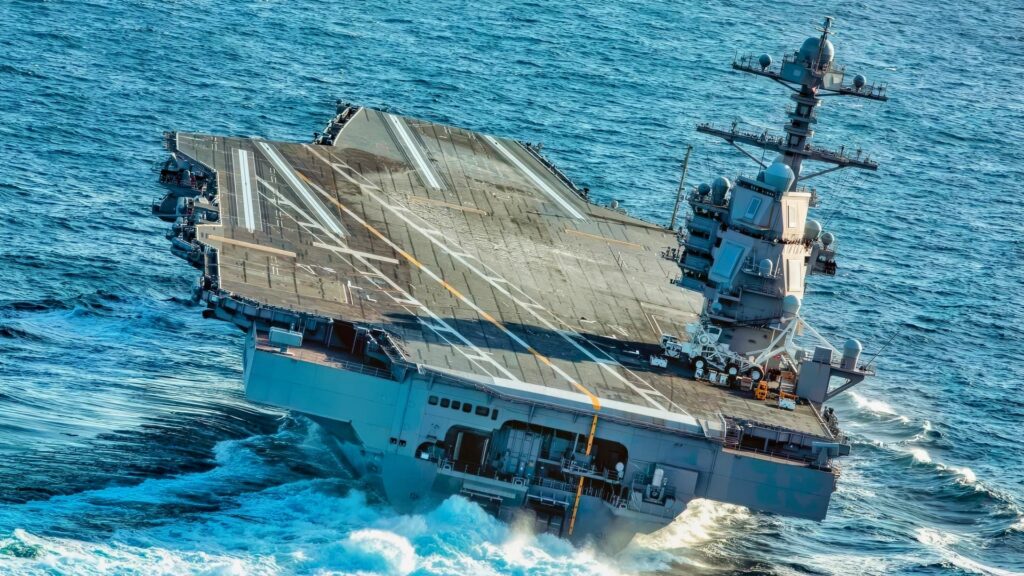
Last week, the White House issued an executive order designed to accomplish one of its goals from the president’s first term: hamstringing a major American fleet unit. Alongside an order that allowed U.S. warships to be built in foreign yards, President Donald J. Trump mandated that the U.S. Navy redesign its latest aircraft carrier to replace the electromagnetic catapult system (EMALS) with older steam catapult technology.
The change is likely to incur substantial, unnecessary expense and delays in the construction of the fourth vessel of the CVN-78 class of aircraft carriers.
Steam catapults were introduced in the U.S. Navy (having been borrowed from the Royal Navy) in the 1950s as a way of launching heavier aircraft than could be contemplated by previous hydraulic catapults.
The system has served effectively for decades and is currently installed on all 10 Nimitz-class aircraft carriers. However, steam catapults have reached the point of diminishing returns in their evolution, relying on bulky, maintenance-heavy components and lacking the efficiency of new designs.
The designers of the CVN-78 class saw an electromagnetic system as a way to sidestep some of the problems with steam.
The EMALS system uses energy more efficiently (important in an increasingly demanding energy environment) to launch aircraft while putting less stress on the airframe.
It takes up less space, requires a smaller maintenance crew, and, perhaps most importantly, can be calibrated for aircraft of different weights and sizes, making it theoretically ideal for launching small, light unmanned aerial vehicles.
In short, EMALS increases the carrier’s sortie rate and flexibility, while saving energy and crew space and relieving stress on aircraft.
On the downside, EMALS has experienced teething problems in service with the USS Gerald R. Ford, and technical issues associated with construction have contributed to delays in the first two CVN-78 ships.
These issues were regarded with embarrassment by the Navy but also represented the kind of teething problems that are often associated with the introduction of a complex new technological system.
These problems did not deter others from adopting electromagnetic systems as the international standard: China’s latest aircraft carrier (CNS Fujian) is equipped with EMALS, and the next generation of carriers is expected to use them as well. France plans to use an EMALS system on its next carrier.
Impact on Ford-class supercarrier
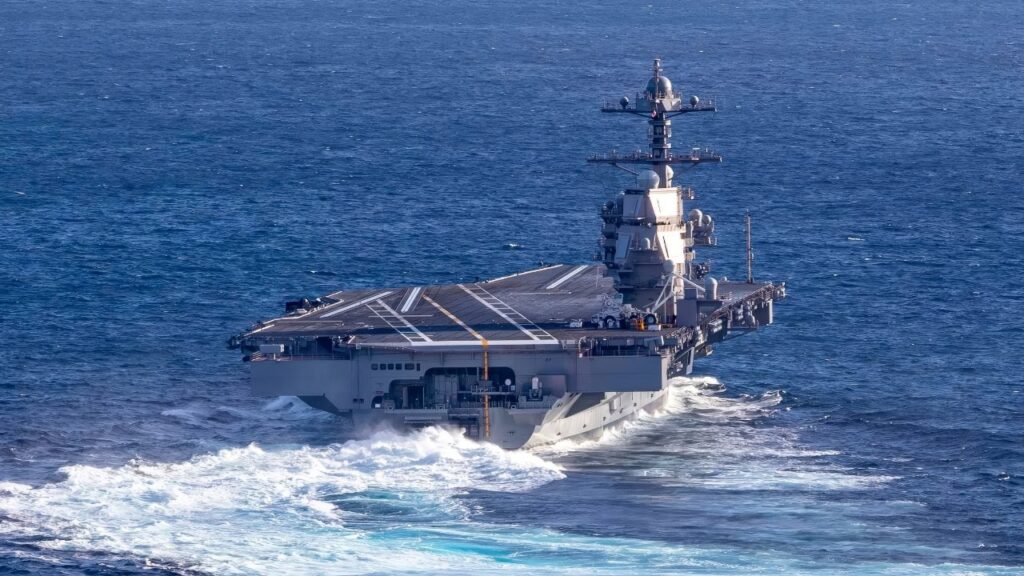
For now, the executive order will affect only one warship.
The first three ships of the CVN-78 class (the Ford, Kennedy, and Enterprise) will retain the EMALS catapult systems that are already installed or in an advanced state of construction. But the fourth ship, the Doris Miller (CVN-81), will require a significant redesign in order to move forward with a steam catapult system.
The catapult system is integrated into the CVN-78 system from the ground up; changing it would require significant structural changes to the ship’s overall design and would result in a vessel with very different capabilities and maintenance requirements than the rest of the class.
It is not a stretch to argue that CVN-81 would become an entirely different class of aircraft carrier as a result of these changes.
The problems extend to construction: The last carrier equipped with steam catapults, the USS George H.W. Bush, entered service seventeen years ago.
While the Navy has decades of experience with steam on carriers, industry hasn’t actually built such a system in nearly 20 years. Reconstituting a supply chain and re-establishing the human capital necessary to build and install the systems, as well as design a carrier around them, will take time and money.
This is a nightmare for the Navy. Although navalists have generally been happy with this administration, few, if any, serious naval architecture analysts have spoken up in defense of this shift.
Indeed, the Navy has been trying to avoid the steam catapult issue since early in Trump’s first term. With a bit more than two years left in his term, the Navy will likely continue to stonewall and obstruct, slow-walking the redesign of CVN-81 until Trump leaves office.
The most likely impact will be a delay in the construction of Dorrie Miller to evaluate these design changes, along with all the corresponding cost increases.
Let there be no mistake; this is an unprecedented intervention by a president in a matter of deep technical concern.
No previous president has mandated changes in naval architecture at such a granular level, and none has done so with less grasp of the technical issues involved.
Fortunately, President Trump’s intervention will likely result in no more than a delay in the construction of the fourth Ford-class carrier, as any successor of either party is likely to reverse the order in January 2029.
Editor’s Note: This article by Robert Farley was originally published by 19FortyFive.com.
Feature Image: USS Gerald R. Ford (CVN 78) conducts high-speed turns in the Atlantic Ocean. (U.S. Navy photo by Petty Officer 3rd Class Connor Loessin)
Read more from Sandboxx News
- The Navy SEALs’ two original and little-known missions are still needed today
- US military wants to expand production of one of its most effective air defense weapons
- How three British guys in a shed revolutionized sniper rifles
- How F-14 and F-15 pilots trained to take down the legendary Blackbird
- Navy gets new floating dry dock, the first of its kind in 40 years