The German Air Force will soon receive its first operational F-35A Lightning II stealth fighter jet.
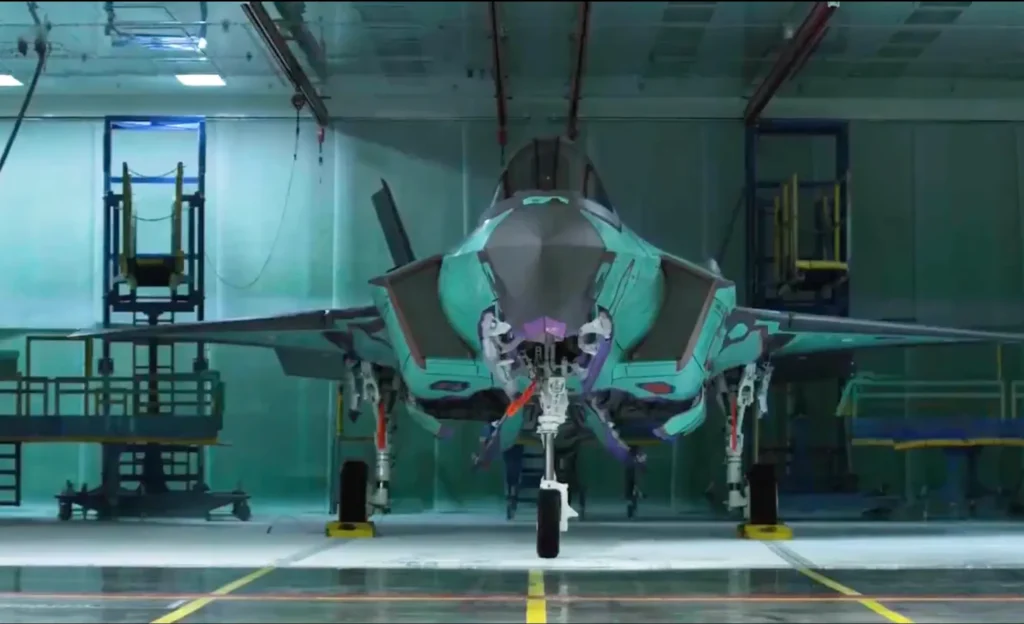
Lockheed Martin said it has completed final assembly of Germany’s first F-35A Lightning II. The aircraft will now go through the final phase of production that includes applying special stealth paint.
“Another milestone for Germany’s first F-35. Following final assembly, the aircraft moved to Aircraft Final Finishes, bringing it one step closer to supporting the Luftwaffe and Germany’s next generation of air power,” Lockheed Martin announced in a social media post.
Lockheed Martin anticipates the aircraft to be delivered on September 18.
An additional seven F-35As are going through different phases of production at Lockheed’s Fort Worth facility in Texas.
The Luftwaffe will operate the F-35 from the Büchel air base, and the aircraft is expected to be operational in early 2027. The stealth fighter jet will replace the Panavia Tornado and will be able to carry B61 nuclear bombs supplied by the U.S. military.
Germany was a rather late addition to the F-35 Joint Strike Fighter program. Berlin announced its decision to purchase the fifth-generation stealth fighter jet in 2022, a few weeks after Russian tanks rolled into Ukraine as part of the Kremlin’s full-scale invasion of its neighbor.
The Luftwaffe has ordered 35 F-35A stealth fighter jets at the cost of 13 billion euros ($13.85 billion). Besides the Russian threat, Germany turned toward the F-35 due to delays with a planned joint Franco-German stealth fighter jet.
A European F-35 fleet
As of today, 20 countries have signed on the F-35 program, and 13 of these are European.
Specifically, the European countries that fly or will fly the F-35 are the United Kingdom, Italy, the Netherlands, Denmark, Norway, Belgium, Poland, Finland, Switzerland, Germany, the Czech Republic, Greece, and Romania. These 13 European countries will have a combined fleet of approximately 676 F-35s of all types once deliveries are completed (countries like Greece are likely to order additional aircraft thereafter).
However, the U.S. military will have the largest F-35 fleet by far. Specifically, the U.S. Air Force, Navy, and Marine Corps have expressed plans for a total of 2,456 F-35s of all types (Air Force: 1,763 F-35As, Navy: 273 F-35Cs, and Marine Corps: 280 F-35Bs; 140 F-35Cs).
Overall, as of August, Lockheed Martin has delivered more than 1,345 F-35s of all variants, and the airframe has exceeded one million flight hours.
Over 3,500 pilots from across the 20 countries are qualified to fly the aircraft, and nearly 22,000 maintainers are trained to support it. The global F-35 fleet has completed almost 800,000 training and operational sorties.
The F-35 is a multi-role fifth-generation stealth fighter jet that can conduct several mission sets, including Strategic Attack, Air Superiority, Close Air Support, Electronic Warfare, Intelligence, Surveillance, and Reconnaissance (ISR), Suppression of Enemy Air Defenses (SEAD), and Destruction of Enemy Air Defenses (DEAD).
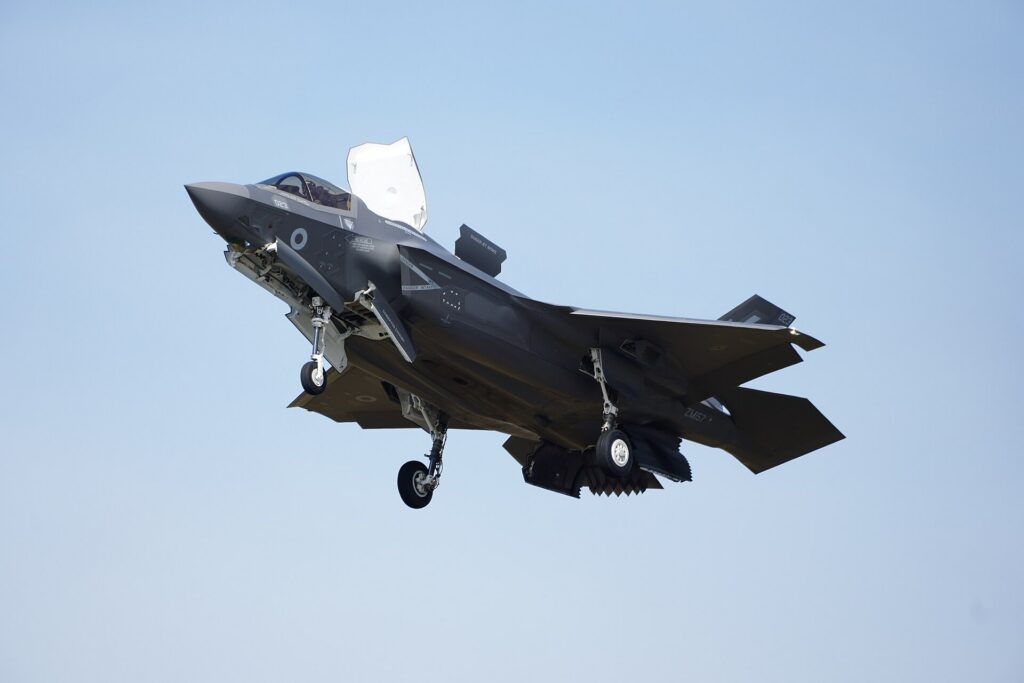
The aircraft comes in three similar but distinct variants. The F-35A, which happens to be the most popular, is the conventional take-off iteration of the aircraft. The F-35B, is the Short Take-Off, Vertical Landing (STOVL) version that can take off and land like a helicopter but still fly like a fighter jet. Finally, the F-35C, which is the rarest, with only the U.S. Navy and Marine Corps operating it, is the carrier-based iteration designed to operate from aircraft carriers.
Feature Image: The first German F-35A aircraft without its coating of stealth paint. (Lockheed Martin)
Read more from Sandboxx News
- Trump orders Ford-class aircraft carriers back to steam catapults – but nobody has built one in 20 years.
- The Navy SEALs’ two original and little-known missions are still needed today
- US military wants to expand production of one of its most effective air defense weapons
- How three British guys in a shed revolutionized sniper rifles
- How F-14 and F-15 pilots trained to take down the legendary Blackbird