The U.S. Navy just awarded Boeing a $75 million contract for BSU-111/B Payload Delivery Unit kits.
These kits will add a turbojet engine, built by Kratos, to cheap 500-pound guided bombs, turning them into low-cost cruise missiles that can strike targets from more than 345 nautical miles. In comparison, the standard JDAM can strike targets from roughly 17 miles out, while the glide-kit equipped JDAM-LR can reach as far as 52 miles.
In effect, these new weapons combine the traditional JDAM with the glide-kit (or deployable wings) of the JDAM-extended range and with a new 200-pound thrust class turbojet engine.
An official price has not been released, but estimates currently place the JDAM-LR ar roughly $200,000 per weapon. This makes them roughly as expensive as new low-cost cruise missiles headed for service while offering slightly less range (345 miles versus 500) but a significantly larger payload (at 500 pounds versus 100).
The kit, when combined with a Mk-82 500-pound general-purpose gravity bomb, will be known as the GBU-75 JDAM-LR.
“This first production contract is a major milestone for the JDAM LR program, demonstrating our ability to deliver long-range precision-strike capability at a significantly lower cost,” Bob Ciesla, the vice president of Boeing Precision Engagement Systems said.
“JDAM LR gives operators an affordable, mass-producible option for striking targets from beyond the effective range of enemy defenses,” he added.
However, these new weapons are about more than just increasing the range of America’s JDAMs: They also include onboard power generation meant to allow for new instruments, for example electro-optical targeting sensors used to target ships.
There is also a maritime mining kit, which allows these weapons to be launched from standoff range before impacting the water, sinking to the bottom, and using the MK57 Target Detecting Device to detect the signatures of enemy vessels as they approach. They then detonate only when they detect the specific signature of their intended target.
One of the most important factors – which has gone largely unnoticed – of this effort is how quickly and easily these weapons can be integrated into America’s combat aircraft.
When a new weapon enters service, it has to go through a great deal of structural, aerodynamic, electromagnetic, loading-and-separation testing for each individual aircraft.
Further, the weapon itself has to be integrated with the aircraft’s onboard fire control systems both physically, via an umbilical harness and digital databus, and digitally via software changes to onboard systems.
Combined, this process often takes years and costs tens of millions of dollars to complete. Just the integration of the JASSM-ER cruise missile into the Navy’s Super Hornets, for example, cost a reported $53 million and took five years.
The GBU-75 JDAM-LR, on the other hand, was specifically designed to use the existing JDAM interface that’s already been integrated to most combat aircraft in American service, meaning any platform that can drop JDAMs today can launch JDAM-LRs tomorrow.
The weapon has now started undergoing some integration-testing across the fleet.
According to Boeing, the weapon recently completed its first flight test off the coast of California. There, it met “the objectives of sustaining powered flight on a predefined test profile and using military-code GPS navigation while maintaining consistent guidance directly to its target.”
So far, the Navy has not said when we can expect the GBU-75 JDAM-LR to enter service.
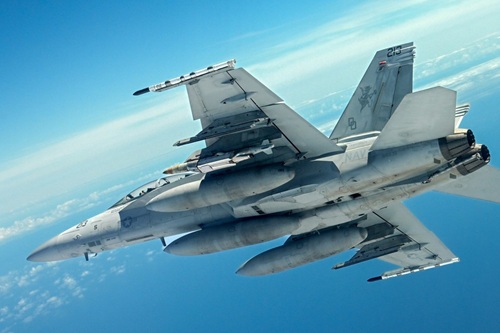
Feature Image: An F/A-18 aircraft carrying a JDAM-LR. (U.S. Navy)
Read more from Sandboxx News
- USS Minnesota returns home after months-long deployment in the Indo-Pacific
- Air Force’s plan to upgrade its 70-year-old B-52 bombers is billions over budget, watchdog finds
- Fore! Special operators parachuting into a golf course
- Navy reclassifies upcoming Virginia-class submarines pointing to the vessels’ future role
- Navy’s C-2 Greyhound, a Cold War warrior, was retired after 60 years of service