Anduril is now working to expand the capabilities of its air-to-air-focused fighter drone, the FQ-44 Fury, to include a variety of air-to-ground weapon systems, potentially turning this small and nimble drone into a full-fledged multi-role fighter.
Fit for Fury.
— Anduril Industries (@anduriltech) September 15, 2026
Notional FQ-44 configurations confirm Fury’s compatibility with a range of munitions, including 500-pound class guided bombs, Small Diameter Bombs, air-launched cruise missiles, rocket pods, external targeting pods, and (many) more. Fight unfair. pic.twitter.com/wxtET00MtD
The FQ-44 Fury is one of two collaborative combat aircraft, or CCA, drones already in production for the U.S. Air Force and slated to enter service in just the next few years.
The Fury is 20-foot-long and boasts a 17-foot wingspan, making it a fair bit smaller than America’s other drone fighter in production, the General Atomics FQ-42 Vengeance. Nevertheless, Fury packs a substantial punch in that small package.
The platform was originally designed by Blue Force Technologies as a target surrogate, meant to represent the air-to-air capabilities of the most advanced adversary fighter aircraft for American pilots to train against. But when Anduril purchased the firm, it chose to turn the drone into a fighter.
Since then, Anduril has refined Fury’s design and onboard systems toward that end. This has resulted in a drone that offers a maximum takeoff weight of around 5,000 pounds, powered by a Williams International FJ-44M non-afterburning turbofan engine that produces roughly 4,000 pounds of thrust – enough to propel the aircraft to a top speed of just below Mach 1 and give it a service ceiling of about 50,000 feet.
The drone will have four hardpoints.
Just like many modern fighters, the FQ-44 can withstand maneuvers up to 9G.
Humans can withstand many more Gs than most tactical aircraft can, as long as the duration is short enough. And that’s really where these drones can shine: by sustaining higher-G turns for longer than a human pilot could.
Fury is clearly not only focused on the air-to-air fight.
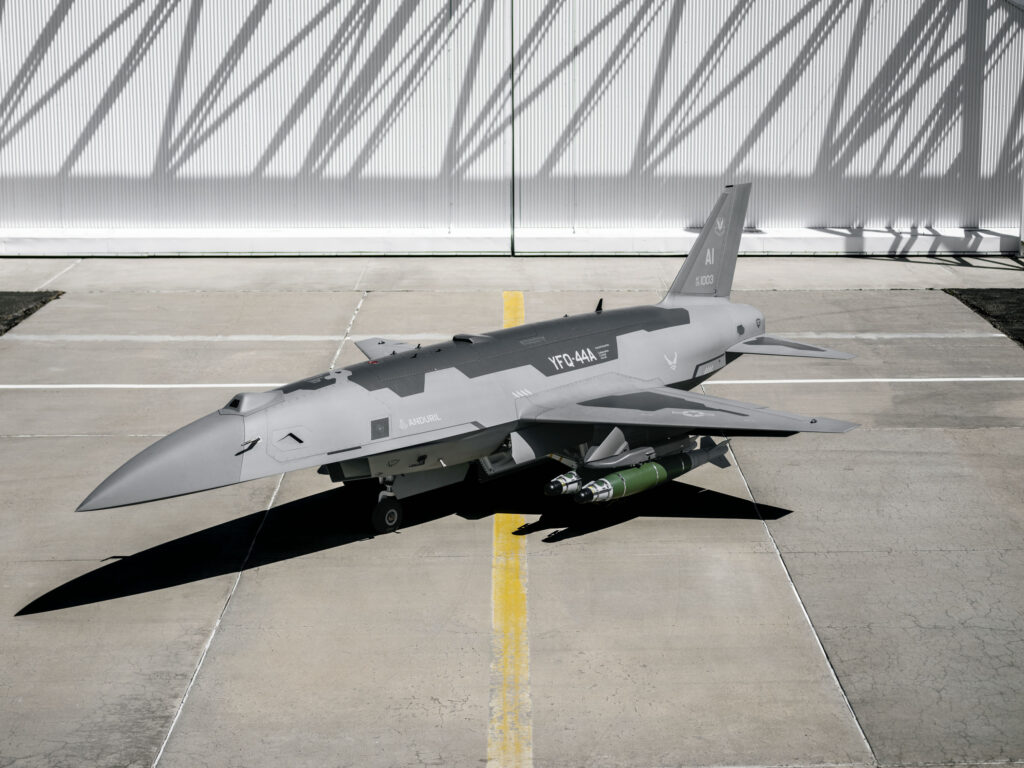
In newly released images, the drone is seen carrying two 500-pound GBU-54 laser-guided JDAMs under one wing, and two LAU-131A 7-shot rocket pods under the other, which fully loaded, would weigh about 600 more. Those pods can be used to launch unguided Hydra rockets at ground targets, or to launch laser- or infrared-guided AGR-20s at airborne drones. Anduril also showed off Fury carrying twice its current air-to-air loadout, or four AIM-120 AMRAAMs.
However, as Stefano D’urso pointed out for The Aviationist, it is important to understand the distinction between testing and actual capabilities.
Anduril’s tests are meant to ensure that the production FQ-44 can structurally carry these munitions; but there is still lots of testing ahead before the program can boast these added capabilities.
However, once testing is concluded and successful, Fury could have the chance to take on a wider variety of mission sets, from hunting drones and cruise missiles to taking out enemy air defense arrays and more.
Feature Image: The FQ-44 Fury loaded with a variety of weapons. (Anduril)
Read more from Sandboxx News
- SWCC are the Naval Special Warfare’s elite boat operators
- Some of America’s best fighters almost ended up having aircraft-carrier variants
- Anthropic says Russian and Chinese actors used Claude as weapons engineering assistant for drone swarming and more
- How Afghanistan released me from the guilt and shame I felt after 9/11
- Army engineers’ work saved ‘thousands of lives’ on 9/11