Military snipers see themselves as hunters, patiently stalking their target from the shadows until it’s time to take the shot. But unmanned aerial systems have changed the dynamic, acting as an unseen eye in the sky that can out-hide and out-loiter any human sniper.
In recognition of the changing combat environment, the U.S. Army Sniper Course at Fort Benning, Georgia, announced in March that it’s building “advanced signature management technology” into its 29-day residency course.
“What we’ve seen in the last few years in recent conflicts has been a lot of drone activity and having to hide from and defeat thermal and drone systems,” course instructor Staff Sgt. Brett Bollinger said in an Army release. “That’s what really drove us to develop these plans because those are the type of assets our near-peer adversaries are going to have in large-scale combat operations.”
According to information published by the course, advanced signature management is now part of the Field Craft portion of the course, which covers use of hides and concealed movement as well as specialized sniper skills such as range estimation and target detection.
As anyone who’s ever seen an elaborate “ghillie suit” knows, snipers pride themselves in going to great lengths to blend with their environment – camouflage and signature management is a specialty, not an innovation. But ghillie suits do nothing to throw off hostile drones armed with thermal cameras.
Bollinger said course staff have been evaluating “multispectral thermal-defeating mitigation technologies” that look like conventional camouflage nets but mask the movements of a human sniper. While the Army hasn’t said what contractor it’s working with, multiple companies now offer nets, covering, and even paint that uses coatings to suppress or block heat emission.

A patent from 2009 using nanotechnology to suppress thermal signatures describes how one method can work.
“Thermal and radar signature suppression counter-measures are embedded into or between layers of this ultra-thin, lightweight system in the form of nano-scale, air or gas-filled microspheres or micro-balloons that can also be metallic coated, such as cenospheres, and pulverized aerogels that consist of over 90% air in nano-scale pores that inhibit heat transfer with low density. These materials in combination with one another provide the mechanism for simultaneous visual camouflage and thermal and radar signature suppression,” the patent states.
“Once the camouflage system is created, it can be applied to military and tactical vehicles (manned and unmanned land, sea or air), military hardware, equipment and engineered structures through the use of adhesives,” it adds.
These small barriers between the object and its surrounding alter how they’re perceived by observers, functioning as something close to an invisibility cloak.
At the sniper course, they’re using versions of thermal suppression tech to allow sniper trainees in stalk lanes to approach a static target without being detected; Bollinger said they were able to get “quite close” to an observer in a vehicle unseen.
Other signature management materials, officials said, may keep troops within a vehicle or concealed location hidden from signature detection equipment.
“We were able to camouflage a vehicle, set up a static hide site and then observe it with thermal products they brought out to see what such a scene would look like and how effective their technology is,” Bollinger said.
Related: SREM-1 – The British experimental sniper rifle
While officials said the sniper course is still “in the early stages” of committing to various systems and integrating them into training and tactics as it continues to evaluate what’s available, it’s likely both detection methods and camouflage technology will keep evolving rapidly.
The company NUTSOF, which sells tactical accessories, described in a blog post a future in which near-invisibility is possible, thanks to outer layers that can bend or manipulate light and heat.
In 2024, a Chinese-made “invisibility cloak” coating made headlines when it appeared to make covered objects disappear to the naked eye. While these technologies remain experimental, the threat of constant observation from the air only increases demand. In the last year, the Army, the Air Force and the Marine Corps all published contracting solicitations seeking multi-spectral camouflage materials.
“For every measure that the world comes up with, there’s a countermeasure to it. And for every countermeasure there’s a way to counter that, so it’s just an ever-evolving circle of defeating new systems,” Staff Sgt. Craig Mordaunt, another Sniper Course instructor, said in a statement. “We’re just trying to increase the survivability of our soldiers that we send out to the force.”
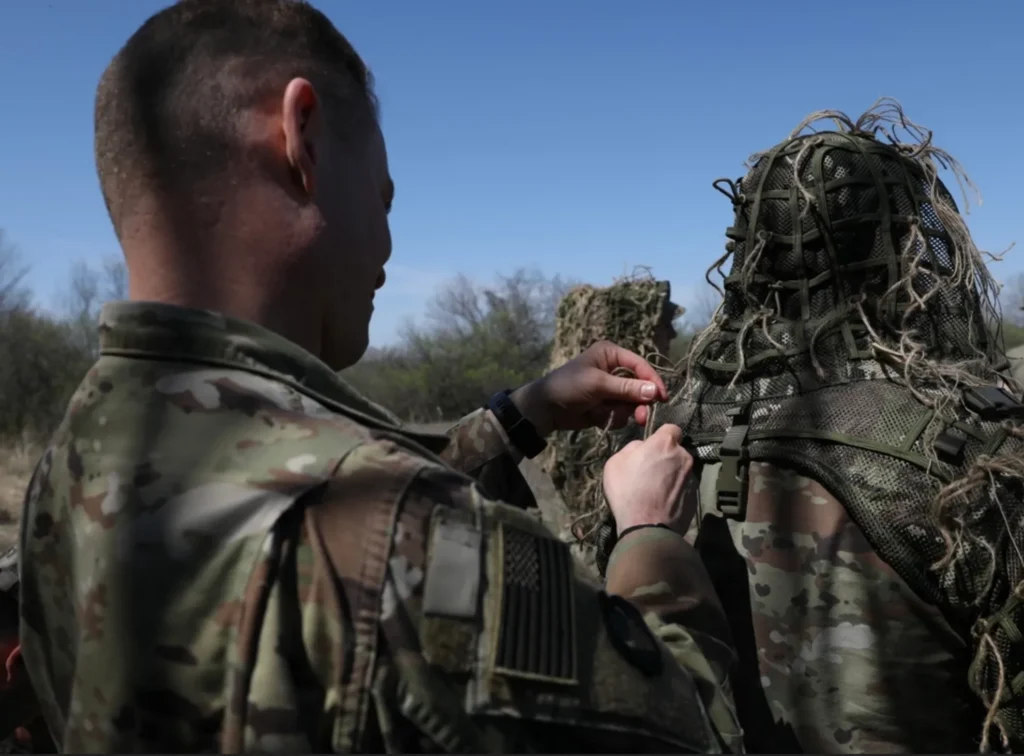
Feature Image: Students in the U.S. Army Sniper Course conduct the ghillie wash exercise May 5, 2025, at Fort Benning, Georgia. The ghillie wash is designed to test the strength and durability of the suits as well as weather them. Sniper course students use sand, water and mud, all in an effort to perfect one of their most important tools: their camouflage. (U.S. Army photo by Capt. Stephanie Snyder)
Read more from Sandboxx News
- Navy will award production contract for F/A-XX program this year
- Incredible mortar-assembly challenges with the Green Berets
- Space Force’s 15-year vision calls for more personnel and simulators to prepare for the future
- Not all drones are created equal: The five different groups of drones and how to counter them
- How a Green Beret achieved immortality during one of the fiercest battles of the Vietnam War