The U.S. Navy awarded Raytheon (RTX) a massive contract to accelerate production of one of its most valuable attack munitions.
On Monday, the Pentagon announced that the Navy awarded Raytheon a $22.9 billion contract to accelerate production of the Tomahawk missile and ensure a sustained long-range strike capability.
In an attempt to address the increasingly serious issue of Tomahawk stocks, the Navy contracted with Raytheon for faster production and delivery of the critical missile.
“The Department called upon industry to expand munitions production, and RTX has answered that call,” Under Secretary of Defense for Acquisition and Sustainment Michael P. Duffey said in a Pentagon press release. “This Tomahawk award increases our ability to equip the Joint Force, ensuring our Warfighters never face a fair fight.”
The Tomahawk Land Attack Missile (TLAM) is an all-weather, long-range cruise missile designed for precision, land attack strikes. It can be fired from surface combatants and submarines.
Besides the U.S. Navy, the Royal Navy, the Royal Australian Navy, and the Royal Netherlands Navy also operate the Tomahawk. Japan and Germany will also be acquiring the missile.
“Guaranteeing our naval and joint forces have the lethal firepower they need to deter aggression and protect the homeland is paramount,” Acting Secretary of the Navy Hung Cao stated.
“This landmark $22.9 billion investment will accelerate Tomahawk missile delivery to our warfighters at unprecedented speed. By working closely with industry to expand our munitions industrial base’s capacity, the Department is utilizing every available tool to meet the demands of our current operations, ensuring they are equipped to fight, win, and come home safe,” Cao added.
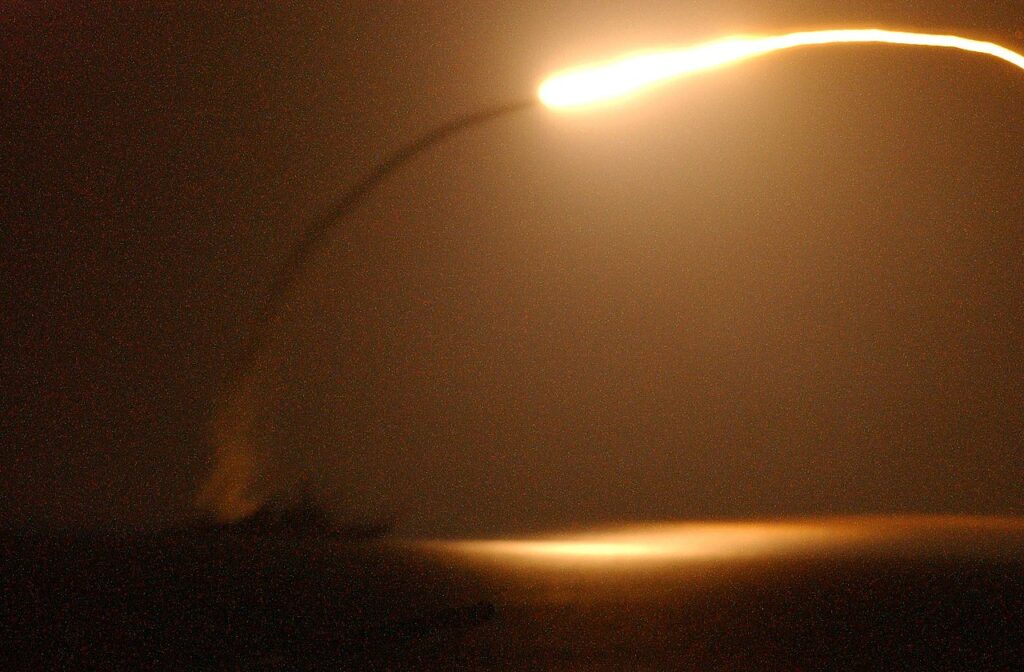
Navy surface combatants and submarines have fired hundreds of Tomahawk missiles in the ongoing active operations against Iran. But the engagement with Iran is not the only recent conflict depleting the Navy’s Tomahawk stocks. For instance, in active operations against Yemeni Houthi rebels in the Red Sea, the USS Dwight D. Eisenhower aircraft carrier battle group fired 135 Tomahawk missiles in just a few months.
The Tomahawk cruise missile is one of the most important munitions in the Navy’s arsenal. It is the go-to choice for precision strikes against targets on land.
Depending on the variant, the Tomahawk can strike targets between 250 miles and 1,550 miles away. There are blast/fragmentary, unitary, and cluster warhead versions. The most advanced variant, the Block V, can loiter over an area and pounce at targets of opportunity.
Increased Tomahawk demand
The Navy’s contract to Raytheon is a direct consequence of ongoing supply issues with and demand for the valuable cruise missile.
Up until recently, the Tomahawk production line only built 90 missiles per year. That is an astoundingly low number to maintain wartime demand. The USS Dwight D. Eisenhower battle group’s expenditure against the Iranian-backed Houthis is telling. Moreover, according to estimates, the U.S. military has used 15 years’ worth of Tomahawk stocks in just four years.
An accelerated production is necessary to meet the Navy’s demands for more Tomahawk munitions.
In its Fiscal Year 2027 budget request, the Navy has asked for $8 billion to buy 785 Tomahawk missiles.
With the prospect of additional conflicts in the near future, an accelerated Tomahawk production will ensure the Navy has the necessary stocks to deal with conventional and non-conventional threats.
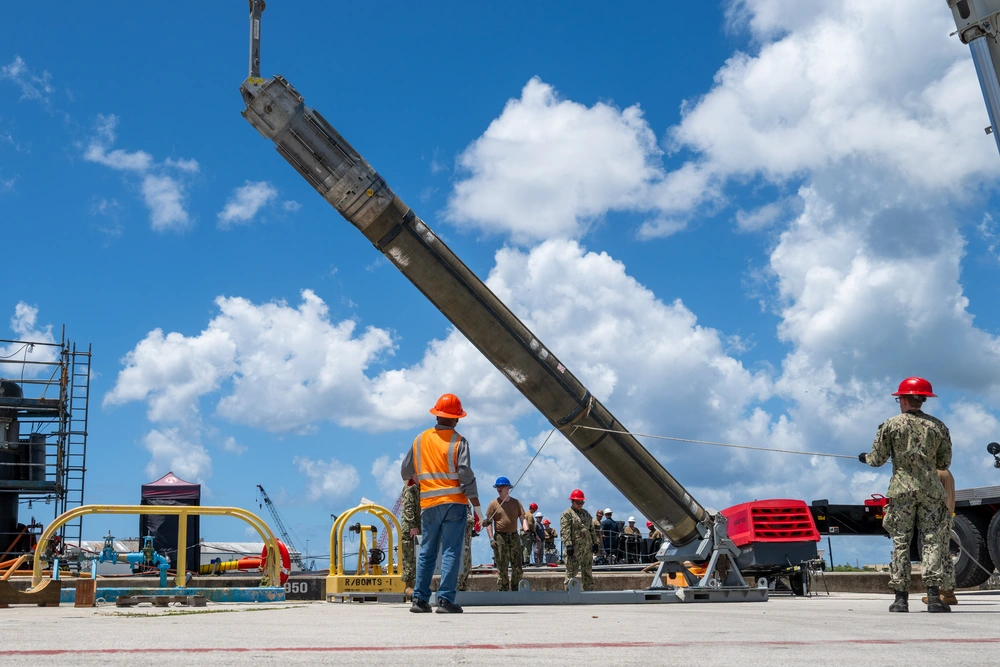
Feature Image: Sailors assigned to Navy Munitions Command Pacific, East Asia Division, Unit Guam load UGM-109 Tomahawk missiles onto the Los Angeles-class fast-attack submarine USS Jefferson City (SSN 759), May 6, 2025. (U.S. Navy photo by Lt. James Caliva)
Read more from Sandboxx News
- Army expands its ‘Amazon-style’ drone marketplace to include bigger drones after initial success
- Which American fighter jet has the best thrust-to-weight ratio?
- Germany to soon receive its first F-35 stealth fighter
- Trump orders Ford-class aircraft carriers back to steam catapults – but nobody has built one in 20 years.
- The Navy SEALs’ two original and little-known missions are still needed today