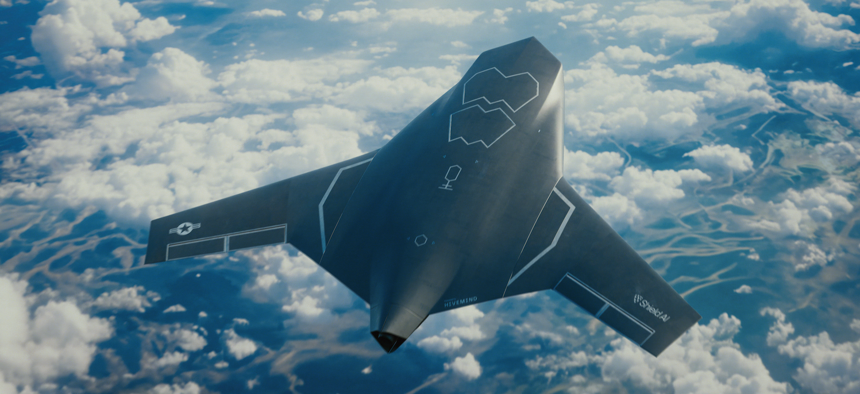
The U.S. Navy just awarded Shield AI a $50 million contract to mature its new vertical take-off and landing X-BAT fighter drone. Notably, the Navy envisions operating these jet drone fighters not just from aircraft carriers but from destroyers as well.
Based on the Request for Information released last month and the contract award announced earlier this week, the Navy wants new long-range strike options for a wide variety of warships, including its fleet of about 75 Arleigh Burke-class guided missile destroyers that serve as the backbone of America’s surface combatant fleet.
These destroyers already boast a variety of weapons, the most potent of which are housed within 90 or 96 vertical launch system, or VLS, cells. These VLS cells can house a variety of surface-to-air interceptors like the SM-2, SM-3, and SM-6, as well as long-range land-attack weapons like the Tomahawk cruise missile.
Yet, once the munitions housed inside these cells are expended, a warship usually has to sail out of the fight and back to a friendly port to rearm.
And that’s where Shield AI’s X-BAT comes in.
This fighter drone is powered by an afterburning and thrust-vectoring GE F110 turbofan, and is designed to take off and land vertically from a tail-sitting position. Therefore, because they’re pointed straight up, these aircraft occupy relatively little space on a ship despite their large size. (The X-BAT has a wingspan of about 39 feet and its fuselage measure about 26 feet.)
Related: Why Shield AI’s X-BAT promises to reshape the nature of drones
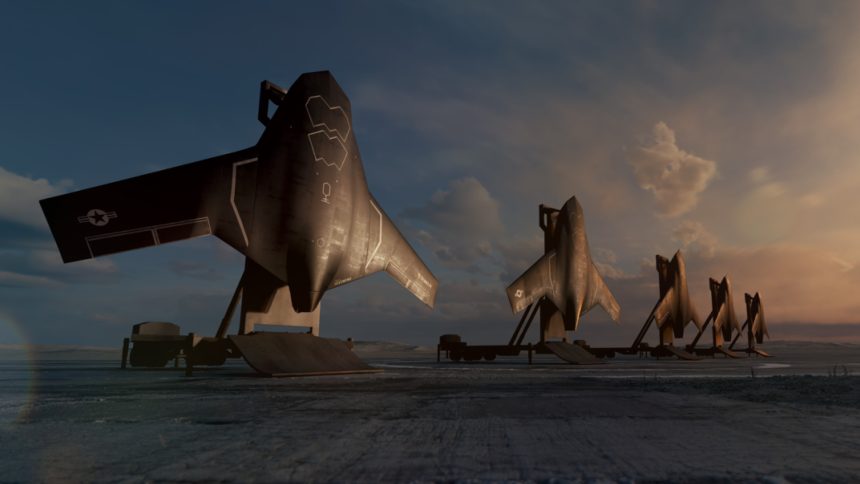
They also don’t require any runway to be launched or recovered. This makes them suitable for amphibious assault ships that are already using their cramped deck space to launch and recover F-35Bs and various rotorcraft. Further, it could also mean equipping destroyers with a handful of X-BATs to serve as their own reusable long-range strike and potentially even air defense fighters.
The Navy said it wants these platforms to be able to conduct strikes at ranges of 1,150 miles, and, according to Shield AI’s promotional materials, the X-BAT fulfills this criterion having an unrefueled range of over 2,300 miles.
Promotionals materials also show the X-BAT flying with a variety of weapon systems, some of which are even Navy-specific, like the AIM-174B Gunslinger – the longest-reaching air-to-air missile in American service today.
The X-BATs, if they prove to work, would all but certainly find themselves operating alongside Boeing’s MQ-25 Stingray, which is the Navy’s new drone refueling tanker.
Shield AI plans to begin limited flight testing of the X-BAT before the end of this year.
Feature Image: Shield AI’s X-BAT fighter drone. (Shield AI)
Read more from Sandboxx News
- Navy awards Raytheon massive $23 billion contract to speed up Tomahawk production
- Army expands its ‘Amazon-style’ drone marketplace to include bigger drones after initial success
- Which American fighter jet has the best thrust-to-weight ratio?
- Germany to soon receive its first F-35 stealth fighter
- Trump orders Ford-class aircraft carriers back to steam catapults – but nobody has built one in 20 years.