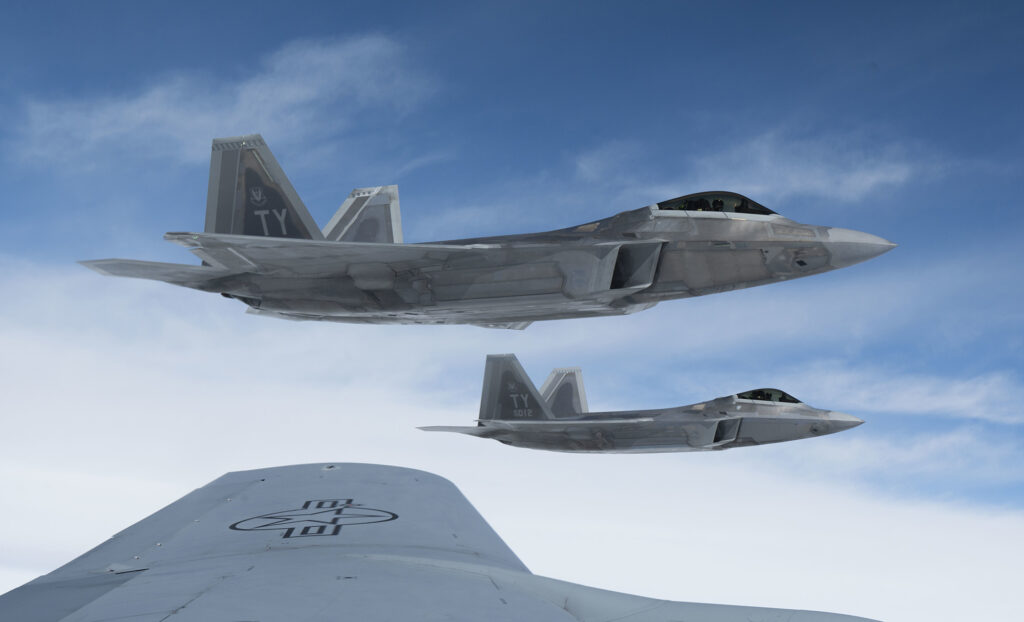
Today, the F-22 Raptor remains the world’s most broadly capable air superiority fighter in service, despite making its first flight nearly 30 years ago.
Yet, incredible as the Raptor may still be, it was always doomed to a shortened service life by the shortsighted decision to slash the jet’s production to just 187 fighters in 2009. Today, there are probably only around 178 Raptors left flying; and 32 of these are older, Block 20 jets without full combat systems and are primarily used for testing and training).
It didn’t take long for Congress and the Air Force to recognize that it was a bad idea to end Raptor production so soon, so a secret study was commissioned in May 2016 to find out what it would take to get F-22s rolling out of Lockheed Martin’s assembly line again.
And what that study determined was something anybody who’s worked in aerospace manufacturing could have told you without a calculator: that it would cost a veritable fortune to resume F-22 production.
There’s a longstanding internet myth that the F-22 Raptor’s tooling, or the specialized fixtures, jigs, templates, and forming equipment created to build Raptors, was destroyed when production halted.
However, when the study was finally released to the public, we learned that the F-22’s tooling is actually being held in storage at the Sierra Army Depot in Herlong, California. Unfortunately, however, that’s about all we have left of the Raptor’s production infrastructure.
According to the report, refurbishing just 20% of the tooling back to working condition would cost more than $1.1 billion just to start. Additionally, one has to consider the cost of building new factories (because the old ones are in use), hiring new workers, training them for the job, redesigning major subsystems because components aren’t on the market anymore, and so on.
All told, the Air Force calculated the one-time startup costs of getting production going again would be just shy of $14 billion in today’s value. In other words, restarting production would cost about the same as buying 140 new F-35s – and that’s before you pay for a single new F-22.
An even if production got underway, the Air Force determined it would cost over $57 billion to build 194 new Raptors over five years. This shakes out to about $294 million per newly-built F-22 – which is nearly as much as the 6th-generation F-47 that’s in development today will cost per jet.
Therefore, the Air Force realized it would cost almost as much to build new fighters designed in the 1980s as it would to build new fighters designed a quarter-century later. So, it opted for the newer design.
The prohibitive cost also explains why the U.S. never repealed a 1998 law banning F-22 export sales. That law was passed nine years before the F-22 entered service, and when stealth was still an exotic technology only the United States had in an appreciable way.
The world has changed a lot since then, and today, the U.S. probably would sell F-22s to other countries. (In fact, it almost let Japan foot the bill to start production on an F-22/F-35 hybrid in 2018). However, there just aren’t any spare Raptors to sell, so there’s no reason to go through all the effort required to change the legislation.
Feature Image: F-22 Raptors fly in formation. (U.S. Air Force photo)
Read more from Sandboxx News
- Air Force commandos complete grueling Argentine mountain warfare course for the first time
- Does the Navy’s small arms training need an overhaul?
- These are the US aircraft qualified to carry nuclear weapons
- U.S. Air Force releases commemorative video honoring 250 years of American warriors
- These are all the Collaborative Combat Aircraft currently in development and testing