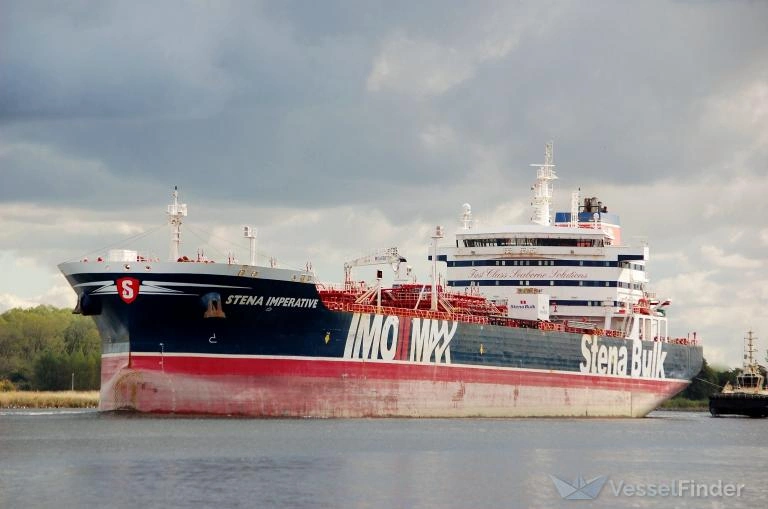
On March 2 the U.S.-flagged oil tanker Stena Imperative was damaged by a fire onboard that resulted from an Iranian aerial projectile attack on the port in Bahrain where it was docked. The attack came as a result of Iran’s ongoing armed conflict with the U.S. and Israel, and it killed one shipyard worker and injured two others.
The Jacksonville, Florida-registered ship was reportedly part of the U.S. government’s Tanker Security Program (TSP), though it was unclear if the Iranian military targeted it for that reason.
The Tanker Security Program is essentially a strategic sealift capability for the U.S. government, to be employed in times of national emergency. While in times of war or other emergency, the TSP can be assumed and operated by the Department of Defense, the program is officially owned in peacetime by the Department of Transportation’s Maritime Administration (MARAD).
According to MARAD, the goal of the TSP is to “ensure that a core fleet of U.S.-based product tankers can…enhance U.S. supply chain resiliency for liquid fuel products.” What this really means is that the U.S. military can take control of the 10 designated TSP oil tankers in times of war or national emergency to ensure the delivery of refined petroleum products – fuel – to the U.S. military, wherever it might be needed.
The need for this capability arose as the number of U.S. flagged tankers in international maritime trade was shrinking in the last decade, and the U.S. military identified a potential gap in its supply chain for fuel. Subsequently, Congress directed the secretary of transportation via the National Defense Authorization Acts of 2021 and 2022 to establish the fleet of TSP vessels.
While in peacetime these vessels take part in routine international maritime trade just like any other naval ship, in times of war or national emergency, they can be directed by the president or defense secretary to support U.S. military operations.
In exchange for agreeing to be a part of this program, the tankers’ owners are paid roughly $6M annually, whether they are called into service for the U.S. government or not. Additionally, one presumes that if they are called into service, their operational costs during those times of service are also covered by the U.S. government. This availability also comes with a requirement to keep the vessels at a baseline state of readiness – in terms of communications gear, training, and personnel – at all times. Then, the commercial ships must be ready to “surge” when and wherever they are needed when the call comes from the government.
Furthermore, the companies that own the TSP vessels design and install the necessary communications equipment at U.S. government expense, working in tandem with the Navy’s Military Sealift Command and the Naval Surface Warfare Center’s Underway Replenishment Division.
While the other nine commercial maritime vessels of the TSP currently remain in use and ready to be employed as a strategic sealift tool available to the U.S. military, no publicly available reports indicate that the TSP program has ever been activated in its short five-year existence. It is also unclear if and for how long the Stena Imperative was rendered inoperable as a result of the Iranian attack.
Feature Image: The U.S.-flagged Stena Imperative tanker that was hit by Iran. (X via VesselFinder)
Read more from Sandboxx News
- The Marine Corps is keeping the M27 rifle – and that’s a good thing
- The LUCAS drone is a needed addition to America’s arsenal despite its modest capabilities
- Raytheon to increase production of its SM-6 all-purpose interceptor missile by 300%
- German military goes against tradition and chooses a non-German weapon as its new handgun
- US embraces ‘Shanzhai’ with copycat Iranian drone