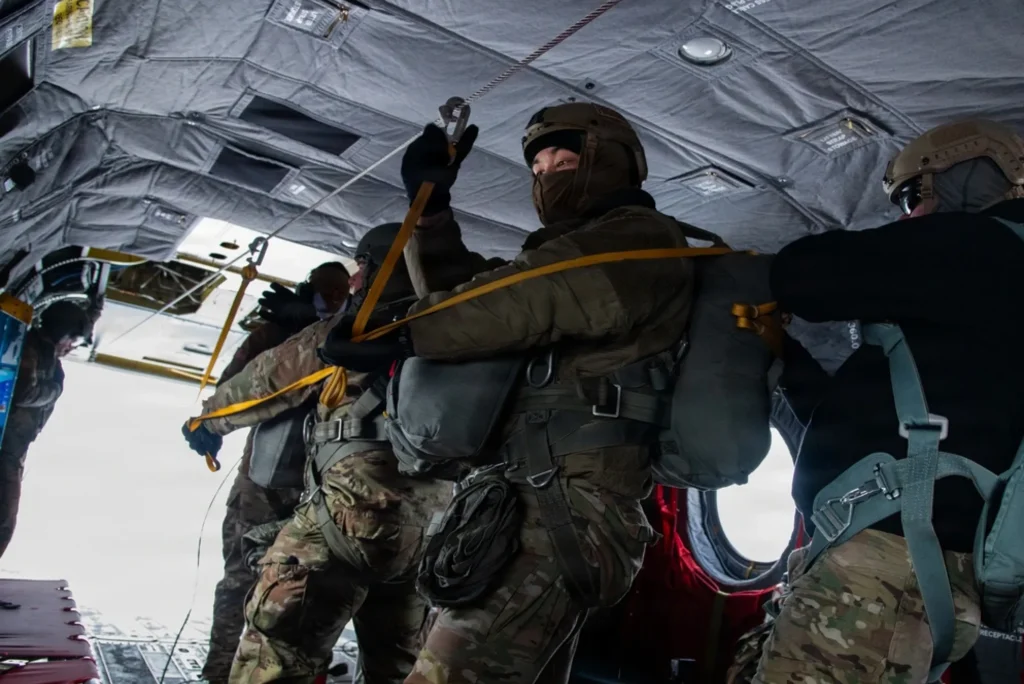
For static jumps, the jumper’s parachute is connected to the jump aircraft by a line which is used to pull the parachute open from its deployment bag. However, if this line is routed incorrectly, it will likely not break the parachute loose from its bag when pulled, preventing the parachute from deploying properly.
The incident is referred to as a “towed jumper;” because, when that happens, the jumper gets towed behind the airplane by his static line. This can be fatal to the jumper himself and even to other jumpers.
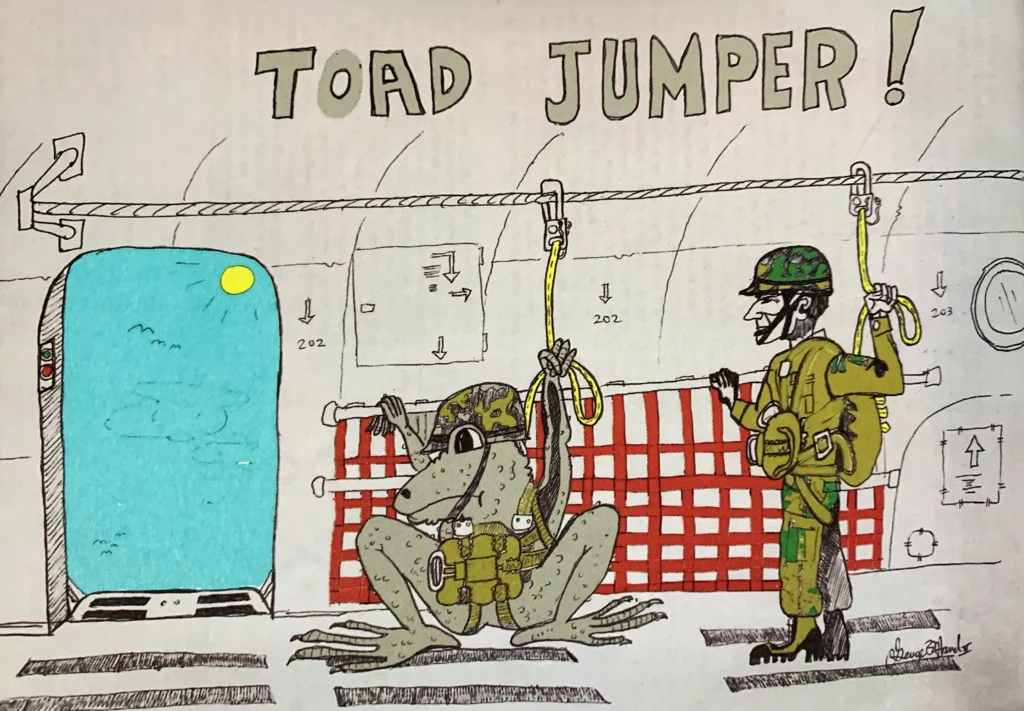
Now, a “toad jumper” is a toad that likes to jump. This is seldom ever seen in military airborne units, and is never fatal.
Probably my favorite Delta operator in the Unit was a brother named Mac. As bad-luck jumpers go, he had the grave misfortune of being a towed jumper on – you’d never guess – his first ever parachute jump ever at Basic Airborne School in Ft. Benning, Georgia. Though surviving, he was seriously injured to the point that he was dropped from the training course for a stay in the hospital to recover from his injuries.
Of the very few reasons that can cause a static-line jumper to be towed behind his jump aircraft, what happened to Mac was the most common: His static line, rather than being routed over his shoulder as it should have been, was routed under his armpit preventing him from giving a good sharp tug on his parachute.
The tug requires approximately 80 pounds of pull for the cotton webbing loop that ties the parachute deployment bag shut to break. If the loop isn’t broken, the parachute won’t deploy properly.
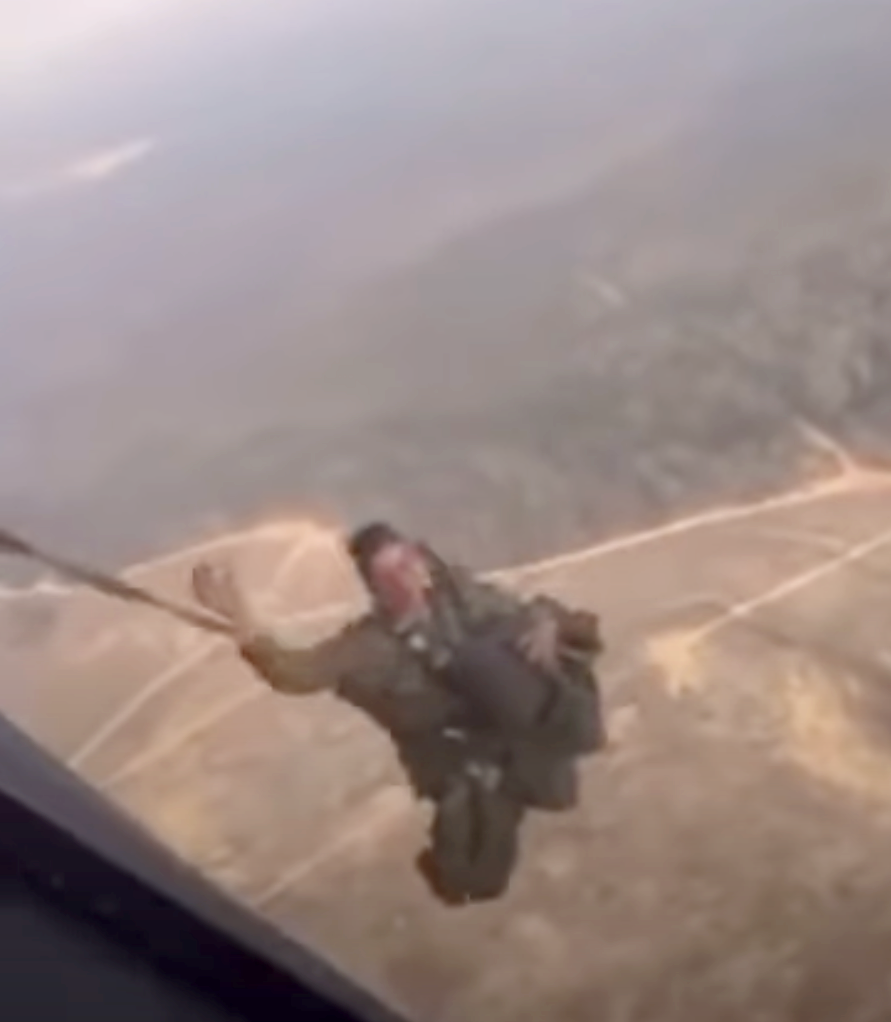
When poor Mac exited the airplane, he experience a violent sudden stop at the end of his 15-foot static line because the cotton loop failed to break. He immediately began to spin and subsequently slam vigorously into the side of the aircraft just behind the jump door.
The jumpmaster saw him, determined that he was conscious, and decided to cut him away from the aircraft leaving him to pull his reserve parachute.
When Mac’s parachute opened, his head was ringing and his whole body – especially his left upper arm – hurt like hell; he couldn’t raise his arm at all to steer his parachute and didn’t know why. As he got lower to the ground he cringed as he prepared to land, anticipating the pain he would undergo upon impact with the ground.
He was right of course, it hurt tremendously… and to add insult to his injury, the wind had picked up a bit on the drop zone such that it filled his parachute canopy and began to drag him across the ground, increasing his pain all the more. The instructor on the ground yelled at him unmercifully through a megaphone as he scooted helplessly across the ground:
“Hey there, leg! Cut loose your riser/canopy attachment assemblies, LEG! Do it now, LEG!”
“Leg” was a disparaging term from long ago that paratroopers assigned to virtually any other man who did not have the gumption to strap on a parachute and brave the exit of a “perfectly good aircraft,” as the saying went.
Mac just took it all in stride as a fellow jumper ran behind his inflated canopy and collapsed it with his body. Mac recovered himself and his parachute to the staging area.
He then showed his upper left arm to others there; his bicep had been ripped from his shoulder and bunched itself down by his forearm in a great bulge. The skin was stretch thin to the point that it bore the hinting red and blue hues of veins and arteries that lay beneath.
“Hey…” Mac began, “do the rest of your arms look like this?”
They all grimaced and shuddered at the grisly sight. Mac, being who he is, reckoned that that was just typically how every jump went, and was to go… and he accepted that!
And yet it happened!
By Almighty God and with honor,
geo sends
Feature Image: Army Staff Sgt. Kyle Holmes, a rigger assigned to Defense Logistics Agency Distribution Susquehanna, Pennsylvania, checks his static line hook prior to a parachute jump from a CH-47 Chinook helicopter at Fort Indiantown Gap as part of airborne operations training Feb. 24. (Photo by Dorie Heyer, Defense Logistics Agency)
Read more from Sandboxx News
- The military is using the southern border as a ‘sandbox’ to test out counter-drone tech amid cartel flights
- Hermeus reveals flying prototype in its pursuit of a reusable hypersonic jet
- How a kamikaze drone that is just ‘good enough’ is changing warfare
- Long-distance targeting is much harder than people think – and that’s bad news for China
- The F-14 Tomcat fighter wasn’t the US Navy’s first choice