1 x
$8.42
-
+


Share This Article
Much like Kleenex, ChapStick, Q-tips, and Band-Aids, the U.S.-based Global Positioning System (GPS) is synonymous with global navigation satellite systems (GNSS). Yet, the GPS is not the only game in town when when it comes to global navigation satellite systems. And the GPS might also be losing its edge when it comes to its reliability and security, as compared to these other systems. But now, the U.S. Space Force hopes to remedy that problem.
According to an October 29 article in The Economist, the U.S. military is undertaking efforts to address some of the primary concerns with the GPS, namely its aging hardware, accuracy, and susceptibility to jamming and other electronic warfare measures.
The GPS was originally designed by the U.S. Department of Defense in the early 1970s, following the launch of the first artificial satellite – Russian’s Sputnik-1 – in 1957. With that launch, American military minds figured out that one could track a satellite’s location using the Doppler effect, and from there, it took the U.S. Navy only two years to invent the first operational satellite-based navigation system. The “Transit system,” as it was known, was used at the time only by U.S. Navy submarines for navigation.
Fast forward to the 1980s and the U.S. military had successfully developed and fielded the modern GPS, and made it available for civilian use (although in a less accurate format). By 1993, all 24 planned GPS satellites had been launched and had resulted in the full satellite constellation still in use today. (Although today, there are 32 known satellites in the constellation).
However, there are also competitors to the GPS – particularly the European Union’s Galileo system and the Chinese BeiDou constellation of satellites.

According to The Economist, those two systems are more reliable than GPS both in terms of accuracy and in their ability to withstand electronic warfare measures. The latter include the jamming and spoofing of the signals satellites send back to the surface receivers you hold in your hand. When jammed, your receiver becomes useless because it receives no signal. When spoofed, it actually provides you with a false signal, thus making it both useless and actually misleading.
The U.S. Space Force is trying to remedy those shortfalls by sending to orbit the experimental Navigation Technology Satellite-3 (NTS-3), with new enhancements that will hopefully overcome the accuracy, jamming, and spoofing concerns. The NTS-3 is a planned precursor for what will be the next generation of flagship GPS satellites, the GPS IIIF, which are intended to start launching in 2027 and all be in orbit by 2037.
These new satellites feature technologies that will help them be more reliable and robust against attacks. They include a new radio transmitter, for one, that will more intently focus the signals sent back to Earth, thus making them harder to jam. Called “spot beams,” these signals should be able to punch through “roughly 60 times more jamming power” than current signals can manage, according to The Economist.
Against spoofing, the new receivers feature measures which amount to an electronic watermark that lets the “good guy” satellites and receivers know that a signal has not been spoofed.
The Economist article curiously fails to mention how much accuracy will be improved with the new satellites, but in simplest terms, you either need more satellites in orbit to give more accurate readings, or you need multiple frequency bands and more advanced signal processing to best determine location.
The U.S. military is determined not to fall behind in this vital technology, and much needed upgrades appear to already be underway.
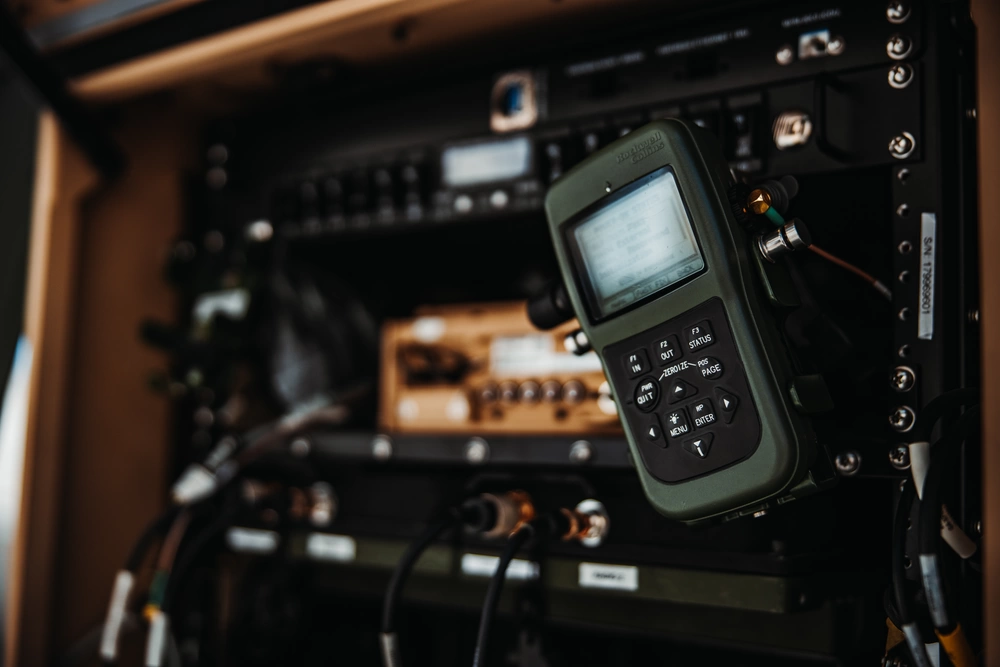
Feature Image: A Defense Advanced GPS Receiver sits ready for use during an Expeditionary Communications Course hosted by Marine Corps Communication-Electronics School at Marine Corps Air-Ground Combat Center, Twentynine Palms, California, April 2, 2024. ECC trains Marines in expeditionary skillsets that enable them to operate in any environment across the full range of military operations. (U.S. Marine Corps photo by Lance Cpl. Richard PerezGarcia)



Frumentarius is a former Navy SEAL, former CIA officer, and currently a battalion chief in a career fire department in the Midwest.