Few stories have the staying power of Homer’s Odyssey, which is about 2,800 years old. The epic poem takes place immediately following the Trojan War, which scholars believe occurred sometime around 1250 BC, during the Late Bronze Age.
The story has been reworked and retold in so many variations since its creation that naming all its iterations would require an entirely separate article. Suffice it to say, Dante took it on with his Inferno, James Joyce adapted it in Ulysses, and the Cohen brothers gave us their version in the 2000 film, O Brother, Where Art Thou? And now, a new movie on the journey releases on July 17. Directed by Christopher Nolan, The Odyssey stars Matt Damon as titular hero Odysseus.
What makes the story so compelling across generations is its focus on one flawed man’s relentless journey home after war. The anti-hero is beset by fantastical foes, epic challenges, and even cosmic, inter-dimensional detours as he seeks to complete his quest for home.
While the movie can speak for itself – for those interested in seeing it – let us here instead look at the events that preceded the story: the Trojan War.
Scholars seem to agree that a war did in-fact occur in the Aegean Sea region between ancient Mycenaean (Greek) city states and the Hittite Empire in Asia Minor in the 13th century BC. The Greek city states in question included Mycenae, Sparta, Ithaca, and Pylos, among others.
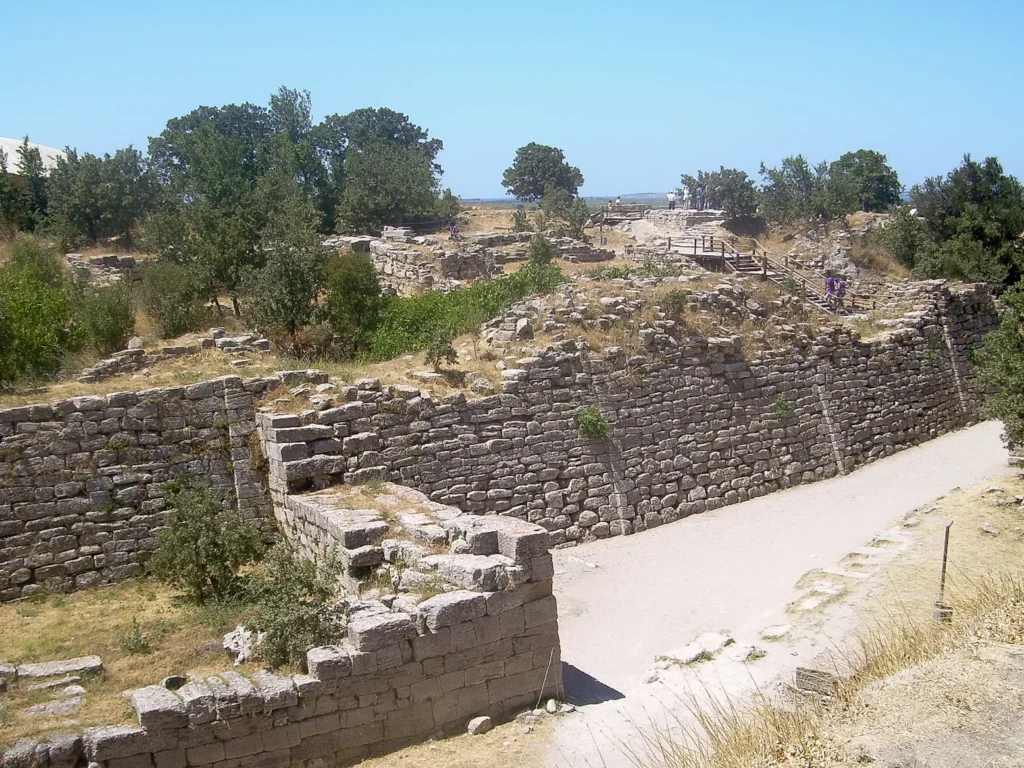
The Hittites occupied parts of western Asia Minor in modern-day Turkey. The city of Troy, located near modern-day Canakkale, next to the strategically significant Hellespont, was a vassal of the Hittite Empire.
World War I aficionados might recognize the Hellespont by its modern-day name – the Dardanelles – which is the same region in which sits Gallipoli. The latter is, of course, the site of the failed allied campaign to secure the same strategically significant strait in 1915-16.
Both the Greeks and Hittites were likely looking to secure control over the vital trade routes and choke points between the Black Sea and the Eastern Mediterranean when they came into conflict in the Trojan War. While Homer would have us believe (in the Iliad) that Trojan prince Paris’ abduction of (or possible elopement with) the stunningly beautiful Helen, queen of Sparta, was the real cause of the war, that is likely literary license based on myth. At most, it could be seen as the immediate casus belli rather than the underlying hard power rationale for war.
Greek city states were rising maritime powers at the time, and thus they would have sought to seek regional influence over trade, as well as control over trade routes.
Troy itself was probably simultaneously a competitor and trade partner of the Greeks, and was a wealthy, walled city controlling the Dardanelles thanks to its location. Conquering such a place could have provided the Greeks with access to resources like metals, slaves, horses, and agricultural goods coming down the Dardanelles from the Black Sea. It is thus not hard to see how a conflict could eventually erupt between the two powers.
Related: Does “The Punisher: One Last Kill” do the iconic character justice?
Homer tells us that the war itself lasted for some 10 years, and included such heroes as Troy’s Hector, and the Greeks’ Achilles and Odysseus, as well as the involvement of various of the Gods. Homer goes on to tell us that the conflict only ended in Greece’s victory after Odysseus craftily devised the ruse of the Trojan Horse, thus allowing the Greeks to open the gates of Troy and to finally sack the city.
However the war ended – and we can assume it was in a far more prosaic and human manner than through divine intervention or a giant wooden horse – and the Hittite empire eventually fell.
Yet, the Greek city states entered into a kind of dark age, despite their victory. Trade in the region decreased significantly and written records all but disappeared. The war was thus a kind of waypoint to geopolitical upheaval, regional anarchy, and the end of the Bronze Age.
One can thus see why Homer would then craft a post-war narrative of great struggle and hardship for Odysseus on his way back home after the war. Odysseus represents all of the Greeks, in a way, suffering after their ostensible triumph. Such is the geopolitical backdrop for the epic post-war journey that will be depicted in the new Hollywood film. You are now fully armed with the context to really enjoy Christopher Nolan’s The Odyssey.
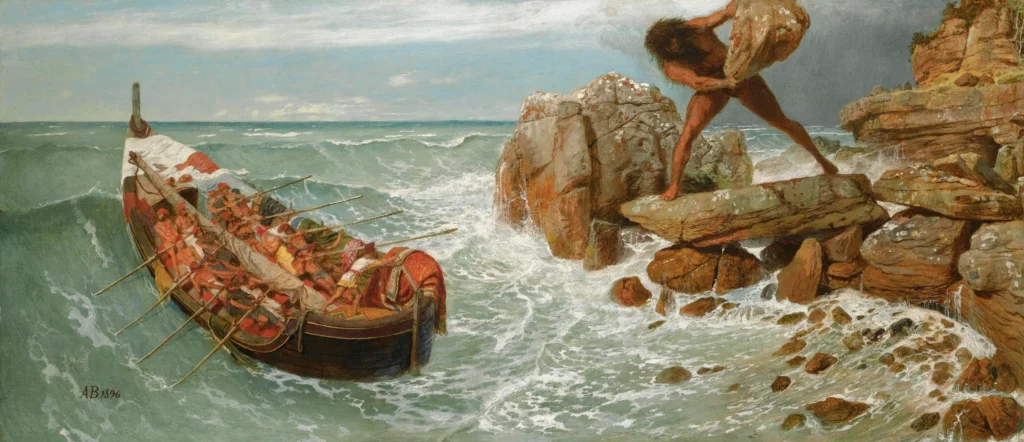
Feature Image: Odysseus and Polyphemus by Arnold Böcklin: the Cyclops’ curse delayed the homecoming of Odysseus for another 10 years. (Creative Commons)
Read more from Sandboxx News
- Bullpup rifles are reaching their end, despite their advantages
- Ukraine strikes more than 110 Russian vessels in a few days to tighten its energy chokehold on Crimea
- How American spies helped the U.K. retake the Falklands
- Why does America keep relying on its 60-year-old B-52 fleet
- The Navy may never build any Constellation-class frigates