Popular author Jason Pargin recently posted on TikTok about whether the United States could have taken over the world following World War II, and we thought it might be a conversation worth delving deeper into.
It is true that the U.S. was the only country on Earth with an atomic arsenal between 1945, when World War II came to an end, and 1949, when the Soviets tested their first atomic weapon. So, on it’s face, it does seem like Uncle Sam would have a terrifying advantage… But history is a lot more nuanced and complicated.
First, the U.S. used all the atomic bombs it had against Japan in August 1945, though there was a third plutonium core already making its way toward becoming the world’s third A-bomb.
While the Manhattan Project had initially predicted that it could produce seven atomic bombs per month, the real figure at maximum capacity was around three per month.
And with WWII coming to a close, atomic weapons production became a slightly lower priority, resulting in the transition to the Atomic Energy Commission, personnel changeover, and production shifts that resulted in only around nine new weapons being built in all of 1946. Things did spin back up, however, and by the middle of 1948, the American atomic arsenal had already swelled to a reported 50 weapons.
But even that number wouldn’t have meant all that much.
The biggest problem with the idea of America taking over the world with its atomic weapons is how those would ever reach foreign soil.
Between 1945 and 1948, the U.S. only had a handful of Silverplate B-29s bombers, which were its only aircraft that could deliver an atomic bomb – and these didn’t have intercontinental range.
The B-29s had to receive engine upgrades and be stripped of most of their armor and gun turrets to stretch their combat radius out to only about 1,500 miles with a single atomic bomb onboard. That means the only way the U.S. aircraft could strike Moscow, at the time, would be to take off, for example, from airfields in the U.K. or farther east.
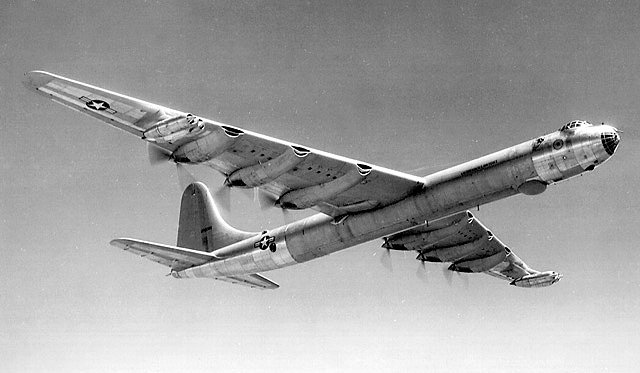
In June 1948, however, 13 months before the Soviets developed their own nuclear weapon, the newly minted U.S. Air Force fielded the monster B-36 Peacemaker that came with an incredible 10,000-mile range, giving the U.S. the ability to deliver nuclear weapons to just about any target on the globe.
Yet, that would have been a very tough year for the Air Force, as the B-36 fleet struggled with reliability problems and wasn’t considered fully operational until 1951.
Finally, atomic bombs just aren’t as powerful as people tend to believe.
According to a 1945 U.S. Army Air Forces study, just destroying the Soviet war machine would have required at least 39 atomic bombs. A subsequent report from 1949 called Offtackle increased the number of bombs needed just to defeat the Soviets to 292.
Essentially, if the threat of a bomb didn’t make a country surrender immediately, the U.S. would have had no way to get enough bombs over the country’s cities to actually wipe them out.
And to Jason’s point, there was just no political will in America for more fighting after WWII came to an end. After World War II, imperialism largely stopped being a military enterprise and arguably became an economic, political, and sometimes even cultural one.
Countries like the U.S., Russia, and more recently, China all continue to compete over access and influence in the developing world and beyond. While one might argue that the American hegemony of recent decades has been largely stabilizing for the world, that doesn’t mean Uncle Sam or his geopolitical adversaries can completely beat any empire-building accusations.
So, while America probably couldn’t take over the world using nuclear weapons after World War II, it could, and arguably did so, in other ways: through soft power, diplomacy, economic pressure, and a deterrent military posture.
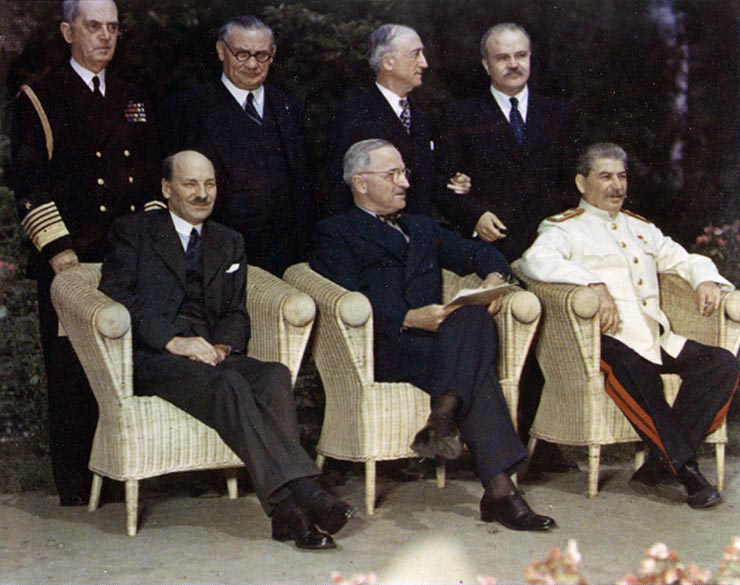
Feature Image: British Prime Minister Clement Attlee, U.S. President Harry S. Truman, and Soviet Premier Joseph Stalin during the Potsdam Conference of July-August 1945. (National Archives/U.S. Navy)
Read more from Sandboxx News
- Trump says U.S. will give Ukraine permission to manufacture Patriot missiles
- Ukrainian drones flew all the way to Siberia to strike Russia’s largest oil refinery
- Military still faces delays in its hypersonic weapon programs, according to government watchdog
- Federal’s Peak Alloy high-pressure ammo will be a game-changer for the Army
- What do we know about the Air Force’s goal to field the world’s longest-range, air-to-air missile