Is the F-14 Tomcat making a comeback? Operationally, no, but the new “Maverick Act” that just passed the Senate and is now headed for a vote in Congress aims to pull three Tomcats out of the boneyard and potentially even make one flight-capable.
The legislation calls for the Secretary of the Navy to take three of the most modern F-14Ds out of the 309th Aerospace Maintenance and Regeneration Group’s Boneyard on Davis Monthan Air Force Base and transfer them to the U.S. Space and Rocket Center Commission in Huntsville, Alabama.
The bi-partisan Maverick Act, which was named after Pete “Maverick” Mitchell – the villain of the original Top Gun (yes, you heard me right) and the hero of Top Gun: Maverick, was introduced by Senators – and veterans – Tim Sheehy and Mark Kelly, and passed unanimously on April 28. (Although Maverick flew an F-14A not an F-14D in the movie.)
The legendary Tomcats retired from American service in 2006, but the story is a lot more complicated than that. Back in the 1976s, the United States inked a deal to sell Iran 80 F-14 Tomcats, and 79 of those jets were delivered prior to the 1979 Islamic Revolution that saw Iran’s current government take power.
Now facing an extremist regime armed with some of America’s most capable fighters, the U.S. took significant steps to limit Iran’s ability to get their hands on replacement parts for their Tomcat fleet, even going so far as to feed many retiring F-14s into an industrial shredder. However, with what was left of Iran’s F-14 fleet seemingly destroyed during Operation Epic Fury, that doesn’t seem to be a very pressing concern anymore.
The bill calls for the Navy to transfer the aircraft and any necessary spare parts in its possession; it specifically says the Navy should not be responsible for purchasing anything to make the transfer possible. However, it also specifies that, if possible, at least one of the F-14Ds should be returned to flyable condition, though without the means to employ any kind of ordnance – meaning these jets will be reserved for shows and exhibitions.
The bill also says the U.S. government should not have to pay for any transportation or restoration work, which would all be covered by the museum commission.
Related: The 2 biggest lies ‘Top Gun’ taught you about military aviation
Nevertheless, the job of restoring any of these Tomcats into flyable condition is not a small one. Even when they were in good working order, these old jets were maintenance-heavy platforms. To make matters more difficult, many of the aircraft’s primary systems are no longer in production, and parts are extremely tough to come by.
Even the F-14D’s vastly improved F110-GE-400 turbofan engines are no longer in production in the same trim, though more modern variants, like the F110-GE-129 and 132 are.
The F-14 (and especially its intakes) were designed for the TF-30 engine, and that already caused some issues when switching to the F110. Today’s more modern F110 engines produce more thrust and more electrical power, which immediately brings to mind concerns about intake compatibility with the Tomcat.
Then you would need to add engine control computers, new cockpit displays, and fault monitoring capabilities, it’s likely you’d need to come up with a new cooling system because the Tomcat wasn’t designed to carry engines that run as hot as modern F110s do. In turn, the vibration caused by more powerful engines might have an impact on such an old airframe.
However, you could certainly get an F-14 back into flyable shape if the mountain of money you start with is tall enough.
And if the U.S. Space & Rocket Center that’s getting these Tomcats wants to make a Kickstarter to fund the effort to get one airborne, I promise right here and now that I’ll be the first in line to throw in my lunch money.
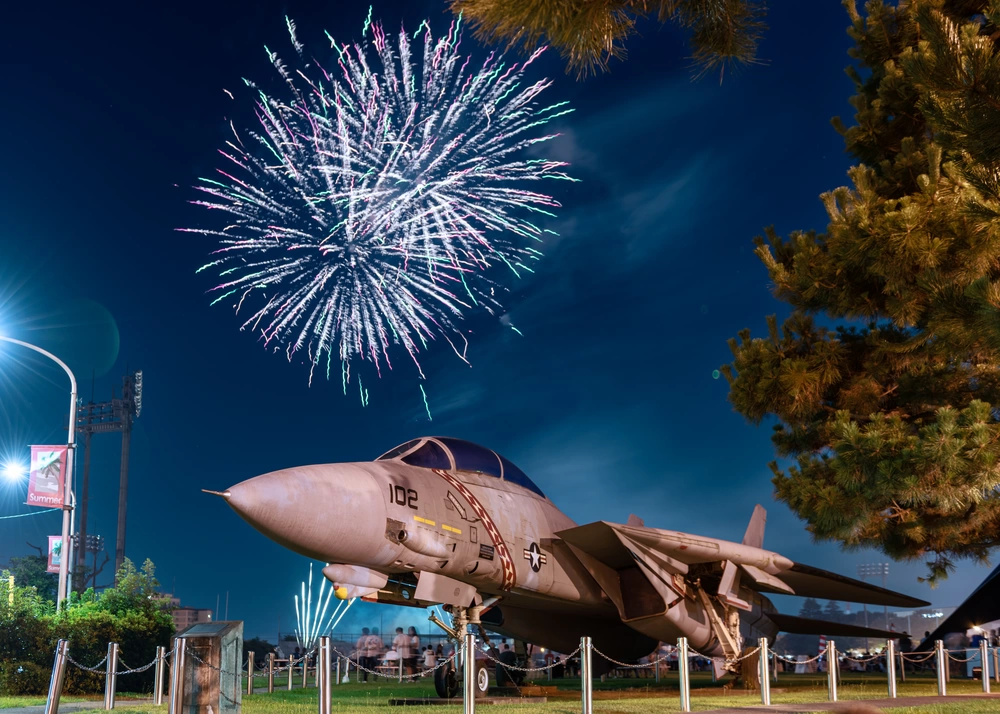
Feature Image: 220701-N-VI040-1035 NAVAL AIR FACILITY ATSUGI, Japan (July 1, 2022) Fireworks explode behind an F-14D Tomcat model on permanent display onboard Naval Air Facility (NAF) Atsugi during the installation’s Independence Day celebration. (U.S. Navy photo by Petty Officer 1st Class Rafael Avelar)
Read more from Sandboxx News
- Ukraine releases new videos of its Flamingo missiles blasting off for 900-mile strikes on Russia’s rear
- Air Force wants to invest $500 million to arm its cargo and tanker aircraft against missiles and drones
- The gravity of the situation: How to fly a fighter jet upside down
- SOCOM leaders testify about special operations’ role in today’s unstable world