Editor’s Note: This article by Matthew Loh was originally published by Business Insider.
Ukrainian President Volodymyr Zelenskyy said on Tuesday that over 200 people from his country are helping the U.S. and its allies battle Iran’s Shahed drones in the Middle East.
“Right now, there are 201 Ukrainians in the Middle East and Gulf region, and another 44 are ready to deploy,” said Zelenskyy in an address to the U.K.’s parliament.
“These are military experts, experts who know how to help. How to defend against Shahed drones,” he said, adding that the U.S. and its allies had requested his government’s help.
The Ukrainian leader said that such teams are already in Saudi Arabia, Qatar, the United Arab Emirates, and are “on the way” to Kuwait.
Zelenskyy didn’t specify the exact roles the teams were playing in the Gulf States – such as whether they were simply advising troops there or actually conducting interceptions.
However, he gave an example of how such advisors could work, saying they could arrive at the U.K.’s military bases in Cyprus, “place interception teams, and set up radars and acoustic coverage.”
“We would guarantee protection,” Zelenskyy added.
Years of fighting thousands of Russian-made Shaheds have trained Ukraine’s air defense network to counter large quantities of the exploding drones. Kyiv has consistently sought to lower the cost of air defense to make it sustainable, through measures such as cheap interceptor drones and truck-mounted machine guns.
Ukrainian officials, including Zelenskyy, have repeatedly said that their forces regularly intercept about 90% of Shahed drones and Russian missiles.
Global interest in those technologies has surged since the U.S. and Israel launched Operation Epic Fury on February 28. The extensive airstrike campaign prompted Iran to launch thousands of one-way Shaheds at U.S. forces in the area and the Gulf states.
The price difference between the Shahed – estimated to cost as little as $20,000 each – and traditional, sometimes million-dollar air defense munitions has spurred nations and organizations to seek cheaper “hard-kill” options, such as interceptor quadcopters.
Ukraine has floated the idea of offering such drones to its allies, even before the war with Iran began.
In his speech, Zelenskyy said sending drone experts overseas was part of a drone deal that Ukraine had earlier proposed to Washington.
Zelenskyy said the deal was “still on the table” and that Kyiv was open to striking similar agreements with other countries.
At this stage, he said, Ukraine can produce 2,000 interceptor drones daily, but only needs roughly 1,000. The rest could go to allies, he suggested.
“We can produce more. It depends on investment,” Zelenskyy added.
During his speech, Zelenskyy also showcased Ukrainian tracking software, which he said its leaders access via iPads, that details every detected Shahed and missile threat, their flight paths, and the air defense tools used to intercept the Russian weapons.
“Some may think it is enough to just buy interceptors and protection is guaranteed,” Zelenskyy said. “But it’s not that simple. The key is the system. The system matters.”
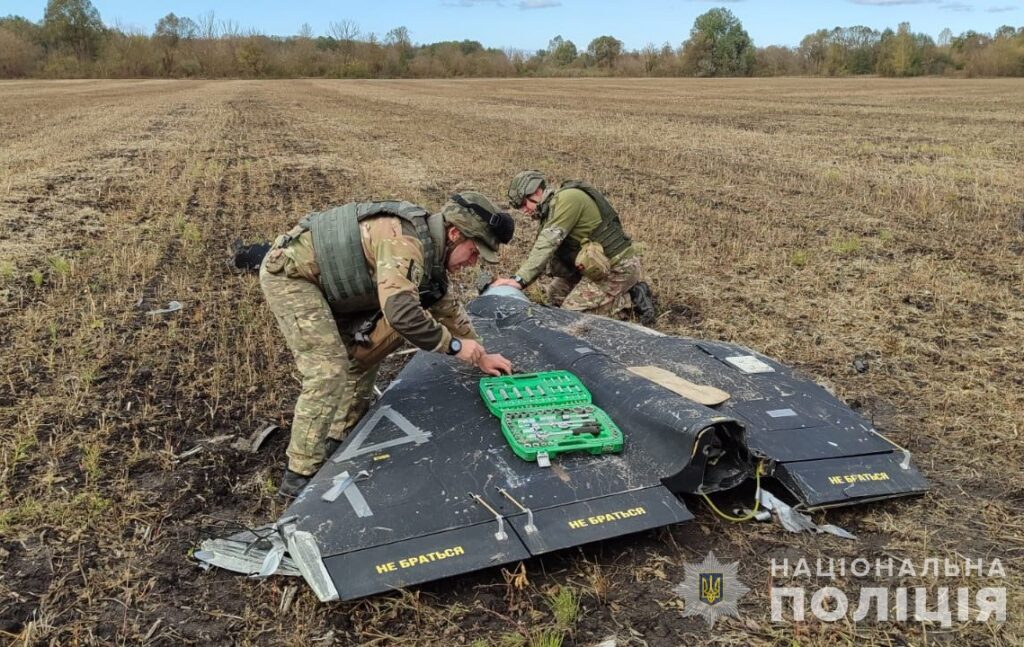
Feature Image: A Geran-2 drone, as the Shahed-136 is designated by Russia, downed in the Sumy region of Ukraine. Explosive experts removed the warhead for disposal, October 2024. (National Police of Ukraine)
Read more from Business Insider
- Zelenskyy says Russia has already earned back $10 billion of its 2026 deficit in 2 weeks of the Iran war
- F-15E Strike Eagles, deployed during Operation Epic Fury, can fly 2.5 times the speed of sound. Take a closer look.
- Top admiral says US forces are hitting more than Iranian warships. They’re destroying mines, drone boats, and torpedoes too.
- Inside the race to cut Russia off from the global internet
- 2 of the US’ 3 mine-hunting ships assigned to the Middle East were just seen in Asia