On February 11, NATO announced that it will launch a mission to strengthen its presence in the Arctic in response to security concerns.
Arctic Sentry, as the mission will be called, will coordinate the increasing military presence of NATO’s members in the strategically important region; it will be led by the alliance’s Joint Force Command headquartered in Norfolk, Virginia.
“Arctic Sentry underscores the Alliance’s commitment to safeguard its members and maintain stability in one of the world’s most strategically significant and environmentally challenging areas,” U.S. Air Force General Alexus G. Grynkewich, NATO’s Supreme Allied Commander Europe, said.
The mission will bring the efforts of individual NATO members in the region under a single command, Mark Rutte, NATO’s secretary general, said.
“We will not only be able to leverage what we are doing much more effectively, we will also be able to assess which gaps there are, which we have to fill. And, of course, we will fill them,” Rutte said.
The Arctic has received increased attention recently as a result of the U.S. administration’s stated desire to acquire Greenland for security reasons. Greenland is a strategically located, autonomous territory belonging to Denmark – which is also a NATO member. Denmark rejected the American overtures.
As tensions within NATO over the issue were escalating, American President Donald Trump met with Rutte to discuss the situation. Arctic Sentry came about as a result of that meeting.
The Arctic is made up of Greenland and the northern parts Canada, Alaska, Iceland, Norway, Sweden, Norway, Finland, and Russia.
As polar ice melts, new waterways become available in the region, making passage between East Asia, Europe, and North America easier for merchant and military vessels.
China is also eyeing the region and – although no part of its territory falls within the Arctic Circle – has tellingly termed itself a “near Arctic nation.” It has included the region in its Belt and Road Initiative and has sought to make investments in Greenland, including in rare earths and infrastructure.
NATO has not yet clarified the size or the composition of the mission, however, Denmark is slated to contribute significantly to it. John Healey, the British defence minister, also stated that his country would play a vital role in the mission.
“Demands on defence are rising, and Russia poses the greatest threat to Arctic and High North security that we have seen since the Cold War,” Healey said.
“We see Putin rapidly re-establishing military presence in the region, including reopening old Cold War bases,” he added.
During a visit to Camp Viking in Norway’s Arctic region, Healey further announced that the British contingent in Norway will double from 1,000 to 2,000 troops over the next three years in response to Russian activity.
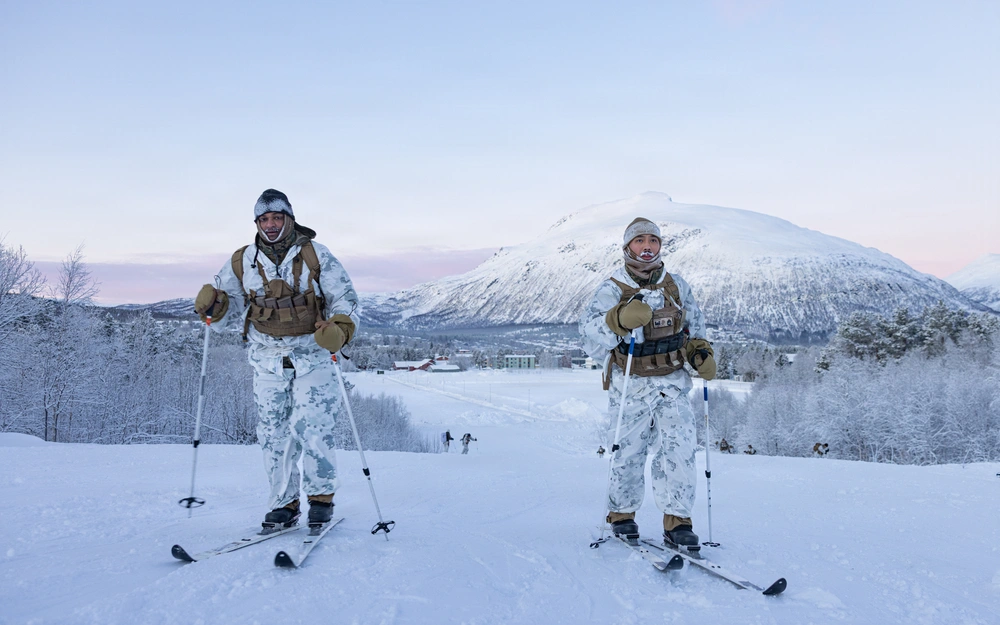
Feature Image: U.S. Marine Corps Staff Sgt. Malon Johnson, left, a combat engineer and Gunnery Sgt. Brent Serquina, a company gunnery sergeant with 2nd Combat Engineer Battalion, 2nd Marine Division, ski up Green Hill during Exercise Cold Response 26 in Setermoen, Norway, Jan. 29, 2026. Exercise Cold Response 26 is a Norwegian-led winter military exercise designed to enhance collective defense capabilities and ensure U.S. readiness to rapidly deploy and seamlessly operate alongside NATO Allies in challenging arctic conditions. (U.S. Marine Corps photo by Cpl. Judith Ann Lazaro)
Read more from Sandboxx News
- What really happened when F-22 Raptors squared off against the Eurofighter Typhoon?
- VBSS: A Navy SEAL explains how to board enemy ships
- SOCOM wants to use AI to better distinguish high value targets and intelligence during operations
- This is the system that used jet power to help overloaded aircraft take off from very short runways
- This is what made the MP7 SEAL Team 6’s favorite Personal Defense Weapon