On March 11, Commander of U.S. Central Command, Admiral Brad Cooper, confirmed to the media that the United States is using artificial intelligence systems to directly support ongoing combat operations over Iran. The admiral made it clear that human beings always make the final decision of whether or not to engage a target, but he also explained that American troops are using a “variety” of AI tools to help “sift through vast amounts of data in seconds so our leaders can cut through the noise and make smarter decisions faster than the enemy can react.”
While he didn’t specifically name the AI tools that are being employed in this fight, it’s all but certain that chief among them is the Maven Smart System.
The Maven Smart System, often referred to simply as “Maven,” is a Palantir-developed command-and-control AI platform that fuses data from upwards of 150 different kinds of sensors from all the battlefield; these range from space-based satellites to airborne ISR drones, to ground-based radar arrays, signals intelligence, and even social media posts. It then uses that data to create a single data-fused god’s-eye-view of the battlefield that can be used to plan a mission, nominate targets for engagement, identify nearby weapon systems capable of completing the strike, relay combat taskers to conduct the strike, and then assess the impact of the strike to ensure mission accomplishment.
Maven makes executing strikes against targets as simple as a few clicks of a mouse. The system is thus taking a process that used to take hundreds of people hours or even days to complete, and wraps it up in a matter of minutes.
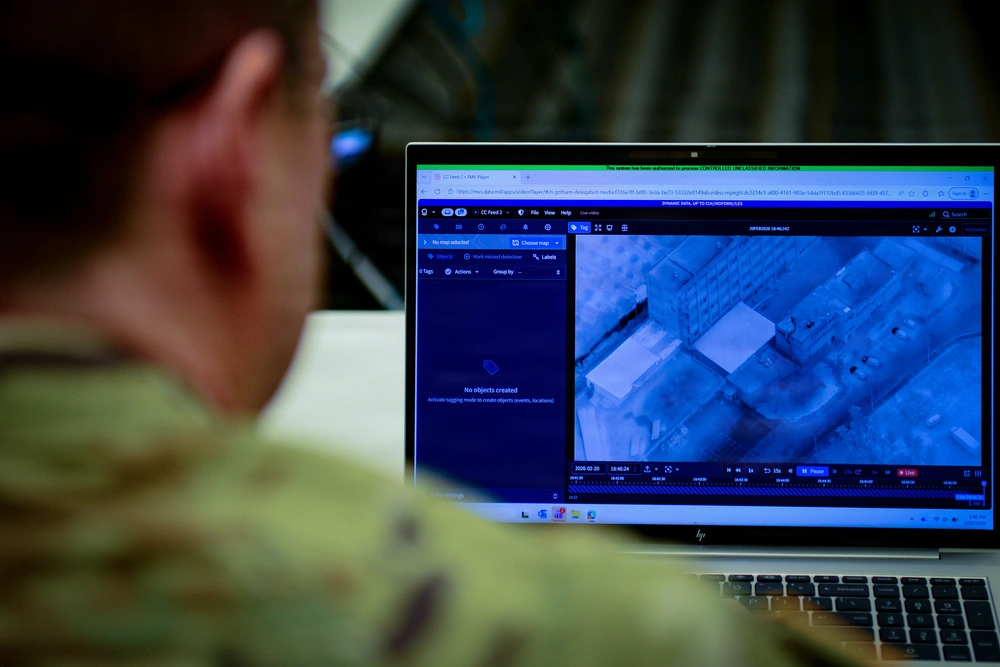
Project Maven was launched by the Pentagon in April 2017 with the initial goal of harnessing computer vision – which is a field of AI meant to analyze, interpret, and understand digital images and video – to help process the mountains of footage being created by American ISR aircraft and drones. A single ISR drone can reportedly produce terabytes of data that human analysts had to pour over manually in order to derive any intelligence value. This time-consuming and expensive process was so labor-intensive that a great deal of footage went completely ignored due to manpower limitations.
Before long, however, Maven began to grow in complexity and capability, eventually coming to process and analyze data flowing into it from over 150 different kinds of sensors.
The Maven Smart System that’s already in service today is capable of ingesting real-time intelligence, surveillance, and reconnaissance (ISR) feeds – including video, imagery, radar, and radio signals – and then applying Convolutional neural network-based computer vision to detect and classify people, vehicles, equipment, and more, geotagging each as it differentiates between friendlies, enemies, and civilians.
It can then use this data to nominate up to 1,000 targets for strikes per hour to users who can then turn to Maven’s AI Asset Tasking Recommender to identify the right weapon to engage each target based on a variety of factors, like the most suitable ordnance for the task, platform flying time, weapons loading details, and the whereabouts of friendly personnel and partner forces.
Once a target has been identified and the appropriate weapon and platform have been determined, Maven can communicate directly with troops in the field or even directly with platforms and weapon systems themselves. In 2020, Maven transmitted fire orders to a U.S. Army M142 HIMARS artillery system in testing at Fort Liberty for the first time.
By 2023, Maven had demonstrated its ability to directly interface with Army Mission Command Systems, like the Advanced Field Artillery Tactical Data System (AFATDS), to generate fire missions in Qatar in real combat operations as a part of Operations Spartan Shield and Inherent Resolve.
In June 2025, Maven gained the ability to interface directly with the U.S. Army’s Aviation Mission Planning System (AMPS), effectively automating the transition from conventional aviation mission-planning systems into Maven’s common operating picture (COP), and creating something of a one-stop shop for effective flight mission planning with the most up-to-date intelligence available.
By January 2026, Maven was deployed across all major American combatant commands, as well as across NATO allied command operations.
Related: SOCOM wants to use AI to better distinguish high value targets and intelligence during operations
In a recent interview with The Register, Maven’s chief architect, Palantir’s Chad Wahlquist said, “I saw stats where normally we would have 2,000 intelligence officers, actually trying to do targeting and look at stuff. Now that’s 20, and they’re doing it in rapid succession as well.”
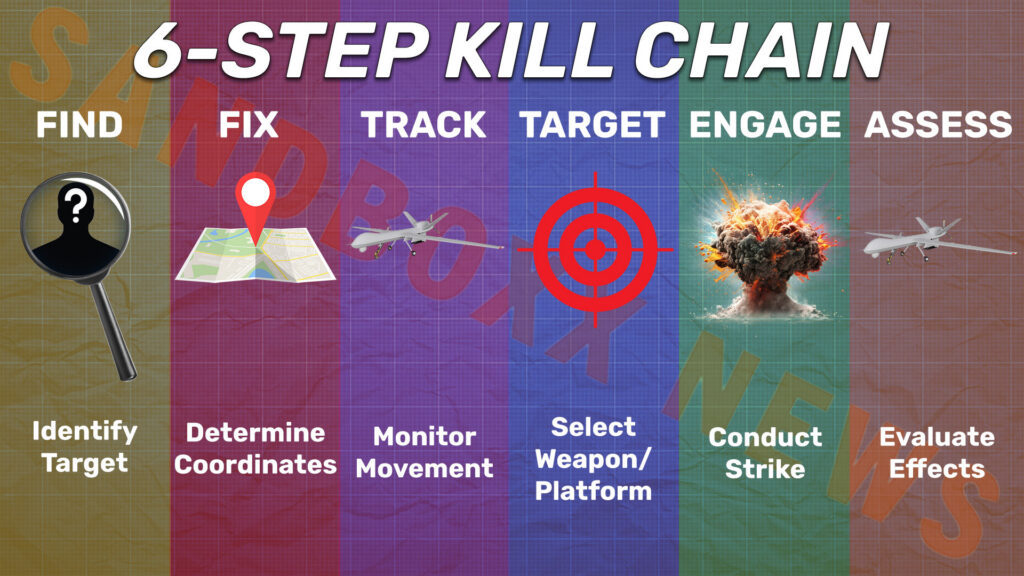
When people talk about Maven’s use in this context, you’ll often hear them refer to opening and closing kill chains, which is the traditional way of executing strikes against battlefield targets. A kill chain (in U.S. warfighting doctrine) has six distinct steps from start to finish: find; fix; track; target; engage; and assess.
This process isn’t simple. In real-world combat, there’s a solid likelihood that many – if not all – of these steps will need to be completed by different assets with potential delays between each based on asset availability and proximity. In movies, the United States military always has a stack of aircraft flying right overhead and available for any immediate tasking, but in real life, warfare tends to be pretty busy work, and you don’t always have your pick of assets to pull from.
As Air Force F-16 pilot and senior fellow at the Mitchell Institute for Aerospace Studies Heather Penny has said, it could sometimes take the American military hours to open and close a kill chain in past Middle East conflicts, with F-16s loitering for hours in the “kill box,” as she puts it, waiting for a weapons release order from the joint force air component commander.
That commander is waiting on analysts pouring over drone feeds, satellite imagery, and maps of the battlespace; while others are looking at the weapons they have available in theater; the aircraft that could potentially deliver them in a timely manner; the refueling tankers that might need to be scrambled to support the striking aircraft, and a whole lot more. All told, this process involved eight to nine separate human-operated systems, often siloed or separated from one another.
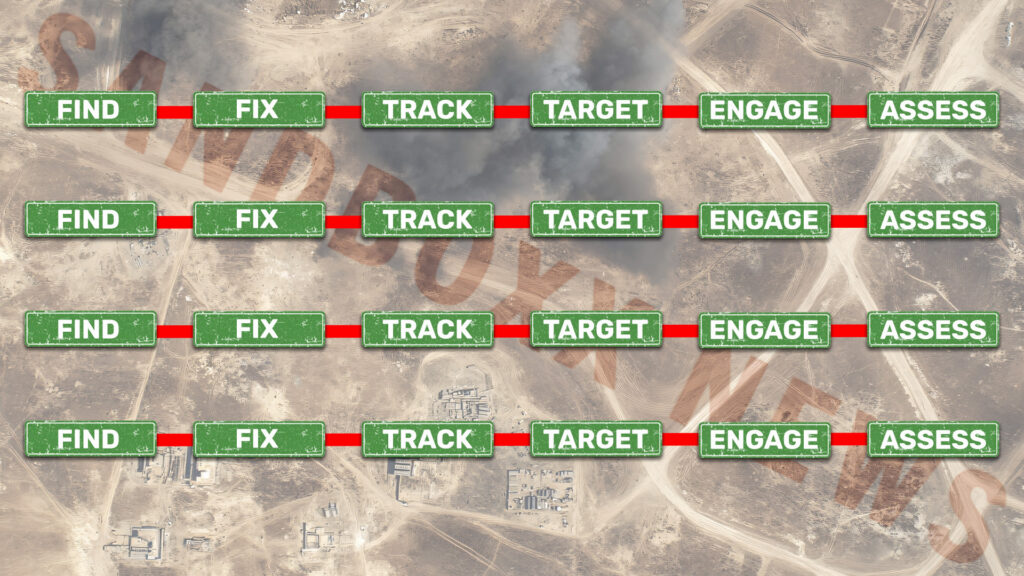
And as messy as that sounds, America is likely the best in the world at rapidly opening and closing kill chains. While Russian performance has improved in this context over the past four years of fighting in Ukraine, it often took entire days for Russian forces to open and close kill chains against Ukrainian targets just on the other side of their own border.
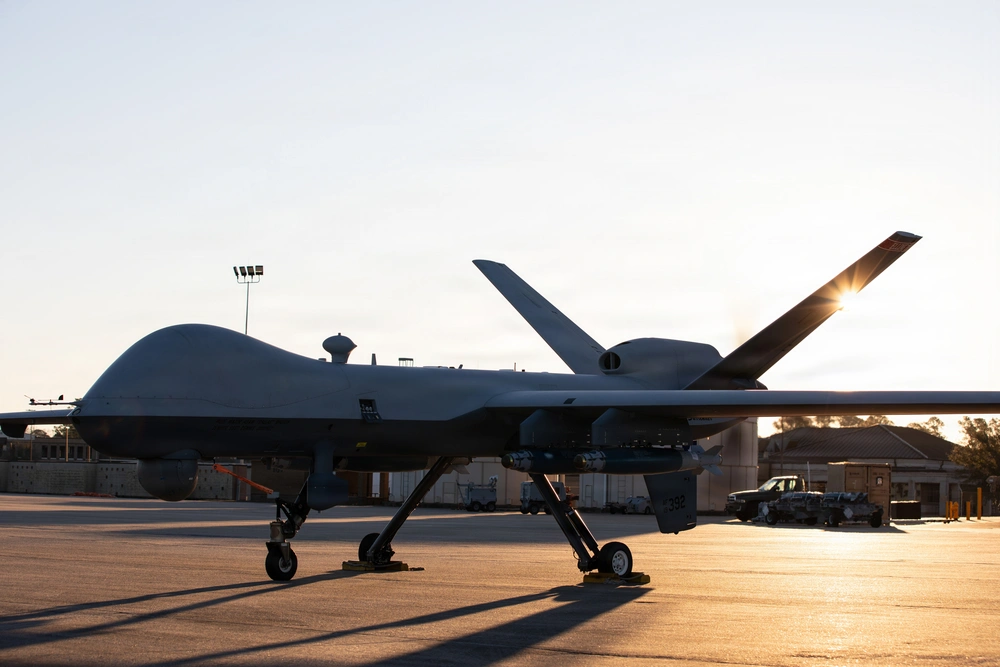
The time it takes to open and close kill chains is incredibly important, and not just because you want to take the target off the board. A vital element of all modern combat operations is working to disrupt your enemy’s kill chains while you attempt to enact your own, and the longer it takes to open and then close a kill chain, the more vulnerable that kill chain is to disruption, for example by shooting down the MQ-9 drone that was tracking a target. If the target’s lost, you’ve got to start the whole process over again once you’re able to find them.
But Maven doesn’t really employ this traditional kill chain model. instead, it serves as the backbone of America’s more modern approach that’s been dubbed “kill webs.”
Rather than executing a dozen separate kill chains, each using assets allocated specifically to the job, a kill web distributes all of the steps for all of those kill chains across all of the assets in the battlespace. This creates sensor and potentially even strike redundancy, meaning if the drone you were using to track the target gets shot down, the job just seamlessly transfers to the next closest drone that can do the same job, interconnecting all of the kill chains until they form a spider’s web of platforms and capabilities that’s much more resilient than separate kill chains ever could be.
Related: Project VENOM: The Air Force is adding AI pilots to 6 F-16s

Yet, this isn’t the only way Maven is employed on the battlefield. For combat pilots, Maven’s battlespace management tools are arguably just as important. As Maven consumes real-time data feeds from sensors all over the battlespace, it fuses it all into a single overhead view that enables very effective mission planning with the most up-to-date information available. This is vital for pilots flying into contested airspace, who need to know what types of air defense assets are deployed where, their maximum targeting envelopes, and more, in order to mitigate risk and maximize the chances of mission accomplishment.
In these scenarios, pilots require extremely up-to-date intelligence that, until now, had to be processed by analysts pouring over images to try to determine what type of surface-to-air missile battery they were looking at and what its precise coordinates were in photos or video.
Maven isn’t limited to just sifting through data to identify targets, friendlies, and non-combatants. It can also monitor vast expanses of the battlespace in other ways, using those same object detection capabilities to notify users when targets suddenly present themselves. It can even identify behavior patterns in individuals that might warrant further study and raising an alert for users.
Related: New weapons and technologies making their debut in the war against Iran
The AI that powers Maven isn’t conspicuous or overt. The advanced AI systems that make up the Maven enterprise are instead somewhat invisible to the user, who, to some extent, is able to run the battlespace like it’s a real-time strategy game.
Maven’s open system software architecture may ultimately prove to be its most valuable asset, as it was purpose-built to work in concert with third-party applications. That means Maven can serve as the intelligence-analyzing backbone of any number of new capabilities that have yet to manifest, or even for some that already have. In December 2025, the U.S. Army Southern European Task Force, Africa public affairs directorate integrated Maven with the Dataminr First Alert platform to feed real-time news alerts directly into Maven to support information operations within various command areas of responsibility, as well as common social media platforms to “visualize social media sentiment” and provide critical insights.
Developing AI warfighting capabilities is arguably the most important deterrent measure the United States military could be focused on today. And while smart targeting capabilities aren’t enough to open the Strait of Hormuz, the experience American forces are gaining with Maven and similar tools in this fight is sure to pay dividends for a long time to come.
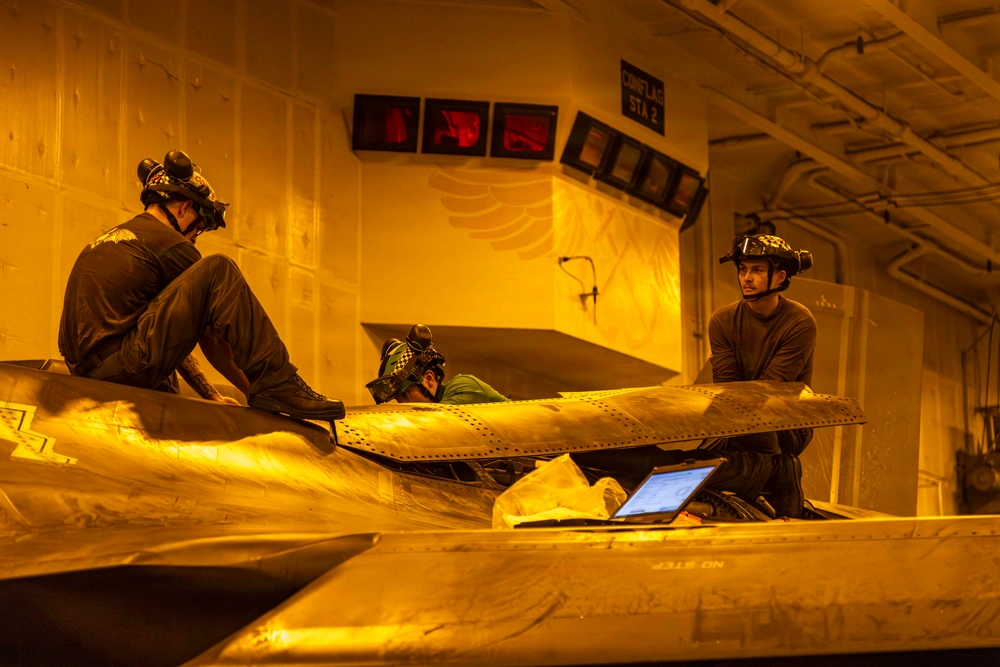
Feature Image: U.S. Sailors conduct maintenance on an F-35C Lightning II, attached to Marine Fighter Attack Squadron (VMFA) 314, in the hangar bay aboard Nimitz-class aircraft carrier USS Abraham Lincoln (CVN 72) during Operation Epic Fury, March 23, 2026. (Photo by NAVCENT Public Affairs)
Read more from Sandboxx News
- What happens when a Delta operator collects too much equipment
- Footage shows F/A-18 Super Hornet narrowly avoid missile over Iran
- Artemis II is headed to the Moon. This is how the military is helping
- Why military leaders should trust their troops with explanations
- Anduril’s AI-piloted Fury drone goes into serial production, but who will buy it?