There are now three different versions of American F-15s prowling the skies: the Eagle, the Strike Eagle, and the Eagle II.
The F-15 Eagle introduced the world to modern air superiority when it entered service in 1976, and since then, it has come to be known as the most dominant air-to-air fighter of its generation.
More than 80% of these Eagles built for the U.S. Air Force were single-seat jets, called F-15Cs (versus two-seat Eagles, which are called F-15Ds). Both other F-15 variants in U.S. service only come with two seats – so if you see an F-15 with just one seat in the cockpit, it is the original F-15 Eagle.
These jets also tend to be painted in a lighter shade of grey than the Strike Eagle, but that’s tough to spot unless the two are side by side, so a better way to tell them apart would be to look alongside the intake trunks on both sides of the fuselage.
Eagles tend to fly pretty clean, without bulgy conformal fuel tanks, and in the rare instances that they do carry those tanks, you won’t see the bomb racks that are standard on the Strike Eagle.
So, if you see an F-15 carrying a strictly air-to-air missile loadout, instead of several of extra bombs and fuel tanks, then it’s probably an F-15 Eagle.
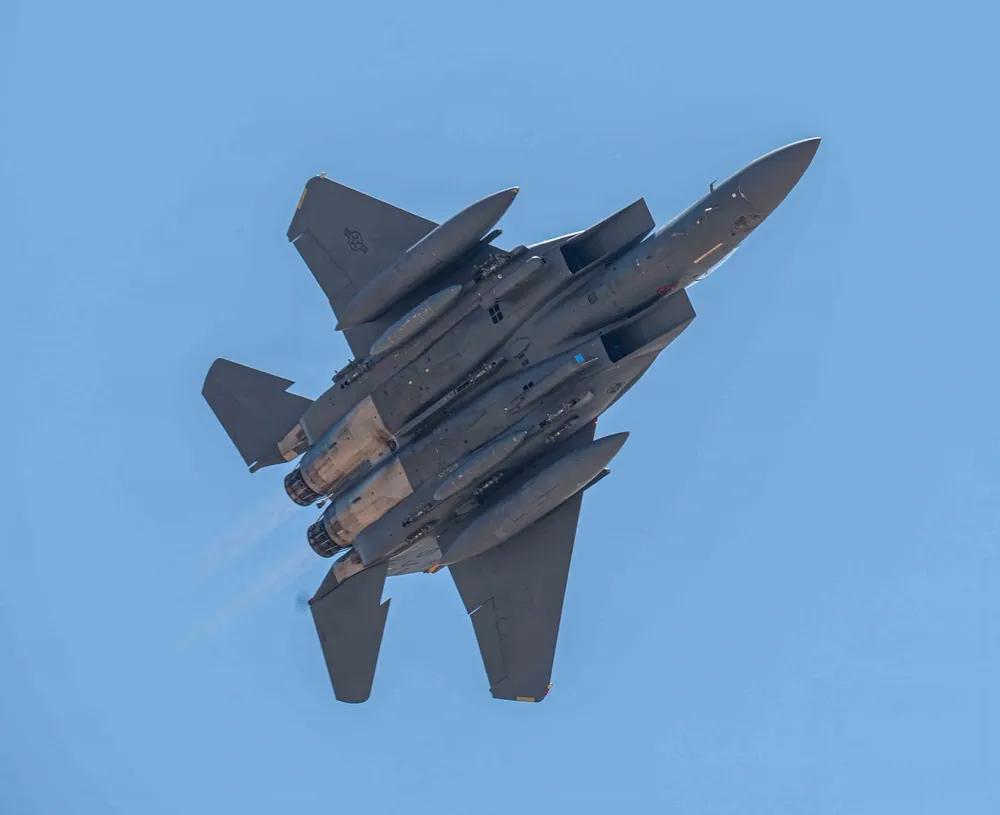
The F-15E Strike Eagle, on the other hand, entered service about 11 years after its older sister and came with a very different role: Rather than strictly dominating in air-to-air combat, the Strike Eagle is also focused on air-to-ground operations, with a reinforced airframe and more than twice as many hardpoints to carry a variety of weapons.
All Strike Eagles are two-seaters, and the easiest way to spot one are its those bulbous conformal fuel tanks with weapon stations on them.
In general, Strike Eagles in a combat environment tend to look like they’re carrying a whole lot of hate. But this is where it can get tricky to differentiate between an F-15E Strike Eagle and the brand-new F-15EX Eagle II – because an F-15EX Eagle II can carry even more.
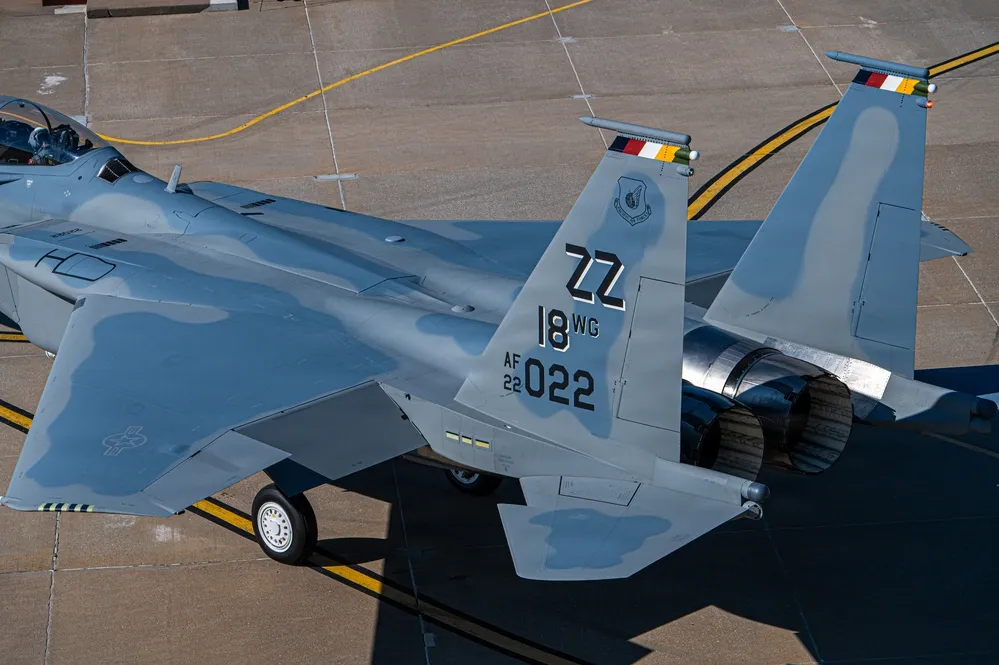
The F-15EX Eagle II entered service just in 2024, and is a thoroughly modern fighter underneath that familiar-looking fuselage. All F-15EXs are two-seaters, just like the Strike Eagle, but the Eagle IIs operated by the Air Force today do not currently have conformal fuel tanks (though future Eagle IIs will include them).
So, sometimes, the F-15EX might look like a two-seat F-15D Eagle, and in the future, it might commonly look more like the F-15E Strike Eagle. Therefore, the easiest way to spot a new F-15EX is to look for the little protrusions sticking out of the fuselage on either side of the cockpit just behind the pilot’s front seat.
Those protrusions are there to house sensors for the aircraft’s Missile Warning System, which visually identifies incoming missiles.
This is an important capability that today’s F-15EXs haven’t incorporated yet, but once online, it will give the pilot advanced warning of any kind of inbound threat, including passively guided heat-seekers that won’t prompt an alert from the jet’s radar warning receiver.
Even though the capability isn’t online in America’s small but growing fleet of Eagle IIs, those protrusions are still there for when the time comes.
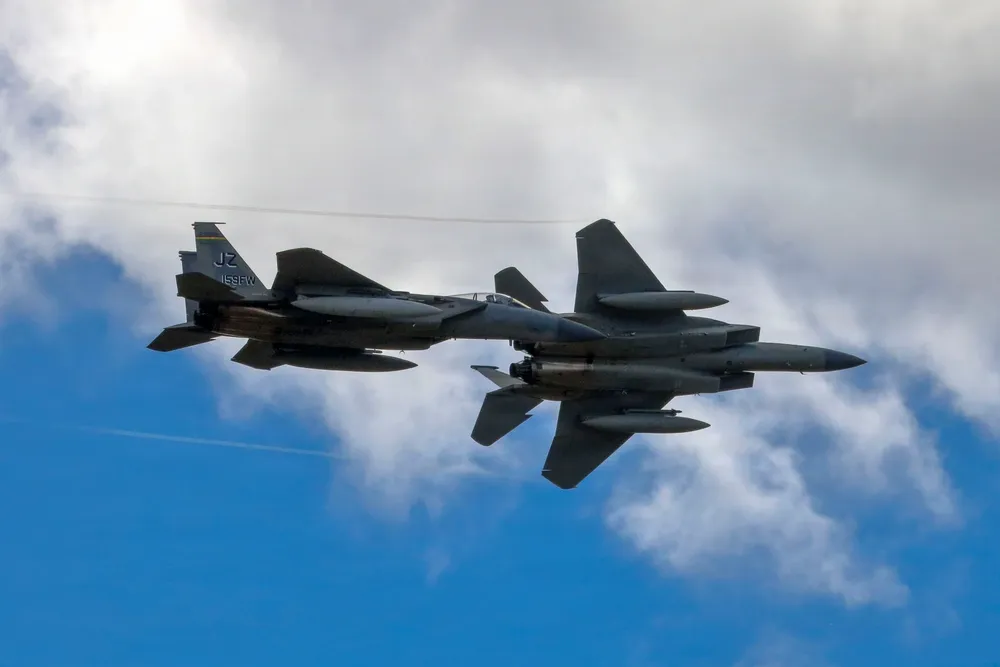
Feature Image: Two U.S. Air Force F-15 Eagle fighter jets assigned to 159th Fighter Wing, Louisiana Air National Guard, perform high-speed precision maneuvers over the flightline during a SkyFest 2026 at Fairchild Air Force Base, Washington June 6, 2026. (U.S. Air Force photo by Staff Sgt. Kristjan A VanWinkle)
Read more from Sandboxx News
- 8 places the CIA and military took me that you should visit
- Beretta has built an AI-powered shotgun turret to take down small drones
- Performance enhancers in Delta Force were not what you’d think
- The ultimate guide to the Patriot air defense system
- Air Force wants to equip its F-16s with hypersonic Blackbeard missiles