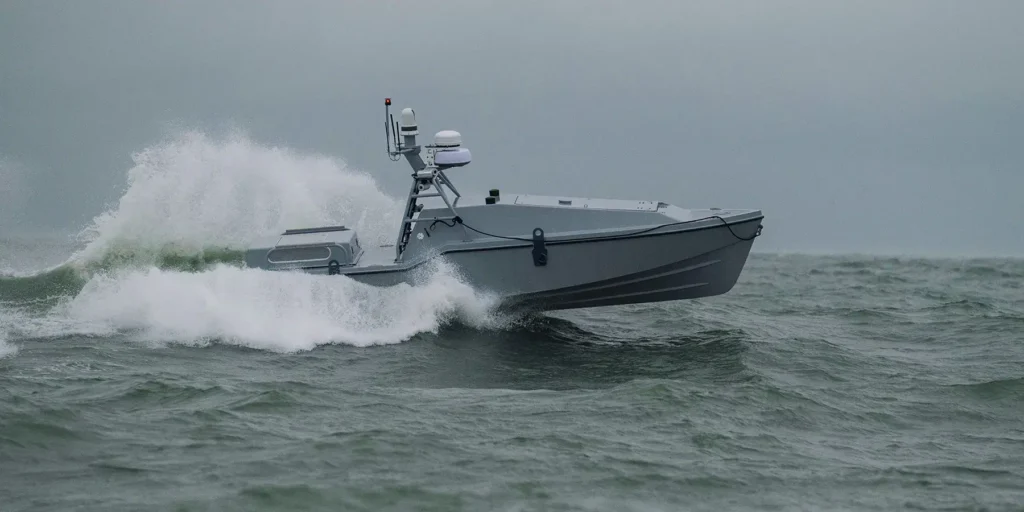
On Sunday, the United States Central Command, or CENTCOM, successfully employed naval one-way attack drones against Iranian targets, marking a significant first in America’s broad shift toward fielding a wider array of unmanned systems in the air, on land, and at sea.
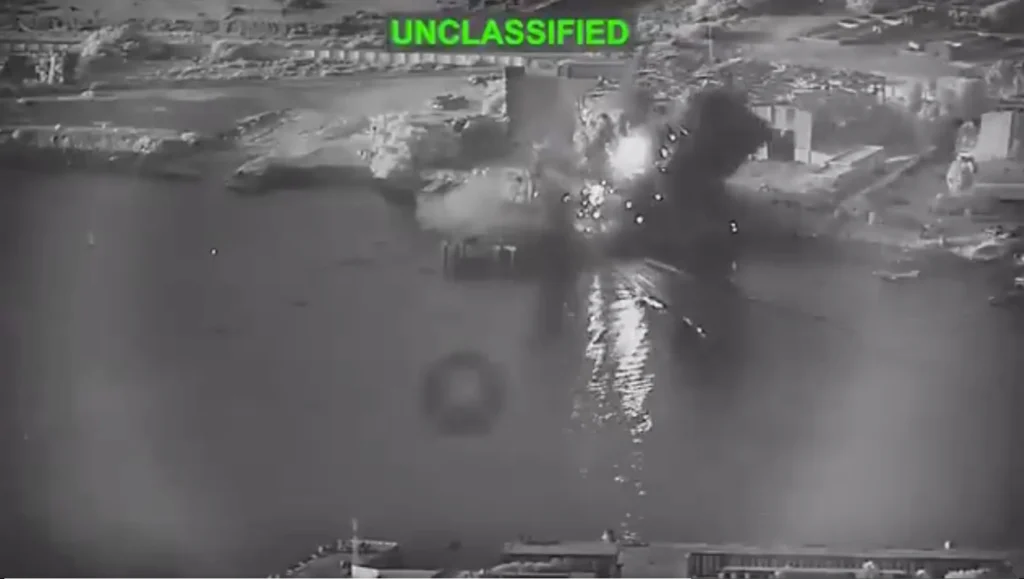
According to a CENTCOM statement published on X, the U.S. Navy employed three Corsair unmanned surface vessels to strike the port at the Bandar Abbas Naval Base in Southern Iran, specifically targeting a submarine that was moored there and a ship-maintenance facility.
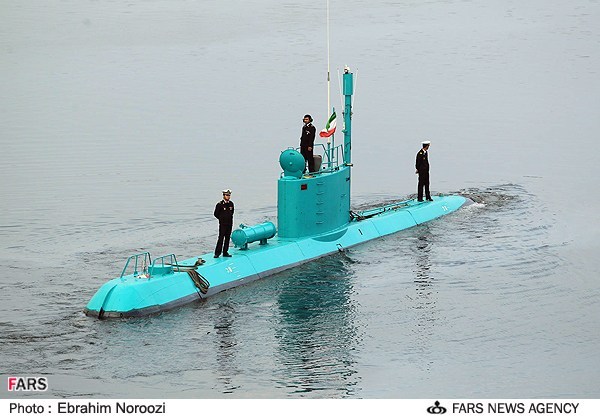
It has yet to be confirmed by Pentagon officials, but the submarine appears to be a Ghadir-class midget submarine, which is a shallow-water diesel-electric sub that entered service for the Iranian Navy in 2007.
CENTCOM stated that this attack marked the first time American forces have employed sea drones for combat operations. But, notably, this is not the first time America’s naval drones, and these Corsair drones in particular, have demonstrated their value in the fight.
These same Corsair drones, developed and built by Texas-based Saronic Technologies, were used on June 8 to rescue the crew of a downed U.S. Army AH-64 Apache attack helicopter near the Strait of Hormuz, only months after quietly entering service for the Navy.
The announcement of the Apache crew rescue in June was the first time many learned of the Navy’s expansive drone fleets that currently include growing numbers of Corsairs, smaller drone speedboats called GARCs (Global Autonomous Reconnaissance Craft), MANTAS T-12s surveillance vessels, 38-foot T38 Devil Ray speed boats, extreme-duration Saildrone Explorers and much more.
At 24 feet long, the Corsair is about the size of a large speedboat and can carry payloads of up to 1,000 pounds at ranges of over 1,150 miles and at speeds of up to 35 knots, or about 40 miles per hour.
The Navy has not disclosed how many of these drones it has in service, but we do know they entered service with the U.S. Navy’s Task Force 59 and its operational counterpart, Task Group 59.1, in March 2026, after Saraonic received a $392 million Navy contract for an undisclosed number of drone platforms in August 2025.
That range, speed, and payload capability all make the Corsair a very capable intelligence, surveillance, and reconnaissance platform, but it also makes these attritable drone boats extremely potent one-way attack drones. If it maximized its payload with explosives, that would give a single Corsair comparable explosive power to as many as 50 AGM-114 Hellfire missiles.
According to Saronic, the Corsair platform has already logged over 100,000 nautical miles in testing thus far.
The platforms can operate autonomously, as part of larger collaborative swarms, or via remote control, with a human-in-the-loop – via a two-way data link – to make some decisions, like employing munitions when armed.
Related: America’s LUCAS kamikaze drones will get a lot scarier thanks to Hivemind AI
In April, Sandboxx News spoke with Representative Adam Smith, the ranking member of the House Armed Services Committee. Rep. Smith brought Saronic up as an example of how the Pentagon and Defense contractors are working toward a positive shift in contracting culture that sees companies take on increased financial responsibility for the success of their products and the programs they’re a part of.
Referencing a conversation he had had with Deputy Secretary of Defense Steve Feinberg, Smith said, “And initially [Feinberg] said, ‘look, you got all these new fangled defense [firms]. They always come in. They show you these big charts and these computer graphics and these simulations. And they all act like they’re going to do all this incredible stuff. And then you see the real product, and he said it was kind of, you know, was kind of lacking.”
“Then the interesting thing was, Saronic fixed it on their own dime. They didn’t come back and say, okay, well, now we’ve got a contract with you, so we can keep giving you this thing that you’ve just told us that you don’t want, or you can pay us another, I don’t know, $2 billion to build something new,” he told Sandboxx News.
In December 2025, Saronic reported having the production capacity to produce between 400 and 500 Corsairs per year at its facility in Austin, Texas. By March 2026, that number had risen to 1,000 meaning the company pumping out nearly three completed Corsairs for the Navy per day, every day.
The firm plans to double that number and establish a new production target of 2,000 drones per year for the not too distant future thanks to the acquisition of a new production facility in Franklin, Louisiana.
Saronic also has two other drone vessels in development and testing, including the much larger 180-feet Marauder that’s slated to demonstrate its ability to launch Castelion’s Blackbeard hypersonic missiles in 2027. Currently, however, the Corsair is the only platform produced by the company with a publicly disclosed production contract.
Feature Image: Saronic’s Corsair drone. (Saronic)
Read more from Sandboxx News
- Marines turn H-1 helicopters into drone motherships
- Navy SEALs deploy to Trinidad and Tobago to help counter drug trafficking into the U.S.
- Does “The Punisher: One Last Kill” do the iconic character justice?
- Air Force wants to replace the MQ-9 Reaper with drone swarms
- Could America have taken over the world after WWII?