The U.S. government’s leading advanced research and development agency, DARPA is currently undertaking a three-year, medically-focused research effort to help save American lives on the battlefield.
Unlike its many other projects, which often involve the development of high-tech kit or advanced munitions, this latest effort is instead focused on the literal life blood of the American servicemember.
The average human body contains approximately five liters of blood inside of it. Losing 40% of that blood – one two-liter soda-sized container of it – is a critical emergency and can prove fatal without rapid control of the bleeding and replenishment of the lost blood.
In the book, Tell Them Yourself: It’s Not Your Day to Die, the authors – including this one – discuss various techniques, equipment, and protocols that can help save the lives of combat wounded on the battlefield, including those suffering from significant blood loss.
For those with severe hemorrhage providing them with whole blood as quickly as possible after wounding is the ideal measure. This best prevents the damage caused by ischemia, which is the lack of oxygen provided to tissues caused by the loss of oxygen-transporting blood. Ultimately, the loss of blood will lead to shock and death if not treated.
In contrast to simply administering one component of whole blood (red blood cells, platelets, or plasma), the provision of whole blood seeks to replace as fully as possible what the body has lost, to aid in clotting and ultimately, the successful recovery of the patient.
The problem with whole blood, however, is three-fold: It requires cold storage; the supply is limited by available donors; and it has an expiration date. These constraints make it difficult to keep whole blood available in far-forward and austere conditions, such as those on a battlefield. Even civilian EMS systems in the United States struggle with the cost, donor issue, and storage requirements of whole blood, and thus few systems across the country carry it on their ambulances.
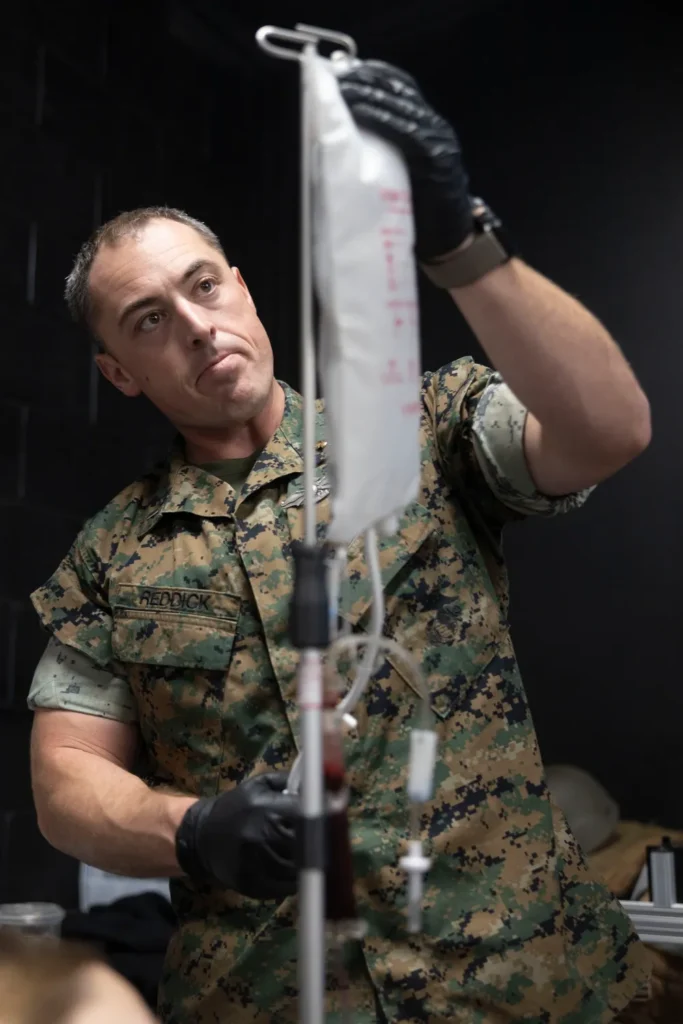
DARPA’s effort, cheekily named the Resuscitation and Prevention of Ischemia-Induced Dysfunction (RAPIID) program is aimed at overcoming those inherent problems with whole blood by creating a “blood analog” – or substitute blood – that will be readily available, long-lasting, and more environmentally robust than actual whole blood. Through the development of such a synthetic whole blood, combat medics would then be able to carry the life-saving product into the field, and thus more quickly administer it to those wounded who are in desperate need of it.
The RAPIID program follows on the heels of another DARPA program called FSHARP, which proved the concept that synthetic blood could be manufactured, according to DARPA, “to achieve resuscitative functions.”
Yet, to achieve its goal, DARPA has not only to successfully create the synthetic blood – which has to be proven effective and safe – but to also address the issues of securing FDA approval and manufacturing the product at scale. Neither of those are necessarily easy hurdles, and many involved in military medicine will testify, in particular, to the frustrations of dealing with a hesitant, risk-averse, and glacial-moving FDA.
DARPA, however, prides itself on identifying “accelerated approval pathways,” meaning it is likely confident that once a viable synthetic blood product exists, it can rapidly move it to approved medical use by the FDA.
If that happens, it then becomes a relatively simple issue of creating effective delivery systems (like syringes) for the synthetic whole blood, then fielding them and training U.S. medics on their use. That could be done through already-existing training programs set up through the National Association of Emergency Medical Technicians and military medicine to deliver tactical combat casualty care education. Then, down the road, the advancement in synthetic blood could hopefully make it out to civilian EMS systems across America.
All in all, DARPA’s RAPIID program is an audacious effort and there is no guarantee of its success. But the program is well worth it to save American lives on the battlefield and beyond.
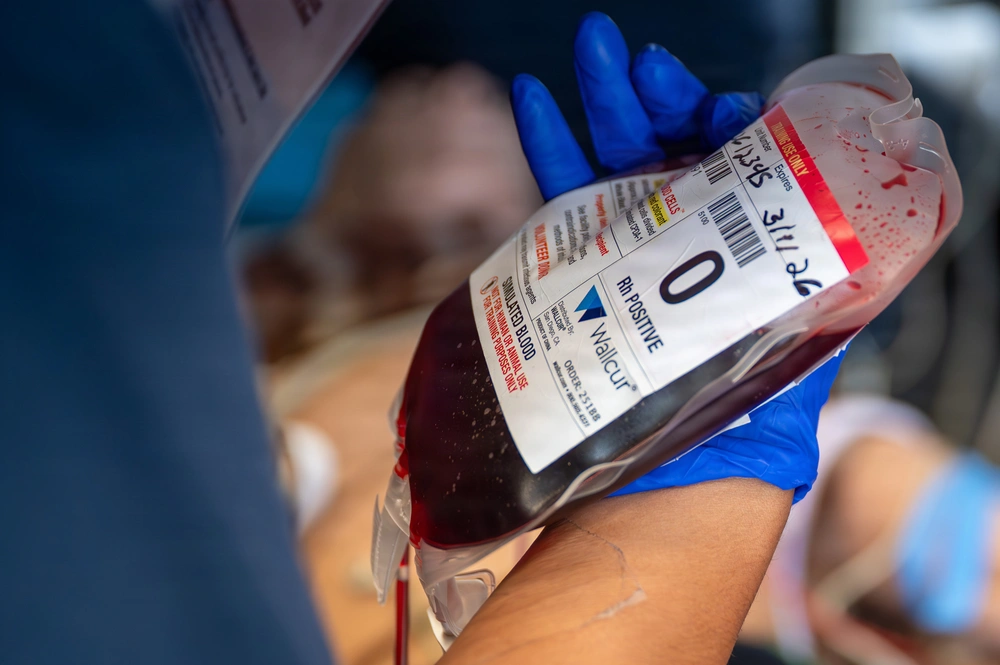
Feature Image: A Berkeley County Emergency Medical Services Team paramedic performs a simulated blood transfusion bag at the Berkeley County EMS exercise at Joint Base Charleston, South Carolina, May 13, 2026. The exercise used realistic medical training aids and scenarios to enhance emergency response and patient care skills. (U.S. Air Force photo by Airman 1st Class Faith Speakman)
Read more from Sandboxx News
- How Navy SEAL candidates recover after Hell Week
- A nod to NODs and the history of US military night vision
- What is OPFOR and why is it among the most fun and valuable things to do in the military?
- American F-15 pilot was shot down twice during Operation Epic Fury, according to report
- Why don’t we have viable hypersonic aircraft yet?