Could Russia attack a NATO member state in the next weeks and months? Possibly yes, according to the prevailing sentiment in European capitals and even the Pentagon.
To be sure, Russia is neither capable nor likely to launch a full-blown attack against NATO. Nevertheless, a limited attack could be in the cards in a last-ditch attempt to break the transatlantic alliance.
Russia has been engaged in a full-blown conventional war in Ukraine for nearly five years. And yet, despite initial Russian intelligence assessments that convinced Moscow that the time was ripe to take over its neighbor, the war did not end in three weeks.
Although the Russian forces have made significant gains inside Ukraine, they are nowhere near achieving the initial strategic objectives set out by the Kremlin. As such, it is highly unlikely that Moscow will launch a full-blown invasion of a NATO member state while the fighting in Ukraine continues.
The Russian military and paramilitary units have taken more than 1.5 million casualties, according to the latest casualty estimates. Russian materiel losses, moreover, are similarly substantial, with tens of thousands of heavy weapon systems damaged or destroyed.
But a full-scale invasion of a NATO member state is not the only option Kremlin planners have.
“Russia could conduct limited ground operations leveraging drones against NATO states not to conquer them, but to break the alliance by causing it to fail to activate and act appropriately on its Article 5 commitments,” the Institute for the Study of War assessed in a recent strategic estimate of the war in Ukraine.
Indeed, a small-scale invasion of a NATO member state bordering Russia is possible, according to Western intelligence chiefs.
“It’s possible. It could involve a limited incursion, false-flag provocations, a massive influence campaign,” Michal Koudelka, the head of the Czech Republic’s BIS security service, told the Guardian in an exclusive interview.
Western spy chiefs assessed that such an incursion, if it takes place, could take place in months, not years.
“We don’t see indications of an imminent attack,” Normunds Mežviets, the director general of the VDD, the Latvian state security service, said. “It’s still an open question if they have direct and concrete plans or if it’s just within the context of their overall attempts to spread fear and uncertainty in Western society.”
NATO certainly understands the threat. The German military, for instance, is permanently positioning a mechanized brigade in Lithuania. The British Army is also leading a battle group in neighboring Estonia. Moreover, more than one-third of Canada’s entire land forces are committed in Latvia.
Moscow’s goal for such an attack would be to sow distrust within NATO. Russian planners seem to believe that a limited incursion or hybrid attack against a small NATO member state would not be enough for the rest of the transatlantic alliance to trigger the famous Article 5, or the common defense clause.
While it is true that there might be differences of opinion – and defense spending – among the 32 member states, and that those on the easternmost flank of the alliance feel the breath of the Russian bear closer, a Russian attack would most likely result in a common response.
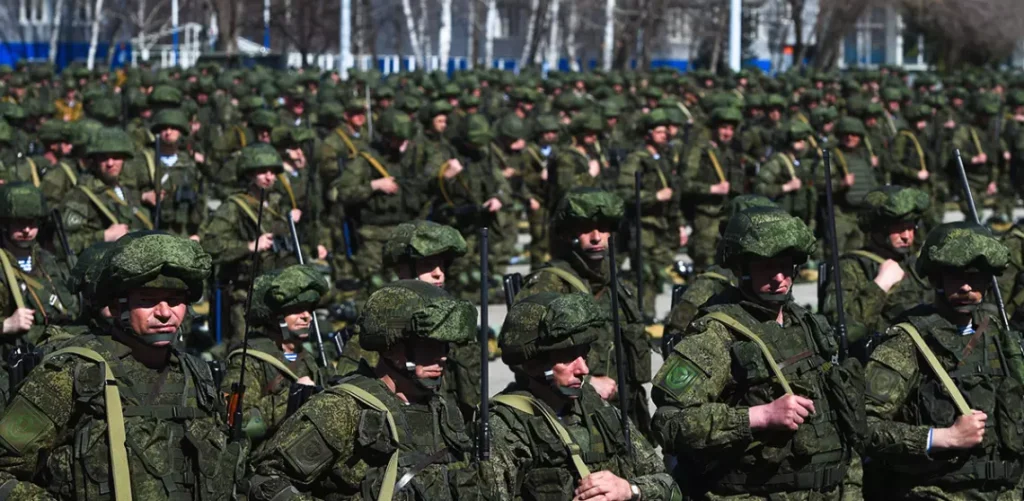
Feature Image: Russian troops. (Creative Commons)
Read more from Sandboxx News
- Air Force wants to extend the service life of B-1 Lancers and B-2 Spirit bombers
- F-35A finds new home in Massachusetts as 104th Fighter Wing welcomes the stealth jet
- The time when a nearly perfect Delta Force sniper made a hilarious mistake
- US Air Force has a $14 billion supply hole, service officials say
- British Army unveils its latest Challenger 3 tank prototype