Beginning on Monday morning, U.S. Navy warships and aircraft are blockading all maritime traffic entering or exiting Iranian ports regardless of the vessels’ flag. And the first data about the difficult operation is out.
Traffic to and from Iranian ports has plummeted, as U.S. warships and aircraft are ready to attack non-compliant vessels.
According to the U.S. Central Command (CENTCOM), the combatant command that is responsible for the Middle East and North Africa area of operations, the blockade of Iran has been quite effective thus far.
In the first 48 hours of the operation, no ships from Iranian ports have made it past the blockade. At least six merchant vessels underway complied with the direction of U.S. warships and turned around.
Over 12 warships are involved in the physical blockade, including the USS Abraham Lincoln aircraft carrier and several Arleigh Burke-class guided-missile destroyers. More than 100 fighter jets, surveillance aircraft, and support aircraft are assisting from above.
However, the Strait of Hormuz is open for ships coming from and heading to the ports of other countries.
According to the White House, at least 34 merchant vessels went through the Strait of Hormuz in the past couple of days, which represents the highest number of vessels traveling through the geopolitical hotspot since Operation Epic Fury began on February 28.
A modern day blockade
Blockades are an ancient concept in naval warfare.
For example, during the Persian Wars in the 5th century BC between the Persian Empire and the Greek city-states, the Greeks blockaded Artemisium to prevent a Persian amphibious operation to the flank of the Greek ground forces blocking Thermopylae.
Blockades can be categorized in open and close ones. During the Napoleonic Wars, the Royal Navy ran an effective close blockade of Continental European ports in French hands using ships of the line and frigates.
A close blockade is highly effective because it maintains a constant vigilance over the enemy port, allowing no gaps for enemy vessels to sneak in or out.
However, around World War I, advances in technology made close blockades inadvisable. Long-range gunnery, sea mines, and torpedoes could be catastrophic for a fleet attempting to run a close blockade of an enemy port. As a result, the concept of an “open blockade” became more popular.
In an open blockade, a naval force deploys farther off the coast and patrols the sea lanes leading into the enemy port in question. It is not as effective as a close blockade in preventing enemy ships from sneaking in or out. But, especially with modern technology of anti-ship missiles and one-way attack unmanned aerial systems, an open blockade is often the only feasible option.
The U.S. Navy is currently running an open blockade of Iranian ports, and it is aided by the geography of the region and the natural chokepoint the Strait of Hormuz creates.
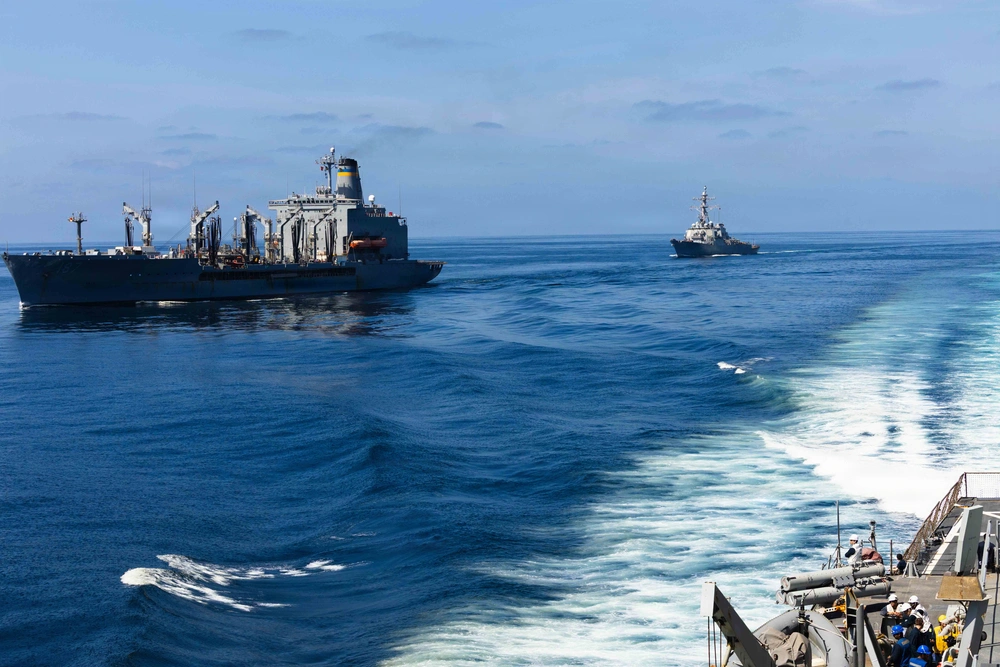
Feature Image: Arleigh Burke-class guided-missile destroyer USS McFaul (DDG 74) makes its approach alongside fleet replenishment oiler USNS Henry J. Kaiser (T-AO-187) for a replenishment-at-sea during Operation Epic Fury, March 27, 2026. (NAVCENT Public Affairs photo)
Read more from Sandboxx News
- Ukrainian logistics drone evacuates wounded soldier from the frontline
- Marines say the best attack drone pilots might be dirt bikers, not gamers
- A-10 gets new adapter to resolve a unique refueling problem
- Iran’s cheap method of striking US aircraft despite American air superiority
- Air Force wants $1 billion to begin fielding AI-piloted drone fighters next year