After years of testing and development, the Air Force Research Lab’s groundbreaking Rapid Dragon concept is finally becoming operationalized as the new Dragon Cart system.
The system turns cargo aircraft, like the C-130 and C-17, into long-range, stand-off bombers that can flood enemy airspace with air-launched cruise missiles deployed from well beyond the reach of enemy air defenses.
Dragon Cart will allow nearly any variant of the C-130 Hercules to launch as many as 12 large cruise missiles in rapid succession, while the larger C-17 can launch as many as 45.
The palletized launch system was designed and built by Lockheed Martin to carry and deploy some of America’s most capable cruise missiles, including Lockheed’s own JASSM, or Joint Air-to-Surface Stand-off Missile, line.
The JASSM line includes the AGM-158B JASSM-ER, a stealthy land-attack cruise missile with a range of over 575 miles; the AGM-158C LRASM, or Long Range Anti-Ship Missile, which offers a similar range while carrying a more advanced guidance suite purpose-built for maritime warfare; and the upcoming JASSM-XR that has a 1,000-mile range and will certainly find a home in Dragon Carts as well.
Yet, as capable as these weapons are, they’re also extremely expensive, ranging from around $1.5 million to over $4 million a piece. So the Air Force is also investing heavily into its new Family of Affordable Mass Munitions, or FAMM, program.
The program aims to field thousands of new low-cost cruise missiles that may not offer the same levels of stealth, advanced guidance, or the 1,000-pound warheads of the JASSM line, but can cover similar distances with smaller warheads for just a fraction of the cost.
Weapons like Lockheed Martin’s CMMT and Anduril’s Barracuda 500M are both rated to carry warheads that weigh 100 pounds or more – roughly five times the explosive payload of a Hellfire missile – to targets more than 575 miles away, for less than a reported $200,000 a piece. Both of these weapons have already seen vertical test launches from surrogate systems meant to replicate how the Dragon Carts work.
As Sandboxx News learned from Lockheed Martin’s Rapid Dragon team, they always envisioned the system as weapon- and aircraft-agnostic, meaning Dragon Carts can feasibly be produced to launch just about any weapon from just about any aircraft large enough to accommodate the pallets.
Down the line, other candidate weapons could be used in conjunction with the system, like Boeing’s new JDAM-LR cruise missile and its maritime strike variant, both of which can deliver 500-pound warheads to targets 375 miles away.
The idea would be to combine pallets of low-cost cruise missiles with higher-end JASSM-ERs and LRASMs, using the less expensive weapons to help saturate enemy airspace while the stealthy JASSM-ERs and LRASMs hunt for more important targets.
Importantly, these Dragon Cart pallets don’t require any modifications to the launching aircraft, as a result, there will be is no modification costs for America’s cargo fleets, Dragon Carts can also be provided to allies or partners in any of the 63 other countries that operate C-130s, making the system a very inexpensive way to provide stand-off strike capabilities to partner forces as well.
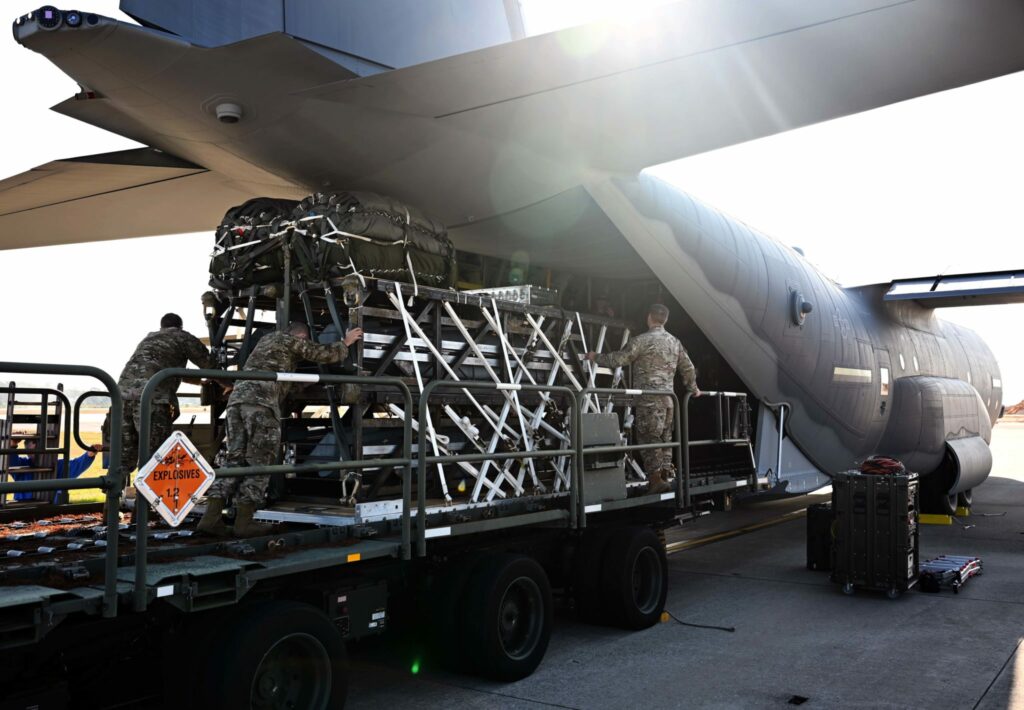
Feature Image: Airmen and Riggers with the 1st Special Operations Squadron Logistics Readiness Squadron load a Rapid Dragon Palletized Weapon System aboard an MC-130J Commando II at Hurlburt Field, Florida, Dec. 13, 2021. The Rapid Dragon Program demonstrates the ability to employ weapons using standard airdrop procedures from cargo aircraft anytime and anywhere. (U.S. Air Force photo by Staff Sgt. Brandon Esau)
Read more from Sandboxx News
- Recon Marines will need to swim more and hide from drones in training shakeup
- Operation Olympic Games: When history’s first cyberweapon targeted Iran’s nuclear program
- Thank you, Maverick: Senate wants to see the legendary F-14 Tomcat fly again
- Ukraine releases new videos of its Flamingo missiles blasting off for 900-mile strikes on Russia’s rear
- Air Force wants to invest $500 million to arm its cargo and tanker aircraft against missiles and drones