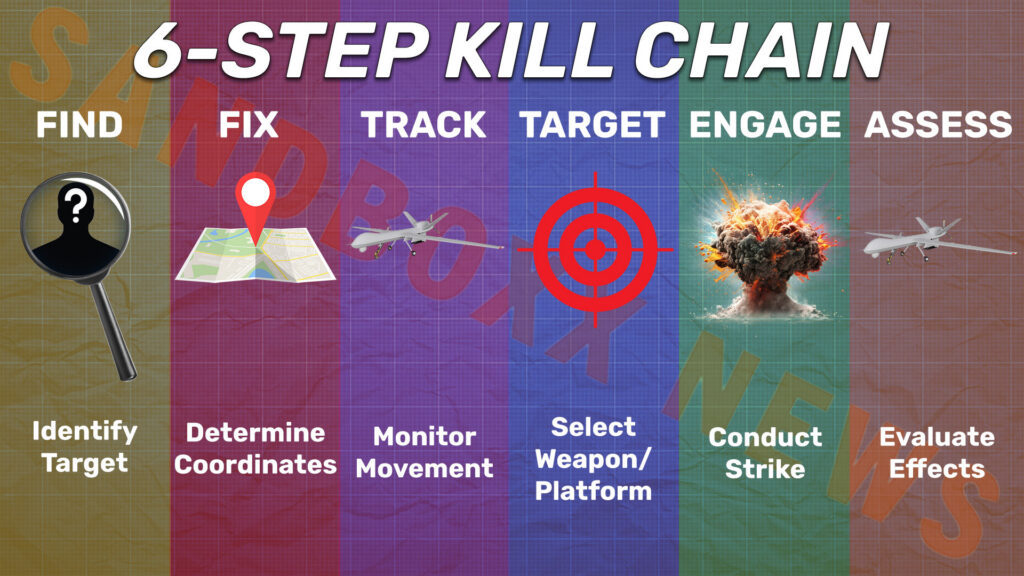
When officials talk about conducting combat operations, you’ll often hear them refer to opening and closing “kill chains.”
A kill chain is the traditional way of executing strikes against battlefield targets. In U.S. warfighting doctrine the kill chain has six distinct steps from start to finish: find, fix, track, target, engage, and assess.
For the first step, “find” a military uses available intelligence to identify its intended target. Then for “fix” it has to determine the specific coordinates of the target’s location. For “track” it monitor the target’s movement to ensure it knows precisely where the target is.
For “target,” it select the appropriate weapon system, launch platform, and exact timeline for the strike. For “engage,” it hits the target with the selected munition. Finally, for “assess” it evaluates the effectiveness of the strike. (The last step is sometimes also called “battle damage assessment.”)
This process is very rarely simple. In combat, there’s a possibility that many – if not all – of these steps will need to be completed by different assets, like drones, aircraft, or other sensors. These could cause delays between each step depending on asset availability and proximity to the target and between different assets. In movies, the United States military always has a stack of aircraft flying right overhead and available for any immediate tasking, but in reality, warfare tends to be pretty busy work, and you don’t always have your pick of assets to pull from.
“Planners must think backward from the target to optimize the kill chains used to attack it,” former U.S. Air Force F-16 pilot and senior fellow at the Mitchell Institute for Aerospace Studies, Heather Penny writes.
“Target characteristics dictate which platforms, sensors, and capabilities planners use; nodes [meaning sensor platforms like drones] that perform similar functions but have different characteristics may not be interchangeable. The type and precision of the sensors used to locate and track a target, the type of weapon and effect, and even the bandwidth and latency of the kill chain’s datalinks must be tailored to the target and mission,” Penny adds.
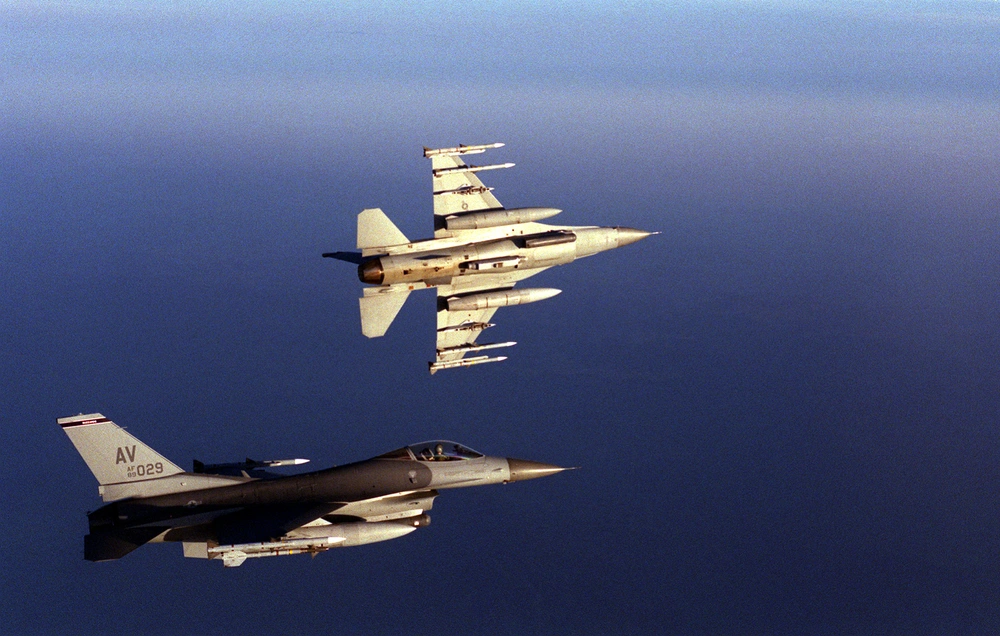
As Penny points out, in past Middle East conflicts, it could sometimes take the American military hours to open and close a kill chain, with F-16s loitering for hours in the “kill box,” as she puts it, waiting for a weapons release order from the joint force air component commander.
That commander, in turn, is waiting on analysts pouring over drone feeds, satellite imagery, and maps of the battlespace, while others are looking at the weapons they have available in theater, the aircraft that could potentially deliver them in a timely manner, the refueling tankers that might need to be scrambled to support the striking aircraft, and many more factors.
Overall, this process used to involve eight to nine separate human-operated systems, often siloed or separated from one another while they worked.
Nevertheless, as chaotic as that sounds, America is arguably the best in the world at rapidly opening and closing kill chains. While Russian performance has improved over the past four years of fighting in Ukraine, it often took entire days for Russian forces to open and close kill chains against Ukrainian targets – a slowness that is even more noteworthy since Ukraine borders Russia.
For a military, speeding up its ability to open and close kill chains is incredibly important – and not just because you want to quickly eliminate a target. A vital element of all modern combat operations is working to disrupt your enemy’s kill chains while you attempt to enact your own. The longer it takes to open and then close a kill chain, the more vulnerable that kill chain is to disruption.
A simple example of this might be shooting down the MQ-9 drone that was tracking a target. If the target’s lost, you’ve got to start the whole process over again once you’re able to find them.
However, the United States is now transitioning toward using a much more resilient process termed “kill web,” thanks to more modern battle management systems, like the U.S. military’s Maven artificial intelligence command and control system.
Feature Image: Illustration of the kill chain’s steps. (Sandboxx News)
Read more from Sandboxx News
- More A-10 Warthogs are heading to the Middle East
- Airborne adventures with a Green Beret Combat Diver Team
- NATO members reach defense spending goals, but Trump calls America’s membership into question
- US air superiority against Iran won’t protect shipping through the Strait of Hormuz
- What actually happens when fighter pilots take off their masks?