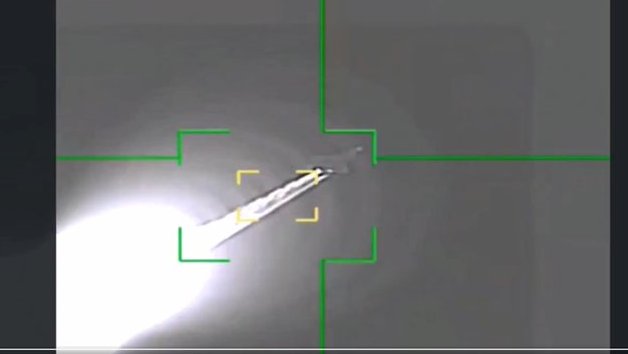
Footage released online allegedly shows an American F-35 being hit by, what may be, an Iranian surface-to-air missile reportedly fired by the country’s Islamic Revolutionary Guard Corps. The footage has not been jet verified, yet, it coincides with confirmed reports of a U.S. Air Force F-35A being forced to make an emergency landing somewhere in the Middle East.
If the footage is real, it offers two equally important lessons.
The first is that the F-35’s stealth is not a cloak of invisibility or invincibility, and even these aircraft are susceptible to being hit by surface-to-air missiles if they’re close enough to the targeting array.
And the second is that the F-35 seems to be a much tougher aircraft than most seem to give it credit for, as the jet seemingly ate that direct hit in stride, and still managed to fly all the way to a friendly airbase in the region and safely land.
“The aircraft landed safely, and the pilot is in stable condition. This incident is under investigation,” Captain Tim Hawkins, a spokesperson for U.S. Central Command, told The Warzone. Hawkins confirmed that the F-35 which made the emergency landing was flying a “combat mission over Iran.”
Thus far, CENTCOM has not confirmed that the F-35 that made an emergency landing was indeed hit by Iranian fire, but CNN claims that unnamed sources have corroborated the story.
It is possible that an F-35 could have been hit by Iranian fire. While American and Israeli forces have established localized air superiority over parts of Iran, primarily in the southwest and northwest of the country, respectively, Iran still has lots of territory to stash a wide variety of air defense capabilities in. This is part of Iran’s overarching strategy of outlasting American political will while exacting increasingly higher costs on American forces and the world economy. Iran knows that it can’t defeat the United States and Israel in direct conflict, but it also knows that the American public is risk-averse and sensitive to losses.
As air operations against Iran continue, American aircraft will press further and further into these windows of uncontrolled airspace to hunt for air defense assets, ballistic missile launchers, and more. This is incredibly dangerous work even for stealth aircraft like the F-35.
But even if the F-35 was indeed hit by a radar-guided interceptor launched from a surface-to-air missile system like Iran’s Russian-sourced S-300s, that still wouldn’t mean the fighter’s stealth was compromised or ineffective.
Stealth aircraft are not invisible to radar; instead, they take great pains to prevent or delay detection and especially targeting. The F-35 may be exceedingly tough to spot and even harder to target, but if it’s close enough to a targeting array, it can still get hit. This is why good intelligence collection about the placement and type of enemy air defense assets is vital to effective stealth mission planning.
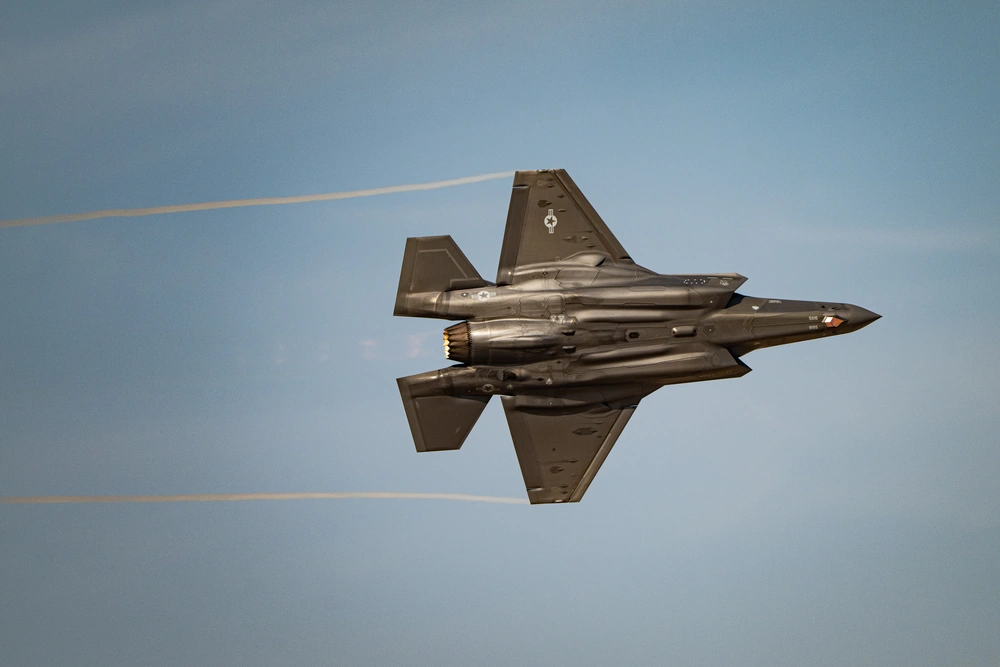
The U.S. has flown thousands of fighter sorties into Iran during the past few weeks. F-35s have been flying into the fight, striking targets, flying home, and then being re-armed to head straight back in again. And because of their stealth and survivability, they’re given the highest-risk mission sets with the highest likelihood of being engaged by enemy air defenses. So it shouldn’t come as a shock when that danger manifests itself.
What is surprising, however, is that – if the footage is real – the F-35 apparently tanked a direct hit from some sort of guided missile and was able to continue flying all the way to a friendly air base.
The interceptors launched by Iran’s long-range air defense systems, like the S-300s or the domestically built Bavar-373s, carry blast fragmentation warheads that range from 330 to 440 pounds – that’s roughly the equivalent of 16 to 22 Sidewinder missiles. If one of them managed to hit an F-35, even if just the blast reached the F-35 via proximity fuse, it would completely destroy the jet.
It’s also important to note that the F-35 in the footage does not seem to take any evasive action nor employ any missile countermeasures. And that could shine at least some light on how the aircraft may have been targeted and why it managed to survive.
The footage suggests that we’re looking at a relatively small, short-range infrared or electro-optically guided weapon, like those employed by Iran’s Majid air defense system. This is a truck-mounted short-range air-defense system that uses electro-optical sensors, rather than radar, to identify and track targets. It’s capable of engaging aircraft at reported distances of eight kilometers, or about five miles, and can reach targets flying as high as nearly 20,000 feet with its AD-08 interceptors. Once launched, the AD-08 uses an infrared sensor to close with the target’s heat signature, delivering a roughly 30-pound blast fragmentation warhead at speeds greater than Mach 2. That places its explosive power between America’s smaller Sidewinder and larger AMRAAM air-to-air missiles.
Related: Why media coverage of the F-35 repeatedly misses the mark
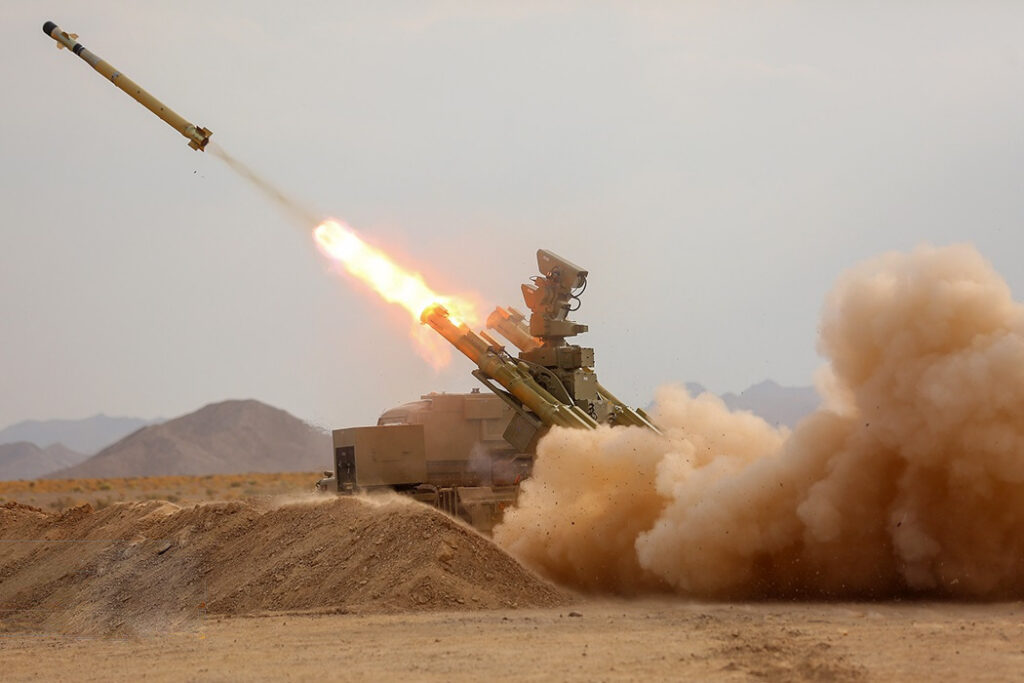
If the F-35 was flying low enough at the time (below 13,000 feet or so), it’s also possible that it could have been hit by a Man Portable Air Defense System, or MANPAD, like Iran’s Misagh-3, which can reach targets out to five kilometers (a bit more than three miles). These weapons use a combination of laser designator and a weapon-borne infrared seeker for guidance, with the goal of making them more effective against countermeasures like flares, but they also carry much smaller warheads, at just 3.3 pounds. So, while it seems less likely that such a weapon was used, it could explain why the F-35 was able to absorb the blast.
Both of these weapons and other similar systems all rely on line-of-sight, rather than radar targeting, dramatically curtailing their effective range, but making them very tricky to counter if they pop up right beneath a jet. Because they use passive sensors for targeting, there are no emissions to detect, so the pilot wouldn’t know a missile was coming until the fighter’s distributed aperture system detected the infrared spike of the launch, maybe a second or less before impact.
So, if this footage proves to be real, we have officially seen the first time an F-35 has ever been hit in combat, but we’ve also officially seen the first time an F-35 managed to make it home after absorbing a direct hit, seemingly proving that the stealth jet is a lot tougher than most would have thought.
Thus far in Operation Epic Fury, the United States has lost four crewed combat aircraft to friendly fire or mishaps, but none to enemy fire, and 10 or potentially 11 MQ-9 Reapers to Iranian air defenses. The risk presented by Iranian air defenses is likely to remain for some time to come.
Feature Image: A still frame reportedly showing an F-35 being hit by a IRGC munition. (X)
Read more from Sandboxx News
- Saab wants to future-proof the Gripen E through the power of software
- Could Delta Force retrieve Iran’s nuclear material?
- Over 200 Ukrainian anti-Shahed experts are helping the US and its allies deal with Iran’s drones, Zelenskyy says
- Sidewinder: The game-changing missile the Navy didn’t actually want
- When Delta Force came up with a new and unique flash-bang grenade