Lasers, or direct energy weapons, have long been the supposed weapon of the future: super-hot light with no recoil, little weight, and seemingly endless magazines. While we haven’t shrunk lasers to handheld blasters just yet, nevertheless, the U.S. military is considering and experimenting with direct energy weapons as counter-drone tools.
Miniature drones are extremely cheap, costing as little as $500. Firing a million-dollar missile to take down a $500 drone just doesn’t add up financially. Aside from price, missiles aren’t exactly small and easy to carry. Therefore, the U.S. military is looking at more affordable solutions.
Direct energy weapons provide an efficient cost-per-kill ratio and the capacity for firing rapid shots without the size and weight of missiles. Additionally, these weapons have a lower chance of causing unwanted casualties.
There are three distinct programs being fielded for potential counter-drone, or counter-UAS, use and they all share more or less the same idea.
HELIOS
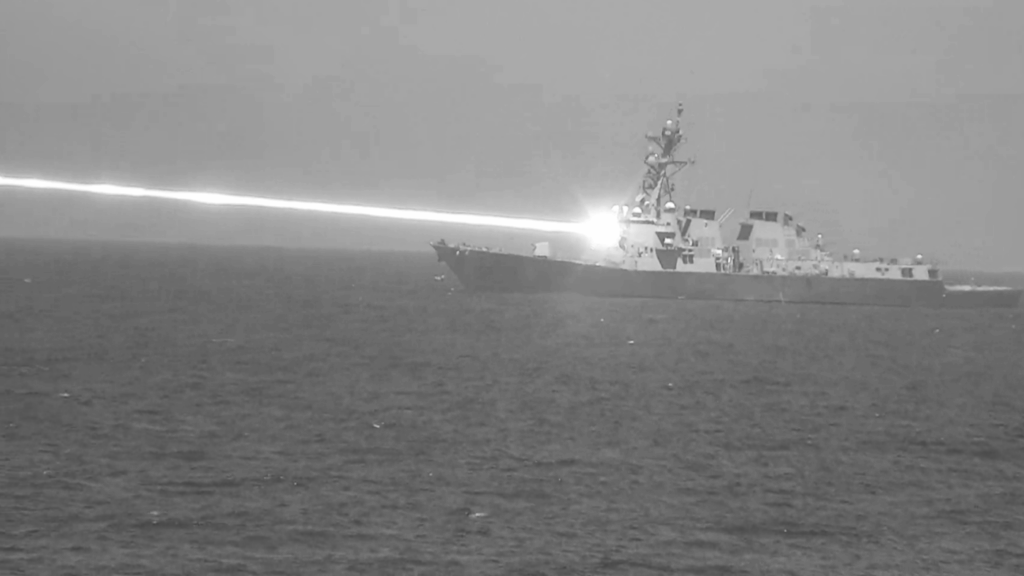
Lockheed Martin’s High Energy Laser with Integrated Optical-dazzler and Surveillance, or HELIOS, is one of the earliest experiments with direct energy weapons. This Navy program began in 2018 and its goal was to provide a shipboard system that could fire a laser that outputted between 60 and 120 kilowatts.
As of 2024, the power of the system has been greatly enhanced to 300 kilowatts. Under such power, HELIOS has a six miles range.
The HELIOS system is capable of intercepting missiles and drones. Its high-end optics allow for advanced surveillance at extended ranges and its advanced targeting systems allow it to actively track potential threats.
Further, the HELIOS can dazzle optical sensors, which renders the sensor useless and this, in turn, can potentially redirect a drone or smart munition. The HELIOS can also inflict direct damage through heat, which will fry components and send drones and missiles into the sea.
However, this system requires tremendous energy and runs solely on a ship’s power system. Rear Admiral Ronald Boxall, director of Navy Surface Warfare said that “The Navy will have to either remove something or look at ‘very aggressive power management.'”
DE M-SHORAD
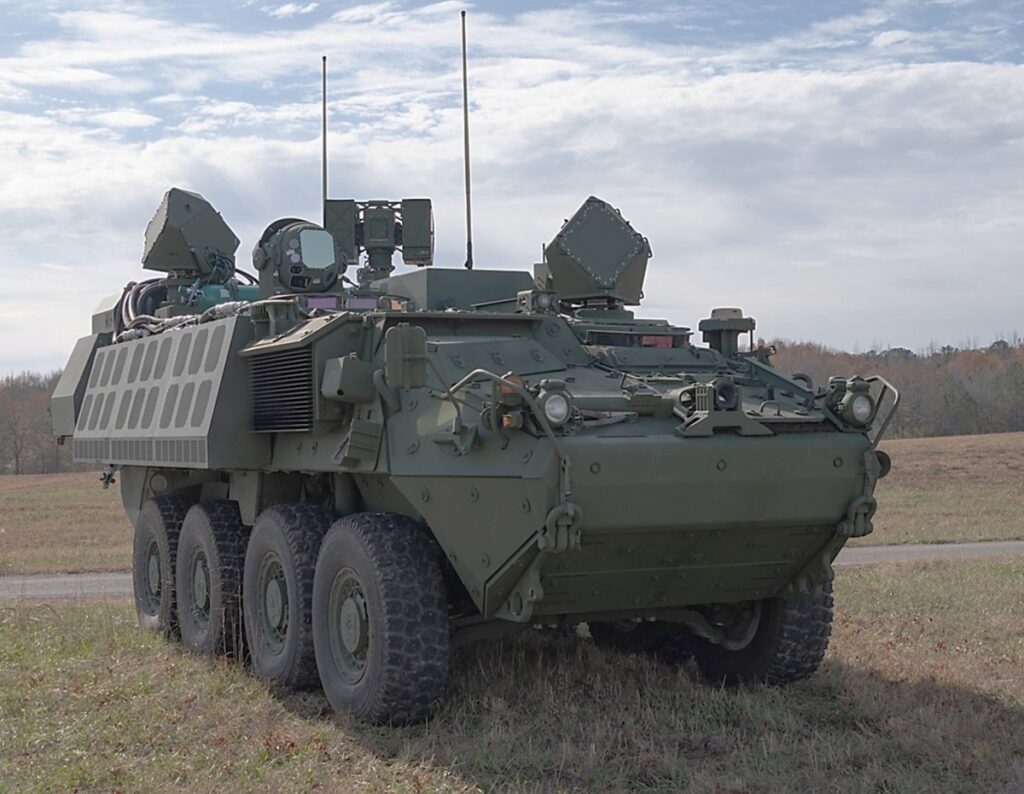
The DE M-SHORAD stands for Directed Energy Maneuver-Short Range Air Defense (the Navy wins the acronym contest). This device is a 50-kilowatt laser mounted on a Stryker vehicle. The weapon’s laser is powered by onboard diesel generators and offers counter-drone as well as counter-rocket, artillery, and mortar (C-RAM) capability.
The primary goal of the DE M-SHORAD is a C-UAS solution. It offers a low cost-per-shot tool for dealing with low-cost drones at an infantry level. Although it still requires an infantry fighting vehicle to function but provides mechanized infantry a layered defense supplemented by guns and rockets.
The system’s range will vary largely based on atmospheric conditions, but its effective range is stated to be between one and five kilometers, or 0.62 to 3.1 miles. There are four systems currently being fielded for use on Stryker vehicles and tested overseas. No conclusive data has been published on their utility.
Related: Army and Marines embrace kamikaze drones for ground combat
LOCUST
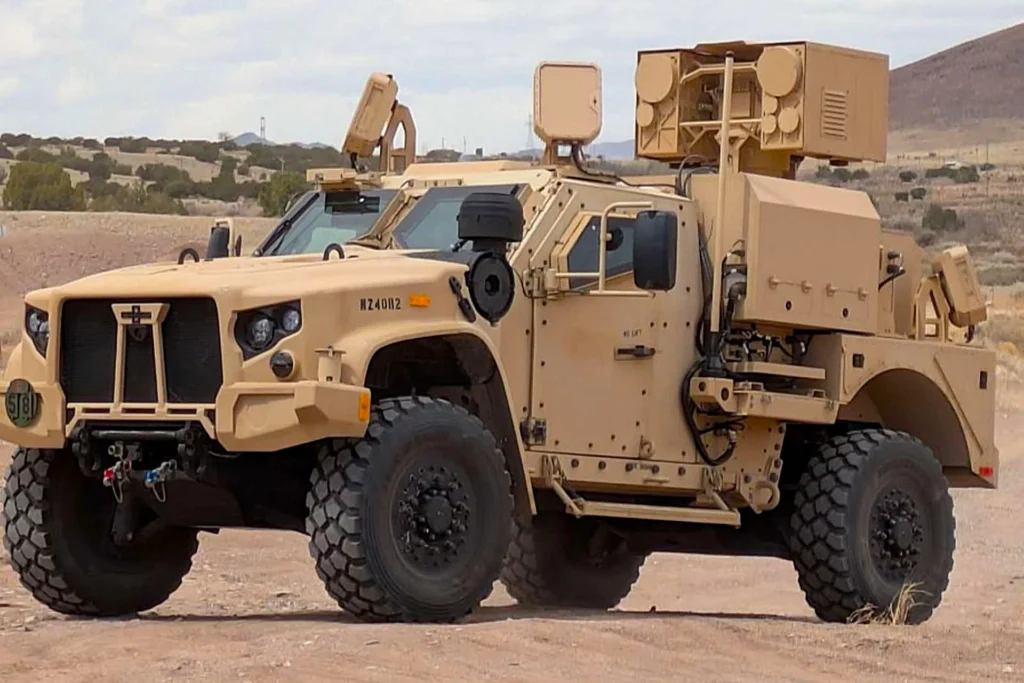
The LOCUST by AeroVironmment is a smaller 20kW laser system designed for direct support of infantry squads. This weapon can be mounted on vehicles like the Infantry Squad Vehicle and the Joint Light Tactical Vehicle. Although the 20kW laser offers less range and power, it improves portability.
The platform is designed to directly counteract Group 1 and Group 2 drones. Those are the small commercial, off-the-shelf drones and dedicated military surveillance drones respectively. Its maximum range is 1.5 to 3 kilometers, or about 0.9 to 1.8 miles, based on atmospheric conditions.
This system is designed to burn through drones, destroying their flight surfaces and internal electronics. Numerous other prototype platforms are being tested and fielded with the U.S. Army.
Challenges laser technology faces
Lasers could be the future of counter-drone weapons but there are still a lot of problems that the military will need to address.
The first and most obvious challenge has to do with power and thermal management. Laser weapons use immense power and that requires the appropriate power and cooling systems. In turn, those systems have to be sufficiently sturdy and allow for easy maintenance. However, cooling systems currently have numerous requirements and can be extremely bulky.
Additionally, laser effectiveness varies greatly based on atmospheric conditions, as rain, fog, dust, or similar effects can scatter the beam reducing its power and range. Further, tracking systems for hitting fast-moving objects, such as drones, will require extremely precise adaptive optics and software. This is where the integration of AI could become invaluable.
Lasers certainly have their problems, but I’d love to see the experiments continue. Anything that can stop drones gets a thumbs up in my book.
Feature Image: USS Preble firing its HELIOS laser. (U.S. Navy)
Read more from Sandboxx News
- How a teenager with a Cessna helped topple the Soviet Union
- Virtual reality has a place in the future of military training
- China has its eyes set on the Moon, but does the new space race matter?
- Heroism of The Hulk: A SEAL in Vietnam demonstrated the true meaning of valor
- Delta man’s showdown against a bully at Wendy’s