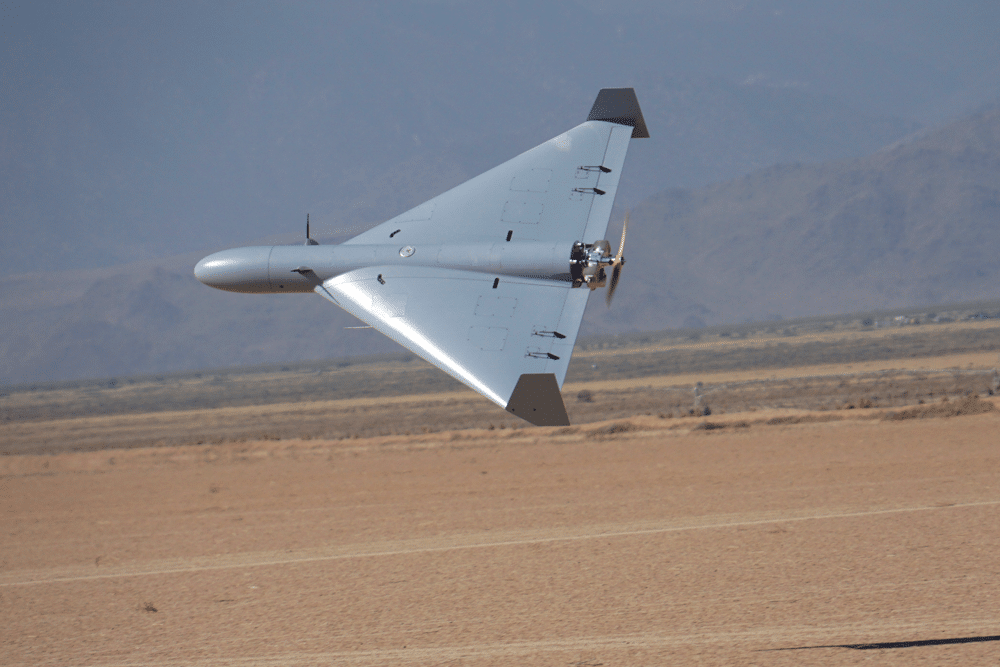
In an address to the world about Operation Epic Fury released on Wednesday, the commander of U.S. Central Command, Adm. Brad Cooper, made a simple but significant admission: the United States’ vaunted low-cost uncrewed one-way attack system (LUCAS) was a rip-off of an Iranian drone: specifically, the HESA Shahed 136.
“I’d like to point out that these drones were originally an Iranian design,” Cooper said in the five-minute briefing. “We took them back to America, made them better, and fired them right back.”
This hardly qualifies as a secret: much has been written about how the Phoenix-based unmanned systems company Spektreworks made the copycat attack drone, giving it a public debut in a static display for top defense officials in the Pentagon courtyard last summer.
“Reverse-engineered for authentic threat emulation,” Spektreworks wrote of the system it called FLM 136.
“With a professional airframe, broad performance capabilities, and multiple launch options, it offers unparalleled mission versatility. Its large payload capacity, drop-in module compatibility, and multiple auxiliary bays ensure ongoing compatibility to meet your evolving needs,” the company had added.
However, the act is significant because it puts the U.S. in the unfamiliar position of copying another country’s weapons system, a trick right out of Iran’s own playbook – but also that of another top competitor: China.
These countries have turned reverse-engineering into an art form, with China coining a term for its practice of creating blow-for-blow copycats of American-made goods, both military and commercial.
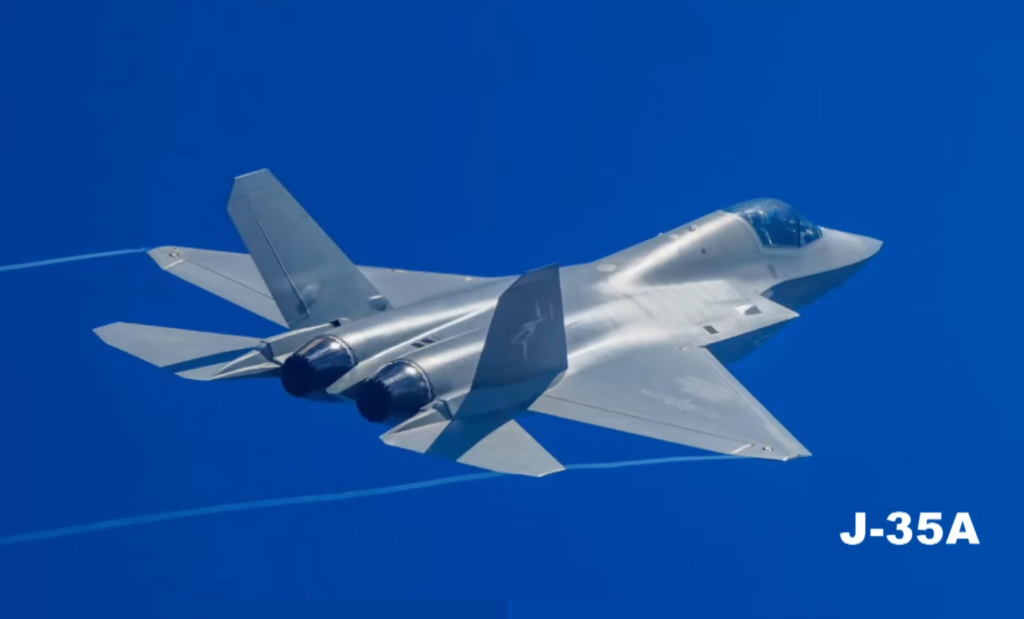
That term is “Shanzhai,” which means “mountain fortress” or “mountain stronghold,” and has been applied to everything from knockoff Nike flip-flops and Nokia cell phones to the Shenyang J-31 fighter jet. Despite being a twin-engine plane, the J-31 has often been referred to as an imitator of the F-35 Joint Strike Fighter due to its similar profile. More recently, China has rolled out its J-35A, an even clearer copy of America’s jet.
“It’s pretty clear,” then-Air Force Chief of Staff Gen. David Allvin told Air and Space Forces Magazine in 2024 about the F-35A. “You could put it side-by-side and see, at least, where we believe they got their blueprints from, if you will.”
China is authoritatively believed to have built its military clones – particularly those of the closely protected Joint Strike Fighter – through illicit activities including document stealing and other forms of spying. That’s significantly different than capturing a Shahed 136 on the battlefield, as U.S. defense officials said they did several years ago, and reverse-engineering it component for component.
As for Iran, it’s alleged to have cribbed the Shahed 136 design itself from various countries. The Ukrainian Defense Express news outlet published a visual breakdown of systems with the Shahed’s distinctive batwing design dating as far back as the German Die Drohne Antiradar (DAR) in the 1980s.
And back in 2023, the United Kingdom’s Conflict Armament Research investigative group found the Shahed 136, which has been used extensively by Russian forces in Ukraine, was powered by German motor technology stolen some two decades before.
That hasn’t stopped Iran from gloating at the U.S. for openly copying Shahed-136.
“There is no greater honor than seeing self-proclaimed superpowers kneel before an Iranian drone and copy it,” Iranian military spokesman Abolfazl Shekarchi reportedly said last December.
It’s not fully clear how the U.S. improved on the Shahed-136 to make LUCAS more effective and secure. CENTCOM officials have said they can be launched via catapults, with a rocket assist, or from vehicles. Imagery of a recovered LUCAS drone set off an online conversation among Russian commentators about the system’s apparent inclusion of an integrated Starlink terminal, prompting SpaceX CEO Elon Musk to respond and clarify that it runs with not Starlink but the government-operated Starshield, a separate network not under SpaceX control.
According to a spec sheet from Spektreworks, its FLM 136 is about three meters long and can fly for about six hours with up to 40 pounds of payload at altitudes exceeding 10,000 feet. Its cruise speed is 55 knots, about 63 miles per hour, while its “dash speed” is 100 knots, or about 115 miles per hour.
Related: Navy launches reversed-engineered Shahed drone
For the U.S., openly copying an adversary’s design is rare, but not unheard of. For example, in 2020, The National Interest recounted how the U.S. and its allies had reverse-engineered the Nazis’ V-1 “Buzz Bomb” cruise missiles during World War II to build the JB-2 missile, which was then deployed against Japan.
The Defense Department’s willingness to reverse-engineer an adversary’s drone now signals an increased interest in conquering the thorny problem of achieving affordable effects on target; enemy drones costing just a few thousand dollars have proved exceedingly capable at taking out expensive legacy weapons systems. Costing between $10,000-$55,000 apiece, LUCAS appears to be just the kind of “affordable mass” the Pentagon has been seeking.
We’ll soon see how U.S. officials apply lessons learned from LUCAS elsewhere on the battlefield and if they find other ways to exchange exquisite and custom-built systems for cheap and effective solutions.
“The U.S. looked at a weapon being used to devastate allies, recognized its strategic logic, and built a better version of it in under a year — at a price point that changes the economics of precision strike entirely,” Pete Modigliani and Matt MacGregor wrote at their Defense Tech and Acquisition Substack. “That is not kneeling. That is learning.”
Feature Image: A LUCAS drone. (Spektreworks)
Read more from Sandboxx News
- American submarine sinks Iranian frigate and achieves Navy’s first torpedo kill since WWII
- F-35 gets its first ever air-to-air kill against a manned aircraft
- A Delta Force parachute saga
- France to send Charles de Gaulle aircraft carrier to the Mediterranean in response to ‘unstable situation’
- B-1 Lancers and B-2 Spirits are operating against Iran suggesting US has achieved air superiority