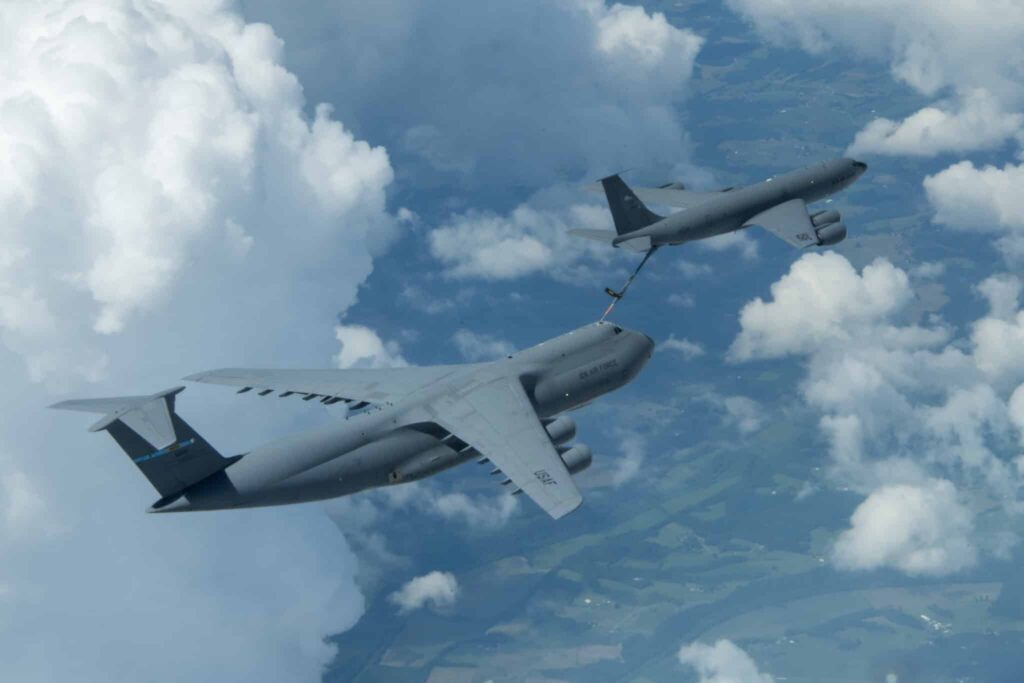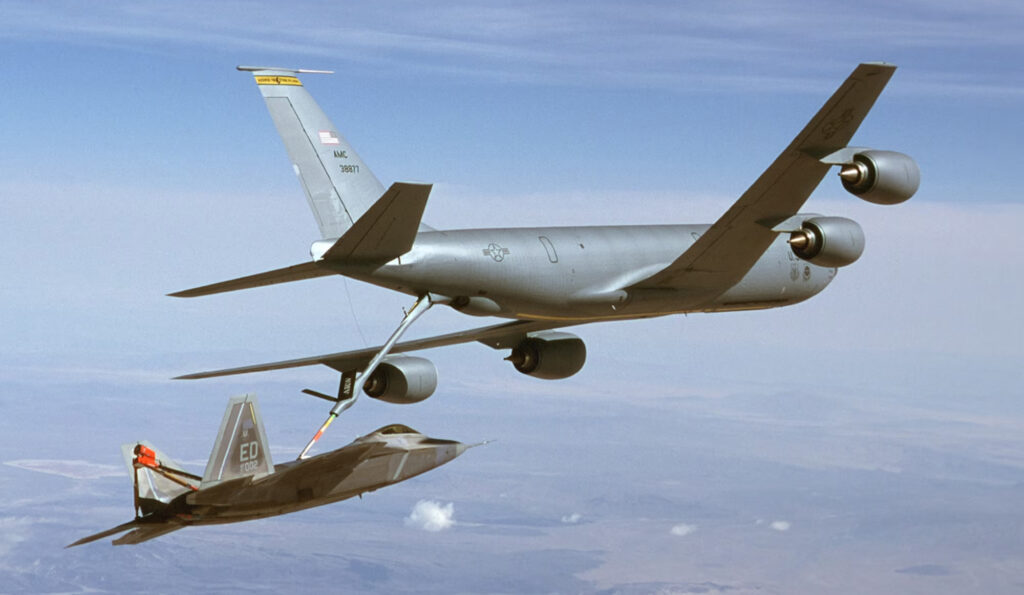
There are aircraft from every branch of the U.S. military that are capable of conducting air-to-air refueling. However, the method of refueling is completely different for Air Force platforms than it is for platforms operated by the U.S. Navy, Marine Corps, and others.
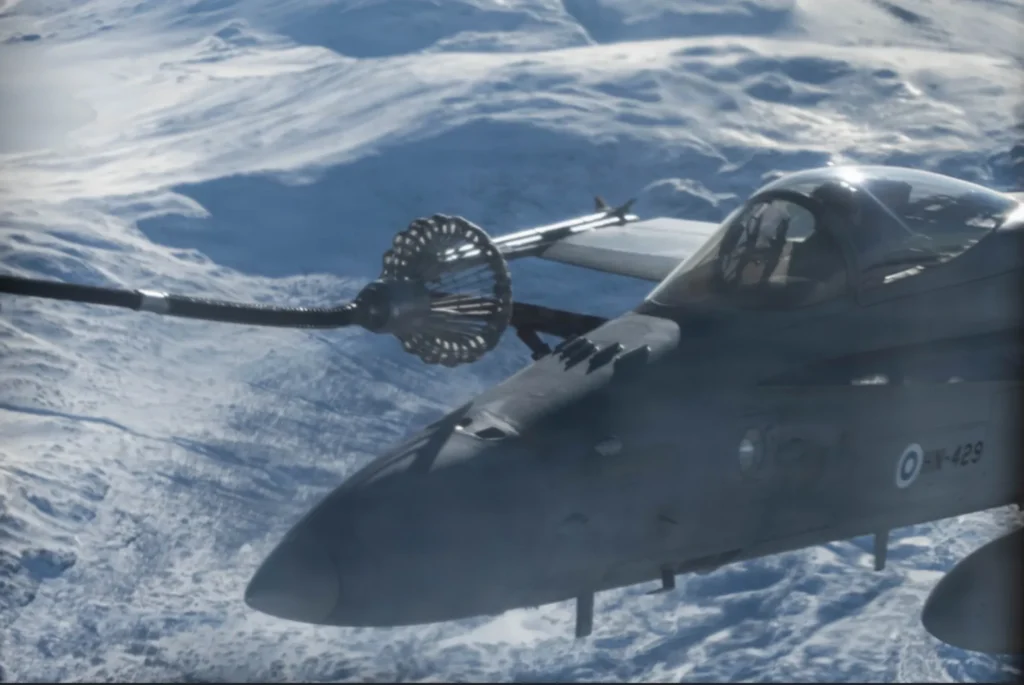
The Air Force uses what’s called a “BOOM” system, whereas the Navy, Marines, and even NATO allies all use the probe-and-drogue method.
And while that may seem inefficient, there’s a very practical reason why the Air Force adopted its more complex BOOM system.
The United States has led the world in air-to-air refueling since the process’ inception. The first mid-flight refueling was conducted by two U.S. Navy lieutenants in 1920. The two men dragged a rope with a grappling hook behind their Huff-Doland aircraft to snatch a five-gallon can of gasoline off a floating raft; they then pulled up the can and poured fuel into the fuel tank themselves.
Very quickly, that concept matured into the first aircraft-to-aircraft mid-flight refueling in 1923, when U.S. Army Air Corps personnel transferred fuel from one DH-4B biplane to another using a simple hose.
Today, more than a century later, the United States has the largest air-to-air refueling fleet on the planet by such a wide margin that there practically isn’t a number two. According to figures gathered by GlobalFirepower, roughly 90% of all refueling aircraft on Earth are operated by the United States, with 610 fuel-carrying airframes compared to Saudi Arabia (ranked second) with 22, Russia (ranked third) with 18, and China (ranked eighth) with just nine.
There’s more to air-to-air refueling than just connecting a hose from a tanker to the fuel tank of another aircraft, however.
One of the biggest factors that needs to be considered is fuel transfer rate, or the volume of fuel you can transfer in a set amount of time. This often isn’t a particular concern for fighters and most other types of tactical aircraft.
Yet, the fuel transfer rate is particularly pressing when refueling America’s globe-spanning fleet of strategic heavy payload bombers, since these aircraft are both fuel-hungry and utterly reliant on airborne refueling tankers to complete their long-range strike missions.
In order to support these kinds of jobs, the Air Force’s boom refueling system uses a rigid, telescoping tube that comes out of the refueling aircraft and is guided into a receptacle on the receiving aircraft by a boom operator inside the tanker.
This method requires a great deal of precision, and can only refuel one aircraft at a time, but it also allows for a much higher fuel throughput – as much as 6,000 pounds of fuel transferred per minute. This high flow rate makes it much more practical to refill jets like the B-52 Stratofortress, which can hold almost 48,000 gallons of jet fuel internally.
The Navy, Marine Corps, NATO allies, and even Air Force and Army helicopters, on the other hand, use the probe-and-drogue method, which sees the refueling tanker hang a flexible hose with a basket at the end, called a “drogue,” from the back of the aircraft. The receiving aircraft’s pilot then steers their aircraft, and the fuel probe sticking out of it, into that drogue to refuel.
This approach comes with several big advantages, including the ability to refuel more than one aircraft at a time. The probe-and-drogue method is generally considered to be a lot easier to learn and a lot more forgiving for pilots, reducing the chances of a tragic mishap.
This approach does, however, limit fuel throughput to a slower rate of only around 1,500 to 2,000 pounds of fuel per minute. This isn’t a big deal for modern fighters, which are broadly limited to a maximum fuel flow rate of around 3,000 pounds of fuel flowing in per minute, but at that rate, it would take well over two hours to refill the internal tanks of a B-52.
Modern tankers now carry adapters that allow them to refuel either type of aircraft for maximum interoperability, but the aircraft themselves are largely limited to only receiving fuel from the type of apparatus they were designed to accommodate.
Read more from Sandboxx News
- The USS Gerald R. Ford is breaking all the rules but strains begin to show
- Navy successfully tests JDAM version that turns the famous weapon into a long-range missile
- JPMorganChase positions itself as a prime financial player in America’s defense rebuild
- Will the B-21 Raider’s production run suffer the same fate as its predecessor’s?
- Delta Force’s ‘Bailey Blaster Door Charge’ blasted down more than its intended target