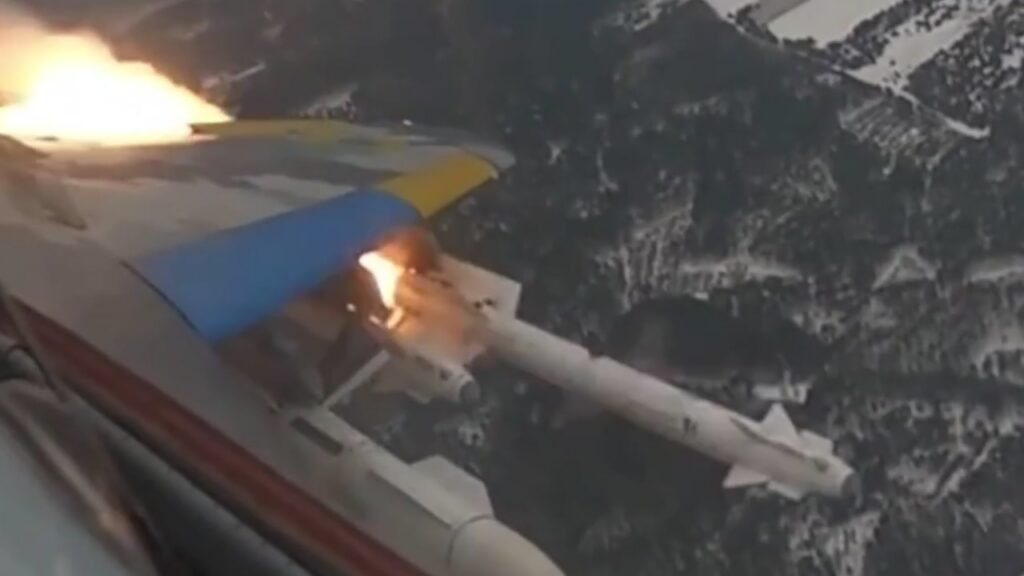
New footage that just surfaced online allegedly shows a Ukrainian MiG-29 going down near Odessa after an air-to-air missile caught fire on the aircraft during an attempted drone interception.
Based on the limited information available, it seems that this could be a hung store or hung missile incident.
A hung missile incident happens when the pilot hits the button to launch an air-to-air missile, the missile’s rocket motor ignites as it’s supposed to do, but the missile’s rail does not release the weapon resulting in the ignition happening next to the airframe.
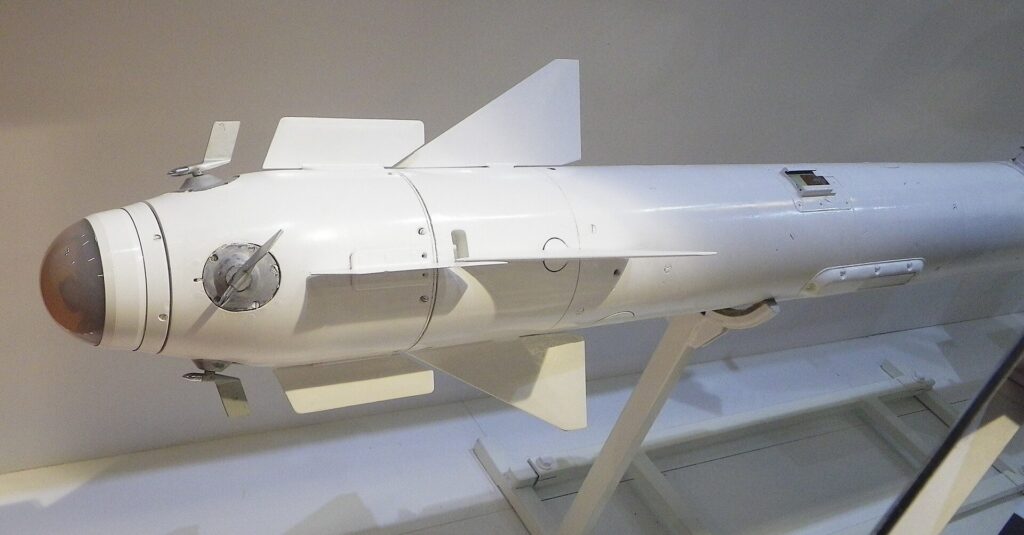
Ukraine operates a handful of different American and Soviet-era air-to-air missiles, but because MiG-29s have not been seen flying with American Sidewinders yet, it’s likely the weapon was a Russian R-73 short-range infrared-guided missile.
Technical details about these weapons aren’t as easy to come by, however, we know that the R-73 has a total weight of around 231 pounds, can push a 16-pound warhead up to Mach 2.5, and has a claimed range of around 19 miles. These figures suggests that the R-73 carries about 50 pounds of high-impulse rocket propellant – and that fuel would burn under the aircraft when the missile failed to release.
Additionally, the R-73’s rocket motor reportedly produces 14.3 kilonewtons of thrust, which shakes out to around 3,150 pounds of thrust; this would create asymmetric thrust, i.e. more thrust being applied to just one side of the aircraft. Although this isn’t enough to lose control of a MiG-29, it’s certainly something that will catch the pilot’s attention while he works through the emergency.
Further, depending on the type of rocket propellant used, the fire pouring out the back of the weapon can range from around 2,900 to 4,700 degrees Celsius.
The MiG-29’s aircraft-aluminum skin will lose a lot of its strength at around 250 degrees Celsius, and it’ll start to melt at 500 degrees. So, in the brief six seconds that R-73’s rocket burned, it produced enough heat to wreak absolute havoc on the airframe and any internals that were within a few feet of that heat source. In other words, a hung missile can, in the worst cases, be a lot like taking a blow torch to your fighter mid-flight.
And even if the aircraft’s manages to stay airborne, the problem is far from over. Hung stores are probably most dangerous during landing, because there’s a real possibility that the weapon finally will jostle loose when the landing gear touches down, potentially detonating or sending a live weapon skidding across the runway to ruin somebody else’s weekend.
No country releases missile failure data that’s specific enough to know how often a hung missile happens, but Sandboxx News has spoken to enough pilots, to know that, while not a common occurrence, a hung missile is certainly more common than most people might want to believe. For example, one of the U.S. Strike Eagles tasked with taking down Iranian attack drones in the Middle East back in 2024 had to white-knuckle a landing with a hung missile right in the middle of the fight.
Hard data on how often this happens is tough to come by, though, because, as dangerous as hung missiles can be, if everything goes well, you can just land and let some very stressed out ordnance guys deal with it. But if everything doesn’t go well… then you get footage like this.
Feature Image: A Ukrainian Mig-29 launches a R-73 air-to-air missile, January 2026. (Ukrainian Air Force)
- An Air Force robot made the C-17 part no vendor would
- Boeing will build Navy’s new missile kit that turns cheap bombs into long-range cruise missiles
- USS Minnesota returns home after months-long deployment in the Indo-Pacific
- Air Force’s plan to upgrade its 70-year-old B-52 bombers is billions over budget, watchdog finds
- Fore! Special operators parachuting into a golf course