As Operation Epic Fury against Iran wraps up its sixth month, the duration and cost of the fight is rapidly draining military resources. But it’s also delivering critical lessons about the realities of contemporary warfare and how to prosecute the fight.
This month, a panel of retired generals, former combat and bomber pilots, and aerospace experts at the Mitchell Institute for Aerospace Studies, an independent research organization, came together to brief reporters on what they’ve learned so far from Operation Epic Fury – and on the warnings the U.S. Air Force should heed since there is no clear end in the fight against Iran.
Bomber strength and stealth remain critical
Retired Air Force Col. Mark Gunzinger, a former B-52 Stratofortress bomber command pilot, said Epic Fury’s protracted air campaign – and the June 2025 Operation Midnight Hammer strikes on key Iranian nuclear facilities – proved both that the U.S. needed its bomber force, and that it did not have enough to fight today’s wars.
With the current B-21 Raider stealthy bomber still in development, the U.S. bomber “bathtub” of plunging supply and availability will last into the 2040s, he said, with fewer than 150 B-2 Spirit stealth bombers and only 76 B-52s left in the inventory.
Without enough B-2s in the inventory, the Air Force has had to resort to non-stealth B-1 Lancer and B-52 bombers to hit targets deep into Iranian territory, which “should also tell us the Air Force now does not have enough stealthy [sic] bombers to meet real-world operation requirements,” Gunzinger said.
“That’s why I characterize our nation’s bomber force as a raid force [that] simply cannot generate enough sorties [for a] conflict with a peer adversary, and that would cripple a future joint operation against China and Russia. [A]nd no other service can provide the weapons density at range needed to quickly [halt an] assault on Taiwan or stop invasion along NATO’s eastern frontier,” he said.
And stealth is a key component to controlling the battlespace and being able to strike deep without risking valuable assets and personnel, said Heather Penney, a former F-16 pilot and director of Studies and Research at the Mitchell Institute.
“We need to be able to have the strategic depth so we can continue to maintain the air superiority to execute those missions,” she said.
Related: Why does America keep relying on its 60-year-old B-52 fleet
Aircraft shortfalls are hurting pilot proficiency
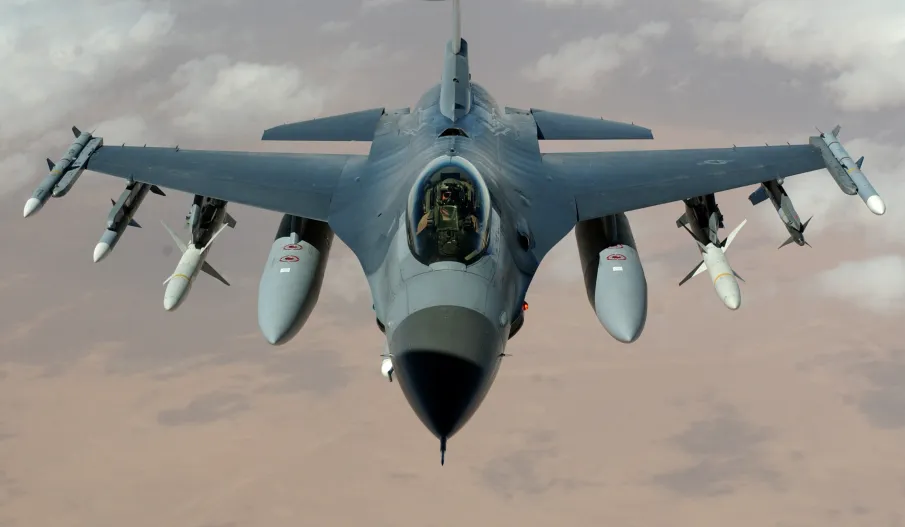
Well before the current conflict, shortfalls of U.S. fighter aircraft were well known. And as of May, at least 42 aircraft, including 17 manned aircraft, had been downed or damaged in operations against Iran; the number has since increased.
With a home station sortie requirement of nine per month and some 24 squadrons and 324 jets supporting Epic Fury, stateside pilots are getting short shrift when it comes to aircraft and flight time.
The jets committed to the fight against Iran represent about one-third of the Air Force’s combat-coded inventory, John Venable, a senior resident fellow at the Mitchell Institute, said.
“The last time the Air Force published any data on [the stateside sortie generation rate], it was around five and a half sorties a month, which is about 60% of what the pilots needed,” Venable said. “That has withered again in the last couple of years, and the Air Force has stopped reporting it.”
All that, he said, leads to healthy aircraft and pilots deployed forward, and poorly trained and ill-resourced ones at home preparing for the next fight.
“If you have ever seen the movie The Right Stuff, there is a scene where one of the astronauts is sitting in the capsule, and his line is, ‘Please, Lord, don’t let me mess up today.’ That’s the prayer of every fighter pilot who is flying once a week, much less once a month,” Venable said.
A new way of warfighting requires more missiles
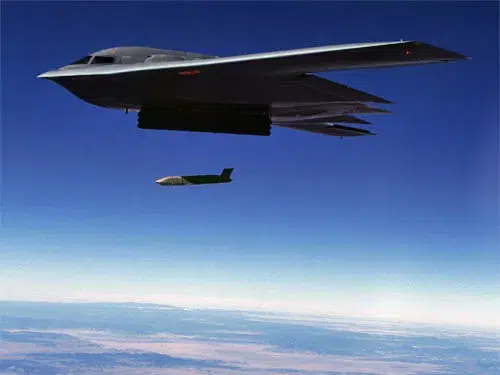
The trend of sending costly munitions to take out significantly cheaper targets in Iran stems from a risk calculation in which preserving human lives are paramount – and more carefully protected than they were in Vietnam and even the Gulf War, said Venable.
“We’re not overhead dropping cheap 500-pound bombs on vulnerable targets in Iran. We’re lobbing long-range weapons into Iran because we’re not overhead dropping cheap 500-pound bombs,” Venable said. “That’s where we’re supposed to be at this phase of this operation.”
The U.S. has not established air superiority due to unwillingness to put fixed-wing aircraft in deep over the fight, he said. And because of that, inventories of munitions like the Joint Air to Surface Standoff Missile and Joint Strike Missile are dropping troublingly low. As manufacturing pipelines adjust to the new needs and reality, delay could become an effective tactic for the enemy, Venable added.
“Time is a weapon,” Gunzinger said.
And change won’t happen immediately, Venable warned.
“It’s going to take industry a while to retool for different types of weapons to prosecute the kind of war that we seem to want to prosecute … We don’t want to take risk in this current conflict,” Venable said.
“We will sacrifice the [MQ-9] Reapers, the unmanned systems all day, and the stockpile of those weapons is being affected … So we’re in the situation now where, Iran’s playing for time because they don’t think we’re going to come and do what we should be doing at this stage of the operation.”
Related: Lockheed Martin and L3Harris team up to speed up critical missile production
Space is now in the front seat

As retired Space Force Col. Charles Galbreath noted, space is now part of air superiority as it’s never been before.
From the early U.S. non-kinetic strikes that took out Iran’s use of satellite imagery and comms to the hits that disabled ground-based GPS and satellite jammers, power from space has delivered key victories, he said.
But it also makes the U.S. vulnerable in new ways, he noted.
“As our application has evolved, so has our adversary’s response. Epic Fury also marked the first time an adversary has directly targeted and successfully attacked space assets in a conflict, which forced the application of resilience and new constitution measures by the United States,” he said.
“The resulting ramification of these rebounds is that space power is no longer just an enabler, nor immune from attack. It’s no longer in the back seat, only making others more effective. It’s in the front seat, taking decisive action and taking hostile fire. Achieving and maintaining space superiority is now more important than ever,” Galbreath added.
Planning for space, as with other domains, he said, must now consider requirements for a long-range conflict and asset losses, beyond planning for immediate combat needs.
While the conflict has revealed a number of troubling U.S. military vulnerabilities, it also, Galbreath said, “marks a key turning point in the evolution of space power employment and the role of [Space Force] Guardians.”
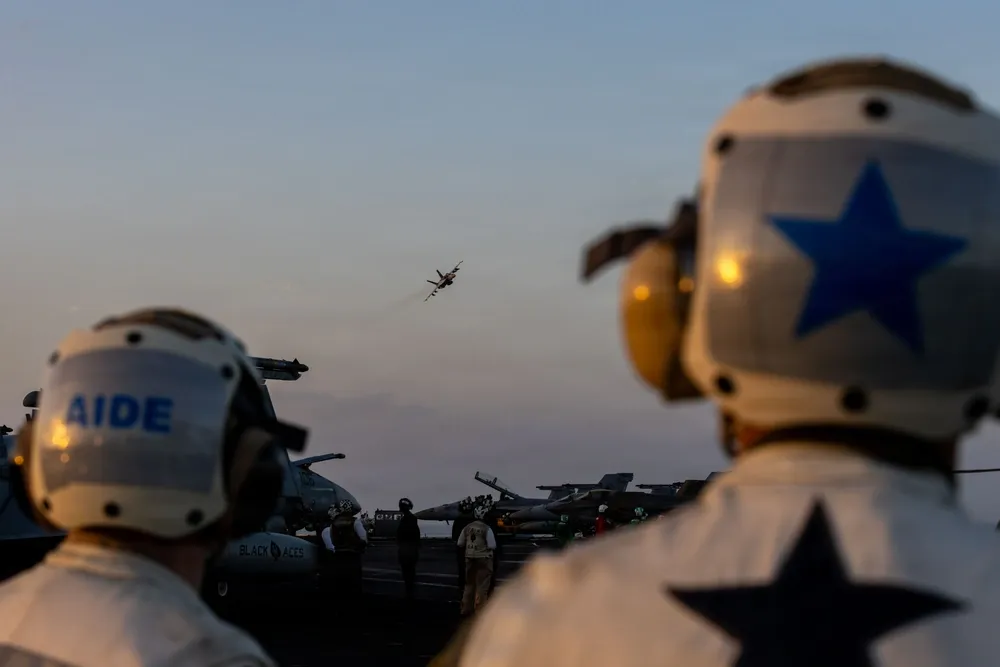
Feature Image: An F/A-18E Super Hornet, attached to Strike Fighter Squadron (VFA) 14, flies over Nimitz-class aircraft carrier USS Abraham Lincoln (CVN 72) during Operation Epic Fury, April 2, 2026. (U.S. Navy photo)
Read more from Sandboxx News
- Anduril is working to make its FQ-44 Fury fighter drone lethal against ground targets too
- SWCC are the Naval Special Warfare’s elite boat operators
- Some of America’s best fighters almost ended up having aircraft-carrier variants
- Anthropic says Russian and Chinese actors used Claude as weapons engineering assistant for drone swarming and more
- How Afghanistan released me from the guilt and shame I felt after 9/11