As supply chains get more strained and the distances between equipment depots and forward bases get longer, the Air Force Rapid Sustainment office is seeking information about kits it might send forward into the field to allow Airmen to assemble their own drones and counter-drone weapons.
A solicitation published at the end of July seeks information from would-be contractors about existing solutions for build kits and on-demand manufacturing capability for first-person view drones; counter-drone weapons and weapons components; and other “purpose-built attritable systems” for battlefield use. The interest is specifically in operating these systems in remote and austere environments, the document states.
“This will allow for the rapid, persistent, and distributed production of unmanned air systems near the point of need, reducing reliance on traditional supply chains and enabling forces to quickly replenish critical assets in contested areas,” the solicitation added.
The request for drone kits could turn Airmen into hobbyists in the field, with assembly processes that may be familiar to model airplane and train enthusiasts.
“Submitters may include concepts for effective assembly solutions to include but not limited to soldering, battery wiring, and motor assembly,” the request continues. “This capability is aimed at being as agile as possible, or to be drone agnostic but compatible with highly desirable materials commonly used in additive manufacturing.”
For drones, the interest is specifically in Group 1 and 2 unmanned aerial systems, which includes those up to 55 pounds. Few additional details are provided about the purpose of these “Expeditionary Unmanned Aerial Systems,” or eUAS, but missions in those size categories can range from surveillance and reconnaissance to loiter and attack.
The early-stage solicitation appears to acknowledge a push from among the services to increase the number of drones delivered and accelerate the speeds at which they are distributed to the fighting forces.
The Pentagon issued a call last December for more than 300,000 small drones to be produced and delivered to the military, at affordable prices, by 2028. The month prior, Army Secretary Dan Driscoll had set an even bigger goal, saying the Army would procure one million attack drones in the same timeline.
In June 2026, an Army brigade commander said the military should start thinking about drones the way it thinks about ammunition, citing a brigade burn rate of up to 1,500 drones per week while in combat or training operations.
And that is still likely just the tip of the iceberg. By 2025, in the war in Ukraine, the Russian and Ukrainian militaries were reportedly using 10,000 drones per day across the battlefield.
For its part, the U.S. Air Force is in the process of standing up small specialized counter-drone units intended to be able to deploy rapidly to the point of need. The demand for these units has become more pronounced amid conflict with Iran, in which enemy drone attacks have been a key contributor to military casualties and destruction of aircraft and equipment.
Related: Royal Navy pairs drones with manned helicopter for the first time
Potentially, having field assembly kits and point-of-need manufacturing processes for drones and counter-drone weapons could enable quicker dispatch of these teams and ensure they have enough of what they need and the ability to make more on-site.
The Air Force would also be taking a page from both the Ukrainian military and the U.S. Army in venturing into point-of-need drone assembly. Business Insider reported in February that Soldiers at the newly established Best Warfighter competition in Huntsville, AL., were encouraged to bring drones they had built or 3D-printed themselves to the event.
The Army’s new Advanced Unmanned Lethality Course, launched last year to train up drone operators and unit leaders, includes dedicated units on building and printing drone components, and aims to compile design files for all graduates to take back to their units.
“Eventually, we want students to build and test their own [first-person view drone] bodies,” Maj. Wolf Amacker, who heads UAS training and tactics at the U.S. Army Aviation Center of Excellence, said at the time.
“We’re teaching and learning from the force on what’s possible and how to sustain these systems in the field,” he added.
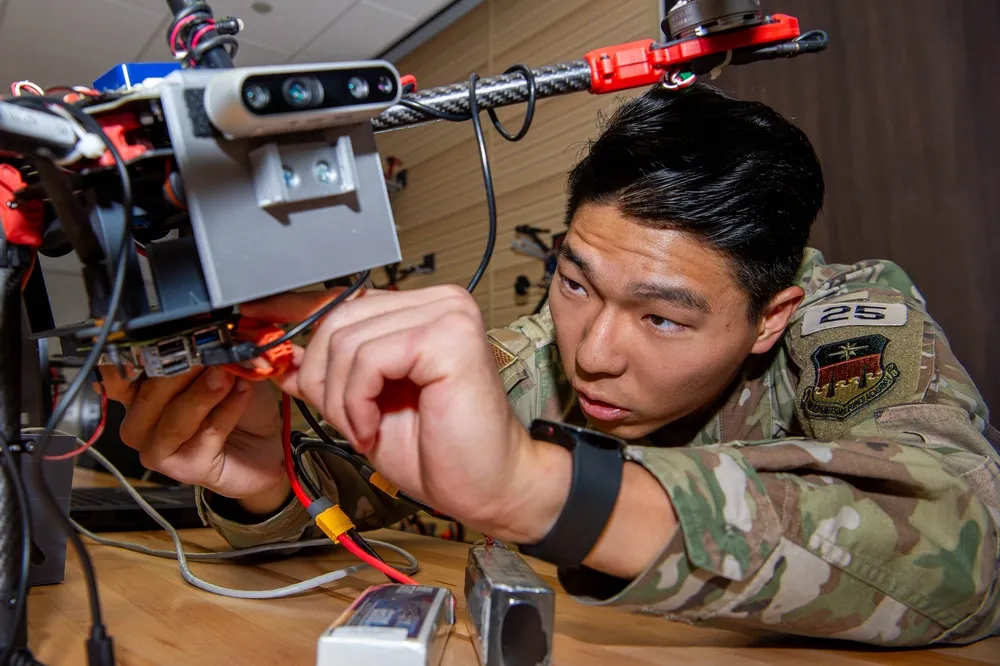
Feature Image: U.S. Air Force Academy cadet Junhyung Park works on an unmanned aircraft vehicle (UAV), known as a discovery drove, on Jan. 16, 2025. Cadet Park tested the drones algorithm’s in a simulation environment in preparation for an upcoming field test. (Photo by Dylan Smith/U.S. Air Force)
Read more from Sandboxx News
- Just how good would an F-22/F-35 hybrid fighter really be?
- Energy drinks were the unsung hero of the Global War on Terror
- How to get through Special Forces selection? Don’t be the ‘Grey Man’
- Navy reveals its new, low-cost hypersonic missile. And the Army is also interested.
- American brigade got destroyed by Ukrainian drone operators in exercise – and that’s a good thing