Marines have never been afraid to embrace aggressiveness, and the Marine Corps Doctrinal Publication 1: Warfighting is a testament to that. But don’t let its name fool you: MCDP 1 isn’t just for Marines; it’s something every servicemember and civilian can read and learn from.
MCDP 1 Warfighting isn’t a technical manual for warfare – it’s the foundational philosophy of the Marine Corps. It was popular enough that it leaked outside of the Corps, was reprinted in several languages for foreign militaries, and even published in the wider civilian market.
The key to the publication’s success is that it’s not a book of tactics or techniques, but instead aims to provide broad guidance through concepts and values.
I’ve recently begun rereading MCDP 1. I read it twice while I was in the Marine Corps and once since I left. Each time I’ve taken away something different from the book and I have applied it in different ways to my life in and out of the Corps. For that reason, I think, at the very least, every member of the military should read it, and if you want a different perspective on personal conflicts and actions, maybe you should too.
At only 150 pages, MCDP 1 is a fairly short read. It is available for free as a PDF file from the Marine Corps. It’s is broken into four chapters: Chapter 1 – Nature of War; Chapter 2 – The Theory of War; Chapter 3 – Preparing For War; Chapter 4 – The Conduct of War .
The most relevant audience of the MCDP 1 would be for the combat arms MOSes and their leaders. However, you can still apply its lessons and philosophy to most challenges you want to overcome and goals to achieve within the military and even outside of it.
There are five lessons I’ve learned from MCDP 1 that I carry with me throughout my life.
Friction
Chapter 1 focuses on the fundamental core of war and discusses friction, uncertainty, fluidity, disorder, the human element, and more. MCDP 1 looks at all those concepts from a high-level and a warfare angle. While they are all worth reading, friction is my favorite lesson from this chapter.
Friction is unavoidable and it doesn’t mean you’re failing if you experience it. Do not focus on the friction like it’s a personal attack; approach it as something you have to overcome. Friction should never prevent action. A broken radio makes communications more difficult, but the mission continues. A flat tire shouldn’t prevent you from getting a workout in.
We have to overcome friction. At the same time, we have to expect friction and accept that it is a part of life.
Initiative
MCDP 1 clearly espouses taking action. “Paralysis by analysis” is a very real thing, and it can delay us from taking action. This isn’t an endorsement for recklessness and taking initiative doesn’t mean charging into the fog of war blind.
Instead, you have to use the intel you have to make a decision and act. You then adapt to the consequences and act again.
MCDP 1 proposes the 70% solution: making a decision that’s 70% correct now is better than making a 100% correct decision later.
Taking the initiative makes the world react to you instead of you reacting to the world. In warfare, you’re putting the enemy on the back foot, forcing them to adapt rapidly to your actions. In life you might not have an enemy, but analysis paralysis can still happen and taking action can still be decisive.
You don’t need the perfect plan; it’s better to have a good plan that you act on now instead of a perfect plan you execute next month.
Related: Advice on self-discipline from an F-35 pilot instructor
Training
You won’t find resilience in the middle of a crisis. You can reveal the resilience you’ve built through training, education, and preparation.
When you’re not at war, you’re preparing for war. You can apply that to a variety of first-responder jobs, from police to firefighting to EMT work.
If you’re involved in any form of competition, preparation is what you’re doing when practicing. If you want to get ahead in your career, then you can’t just keep doing the same thing.
Prepare, educate, and train for what comes next, be it war, a competition, or promotion. Initiative and boldness are traits to be praised, nurtured, and grown.
Lead by intent
MCDP 1 places a large focus on commander’s intent.
If you’re a leader, you shouldn’t have to micromanage. Micromanaging takes too much time and effort and is, at best, inefficient. Instead, leaders should lead by intent, and a commander’s intent shouldn’t focus on the how a task is completed.
Instead, a commander’s intent focuses on the why: Here’s the goal, and here’s why it’s important. The how is left up to the folks on the ground floor of the problem. At most, a commander or leader should establish the boundaries.
This method of leadership helps foster trust, gives your team the ability to be creative, and prevents bottlenecks.
Related: Air Force to build realistic training ranges to enhance its Basic Military Training
The schwerpunkt
“Schwerpunkt” is a funny word which translates to “the focal point.” It’s the single most critical point in which you should focus your effort. The skill one has to develop is finding the schwerpunkt. Identifying it can require collaboration and intel. Further, that point may change as the situation develops.
You can’t focus on everything equally; if you do, you’ll just perform a lot of different tasks cursorily. You will become overstretched, and in warfare this leads to half measures that allow the enemy to react accordingly and with greater ease.
In life, you have to stop treating every item on a to-do list with the same weight. You have to identify the tasks that will have the biggest impact on your day and focus your attention on them. Once those tasks are accomplished, move on to the next, and do the same. Eventually you’ll either receive more important tasks, or time to focus on those minor tasks.
I think MCDP 1 is useful for everyone. I’m not the first to say this, and won’t be the last. The fact that it’s free, easy to find, and short eliminates any excuses not to read it. There are plenty of lessons you can take from MCDP 1 for warfare, but plenty for life too.
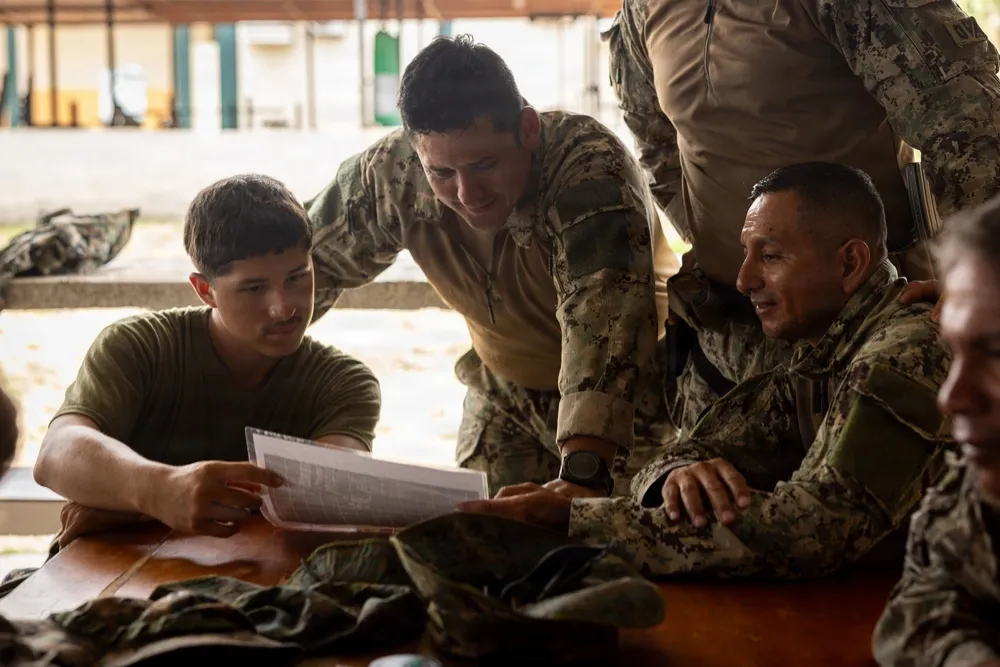
Feature Image: A U.S. Marine with Light Armored Reconnaissance Company, Battalion Landing Team 3/6, 22nd Marine Expeditionary Unit (Special Operations Capable), and Ecuadorian Marines plan for a simulated raid during a bilateral exercise on Naval Base Jaramijó, Ecuador, April 30, 2026. (Photo by Staff Sgt. Nathan Mitchell/22nd Marine Expeditionary Unit)
Read more from Sandboxx News
- Navy used reconnaissance sea drones to sink 820-foot warship
- Army is using AI to help better train special operations medics
- Stuxnet unleashed upon Iran: The tactics behind the world’s first cyberweapon
- Deep-diving into Anduril’s new Thunder tilt-rotor, attack drone
- ACE operations: Deploying in theater is half the fight