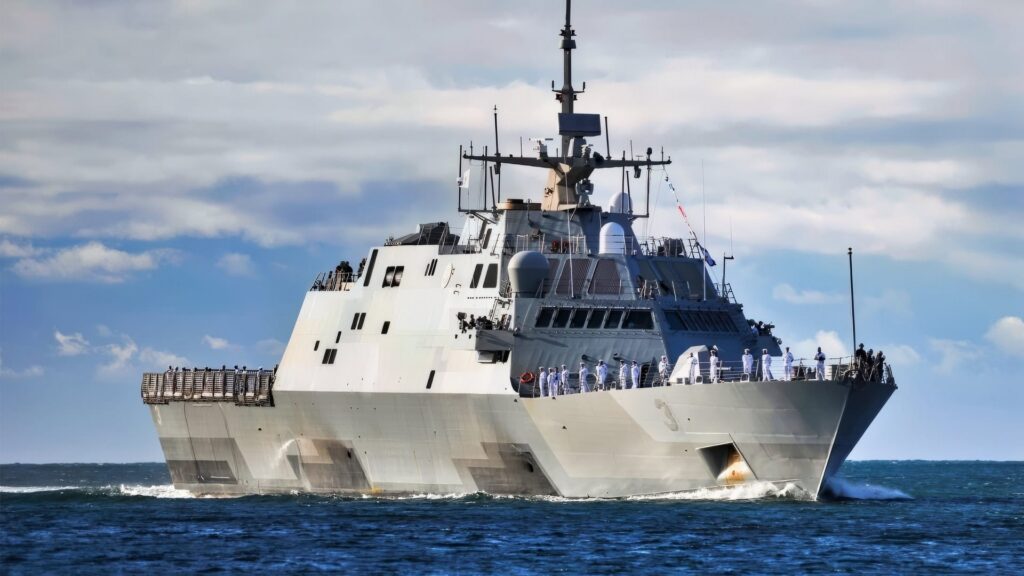
The U.S. Navy commissioned USS Cleveland, the sixteenth and final Freedom-class littoral combat ship, on May 16. Ten weeks later, on July 29, it decommissioned USS Fort Worth, a sister ship barely 14 years old, at Naval Base San Diego.
The class has been shedding hulls early for years now. Fort Worth was the sixth Freedom-class ship retired ahead of schedule, joining Freedom herself, Detroit, Milwaukee, Sioux City, and Little Rock.
What deserves attention in 2026 is the timing. The Navy only just finished building the 16-ship class it has already spent years quietly dismantling.
That’s the detail worth pausing on, and it isn’t the one getting the attention. The easy version of this story writes itself, and most of it is true.
Something north of $20 billion for a class of ships that cost far more than promised and delivered far less than justified the price: an anti-submarine warfare module the Navy moved to cancel in 2022, amid gear failures that halted Freedom-variant deliveries for months.
None of that is wrong, and I’m not going to spend this column arguing it away. What I want to spend it on is what the Navy did with the lesson LCS was supposed to teach it. That lesson has already been tested once more, and another test is about to start.
The Littoral Combat Ship’s real legacy was never the hulls themselves. It’s the acquisition habit the program exposed, and whether the Navy can hold on to the fix now that it has finally said out loud that it understands the problem.
What the Navy actually promised
Go back to the program’s original premise from 2002, the one the Government Accountability Office summarized this way.
The original case for LCS wasn’t modularity or 40-knot sprint speed, though those got the press. It was cost and schedule, and the mechanism for achieving both was spelled out plainly: leverage existing designs for reduced cost and rapid fielding.
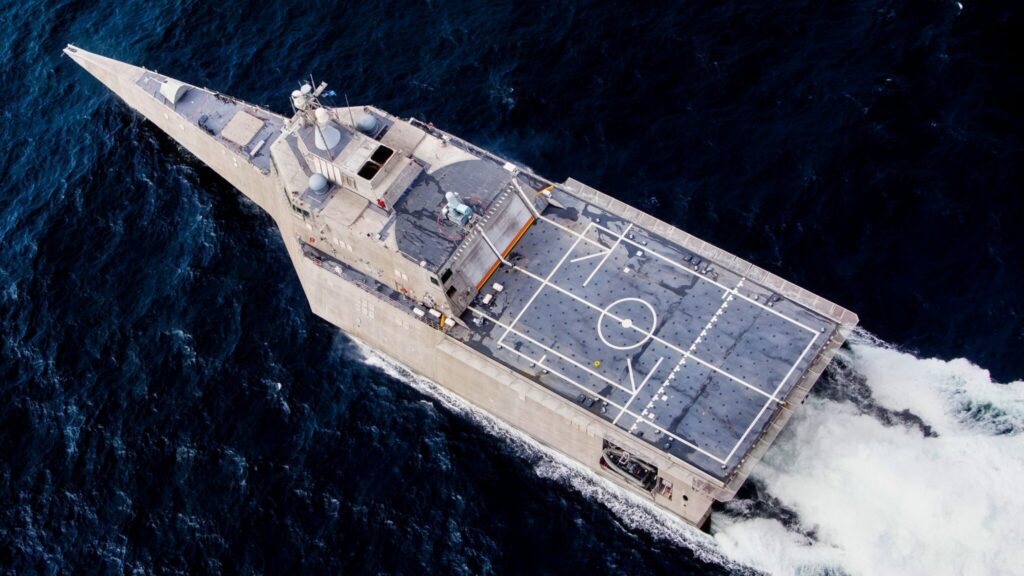
Both seakeels were adapted from commercial designs: the Freedom variant from a semi-planing monohull family, and Independence from Austal’s aluminum trimaran ferries. Neither met full naval survivability standards.
A ferry didn’t need to be. Then the Navy asked them to become warships.
Combat systems and survivability requirements no ferry was built for got layered onto hulls never meant to carry them.
The schedule and cost advantage “existing design” was supposed to buy got eaten alive by the conversion. The acquisition shortcut LCS was built on consumed itself.
The conversion cost the schedule and money it was meant to save. It’s worth noticing how familiar the language sounds now. “Existing design.” “Proven.” “Leverage.”
All three of the Navy’s last small-combatant programs opened with some version of that vocabulary, across 23 years. The words never changed. What happened after each announcement did, twice.
Constellation inherited the habit
If LCS left the Navy anything usable, Constellation was the first place to find out whether the service had picked it up.
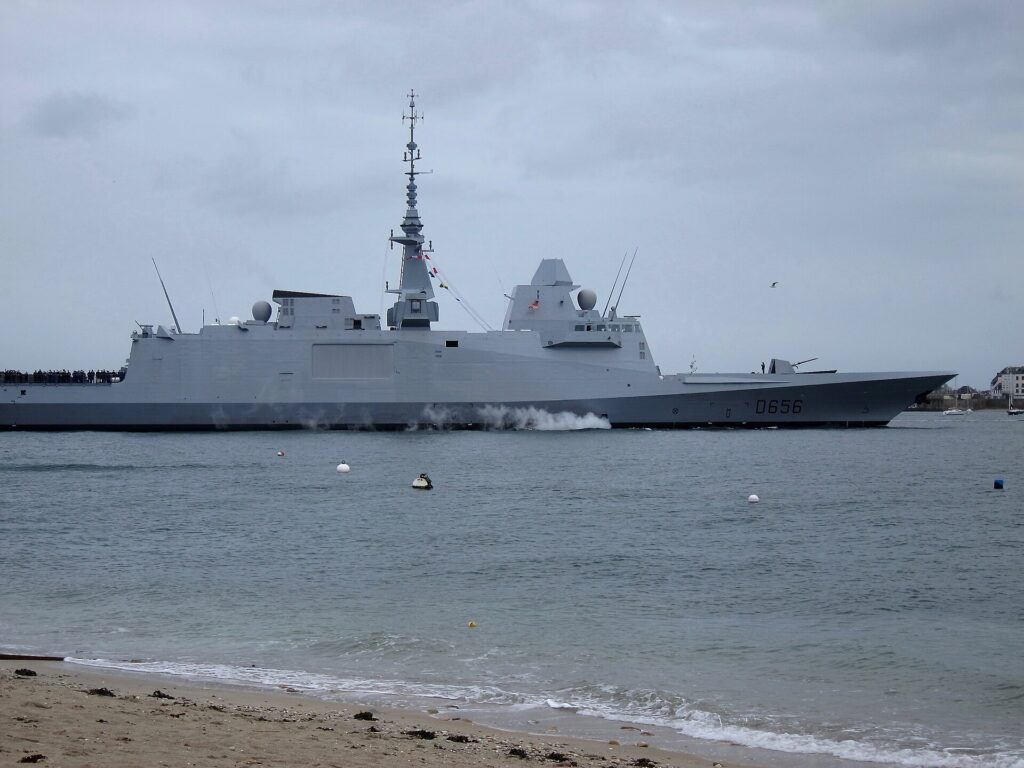
When the Navy went looking for a frigate in 2020, it chose a mature, combat-proven parent design, the Franco-Italian FREMM, in service with two allied navies.
Marinette Marine got the contract on the explicit understanding that starting further along the curve meant the old mistake wouldn’t be repeated. It repeated anyway, just differently.
The Navy allowed Fincantieri to begin cutting steel on the lead ship in August 2022, before the functional design was locked.
Three years later, in September 2025, the Government Accountability Office found the design still only 87% complete: commonality with the FREMM parent had fallen from a planned 85% to roughly 15, and the Navy’s requirements were spelled out across more than 500 design documents.
Weight grew by at least 759 metric tons. In November, the Navy terminated four of the six ships under contract.
LCS broke, converting a commercial hull into something survivable. Constellation broke because a complete, proven design kept getting modified faster than it could settle.
Different mechanisms, same failure: they couldn’t keep the design stable once construction started. That pressure broke both programs in different ways, and it’s the pressure FFX now has to survive.
Related: The Navy may never build any Constellation-class frigates
The Navy says it finally learned
Constellation showed the lesson had been half learned. FFX is the test of whether the Navy has learned the rest of it.
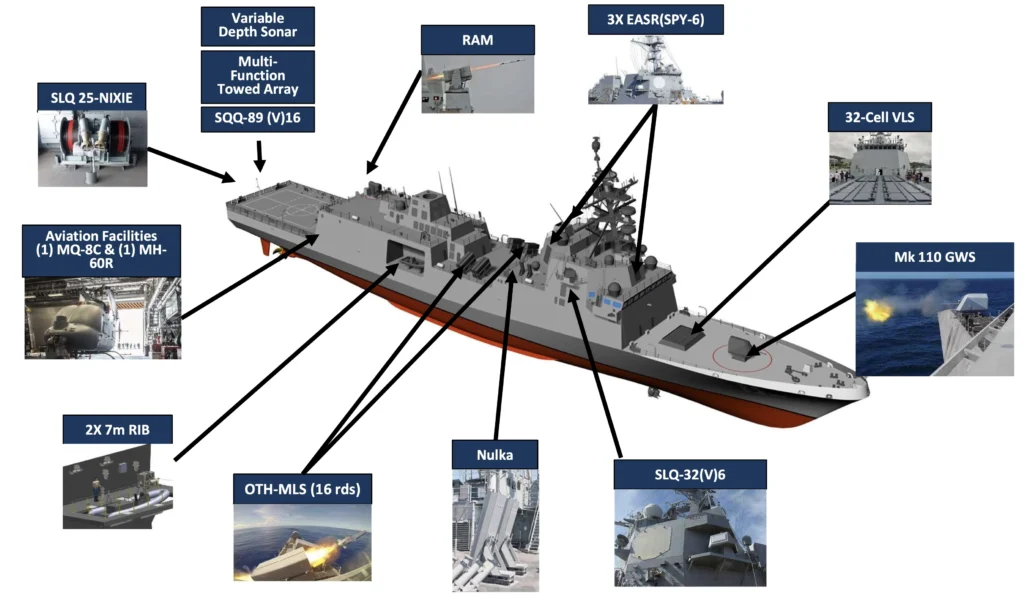
In December, the Navy announced what comes after Constellation: a new frigate built on the Huntington Ingalls Industries-built Legend-class National Security Cutter, a design the Coast Guard has operated since 2008, with 10 hulls in service.
Secretary of the Navy John Phelan called it a “proven, American-built ship” that has been protecting U.S. interests at home and abroad.
Chief of Naval Operations Admiral Daryl Caudle put it more bluntly: the Navy’s small surface combatant inventory, he said, is a third of what it needs.
A month later, at the Surface Navy Association’s January symposium, Phelan went further. “We learned the lesson of ever-changing requirements and open-ended designs,” he told the room. “This time, integration is deliberate, finite, and executable.” He talked about “locking in designs earlier” and “enforcing disciplined requirements.” It’s the correct diagnosis, the same one an outside critic would offer him.
There’s a complication. Phelan no longer has to deliver on it. He left the administration on April 22, just over four months after the announcement, and Under Secretary Hung Cao has served in an acting capacity since.
The man who made the promise isn’t the one who has to keep it.
What locking in actually requires
FFX starts from a hull already built in series, sidestepping the structural improvisation that sank LCS. It doesn’t sidestep conversion risk altogether.
The Legend-class was built to a Coast Guard survivability standard, the lowest tier the Navy uses, short of what a frontline combatant needs.
Flight I’s answer, for now, is Navy weapons and communications systems, a new weapons station where the boat ramp used to be, and standard Navy gray paint.
Vertical launch cells and anti-submarine gear are being considered for later flights, the same approach the Navy uses to spread upgrades across the Arleigh Burkes.
That’s what the last two programs got wrong, and what will decide this one. Somewhere between now and 2028, when the first hull is due in the water, somebody in the fleet will want a capability that isn’t in the current spec.
A sensor. A weapon. Expanded air-defense capability beyond Flight I’s point-defense fit.
The test isn’t whether the Navy changes nothing. No warship program works that way.
It’s whether new requirements are allowed to destabilize the baseline once construction begins, or are deferred to the later flights the Navy says it’s planning for.
Caudle’s number, a third of what the fleet needs, is the reason nobody can afford to let this one drift into another redesign. The fleet doesn’t have that kind of time to spare.
If FFX reaches the water on time without its baseline coming apart, the Navy may finally have learned what the Littoral Combat Ship spent twenty-three years teaching it.
Editor’s Note: This article by Andrew Latham was originally published by 19FortyFive.com.
Feature Image: The littoral combat ship USS Fort Worth (LCS 3) arrives to Joint Base Pearl Harbor-Hickam for a scheduled port visit. (U.S. Navy photo by Mass Communication Specialist 2nd Class Diana Quinlan/Released)
Read more from Sandboxx News
- Marine Corps document points to autonomous robots, drones, and basic soldiering skills for Marines’ future
- ‘Time is a weapon:’ Former fighter, bomber pilots deliver report card on Operation Epic Fury
- Anduril is working to make its FQ-44 Fury fighter drone lethal against ground targets too
- SWCC are the Naval Special Warfare’s elite boat operators
- Some of America’s best fighters almost ended up having aircraft-carrier variants