When political and military leaders talk of putting “boots on the ground,” it signifies that combat forces will be deployed to a key geographical area in order to gain military or strategic advantage. But such terminology might become woefully out-of-date soon, as future boots won’t be anywhere near the ground. Instead, militaries will be deploying assets to what is sure to become one of the more important strategic areas in future military conflicts: space.
We are not talking about Star Wars-style ship-to-ship laser battles in outer space here. The fighting will continue to take place primarily on the surface of the Earth, but it will undoubtedly expand out to (inner) space, as well. In this way, by “space,” we mean the orbital domain just past the Earth’s atmosphere, where satellites are positioned and operate.
This area is becoming ever-more strategically significant because greater numbers of satellites are being put into space all the time. These satellites facilitate and enable everything from communications, to intelligence gathering, to navigation, to identifying and targeting, to possibly even launching space-based weapons against Earth-based assets.
It is no surprise that the U.S. stood up its Space Force in 2020, transitioning what was previously an Air Force subordinate command into its own branch of service, co-equal to the Army, Air Force, Navy, and Marines.
There has long been a recognition by governments across the globe that military operations in space will become more and more strategically significant. Those operations look set in the coming decades to be both defensive and offensive in nature.
In terms of defensive space-based operations, perhaps the most ambitious plans are those of American President Donald Trump, for the so-called “Golden Dome.” In essence, this is a combination of the Israeli “Iron Dome” program and the 1980s Reagan-era program called the Strategic Defense Initiative (SDI), which was known colloquially as “Star Wars.” While Iron Dome focuses on defending Israel against short-range rockets and artillery, and SDI focused on intercepting intercontinental ballistic missiles, the Golden Dome program looks to do both things, and more.
Related: Dogfighting in space? Not too far-fetched, Space Force chief says
Golden Dome, in theory, would protect against hypersonic, cruise, and ballistic missiles, as well as possibly even large and small unmanned aerial vehicles (UAVs), if the program is funded and built-out to its full capabilities. At the heart of it, though, would be hundreds of space-based sensors – satellites – coupled with kinetic interceptors and directed-energy weapons. If funded and executed, the program would involve launching hundreds more satellites into space than the number currently clutter the orbital realm.
Meanwhile, offensive operations in space also look to be on the rise, as addressed recently in an article in The Economist entitled Military Competition in Space will Intensify that focuses on coming global trends. The article mentioned SpaceX’s capacity to launch ever more satellites into orbit, which is critical to any effort to maintain a capability in space operations, and also touched on examples such as Britain’s announcement this year that it would develop “counter-space” capabilities which include attacking and/or disrupting satellites.
The French are also starting to act offensively in orbit, namely through a recent “rendezvous and proximity operation” (RPO) – in coordination with the United States – against what was suspected to be a Russian satellite. This essentially means that a French satellite approached a Russian one in orbit and then maintained a position in proximity to it for some unspecified amount of time. Such a maneuver could obviously be used in a future orbital attack operation against Russian or other enemy satellites. The U.S. and China have also reportedly undertaken such RPO maneuvers against one another in the past, according to The Economist.
While military operations on land, sea, and in the air have dominated throughout human history, we might be seeing soon a rise in operations off-world, where militaries battle over control of the orbital realm. Maybe Star Wars is not so far off, after all.
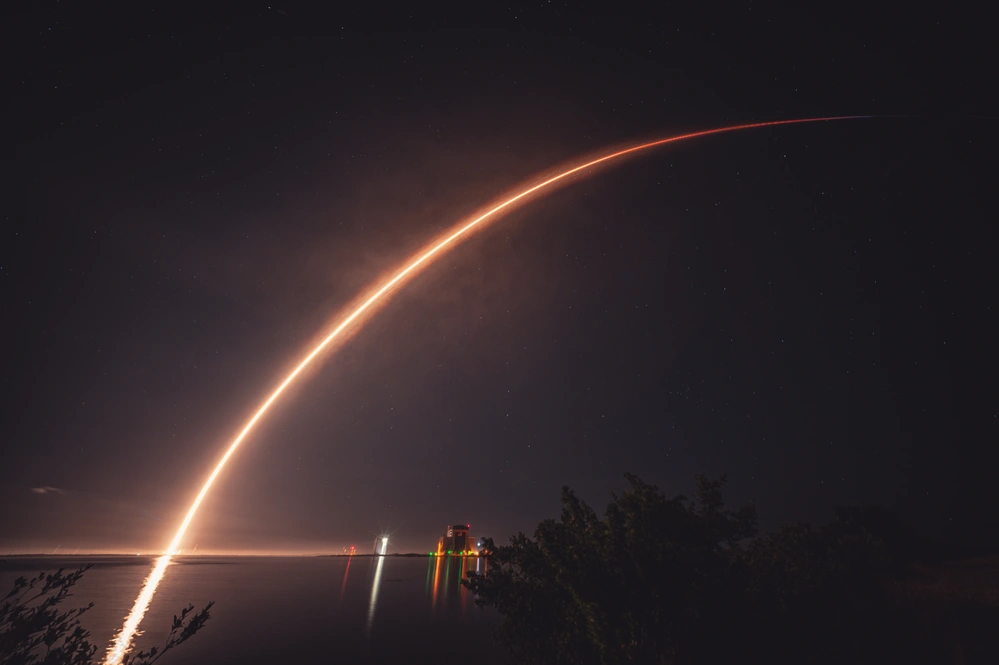
Feature Image: A Falcon 9 rocket carrying the Starlink 6-86 mission successfully launches from Launch Complex 39A at Kennedy Space Center, Florida, on Dec. 1, 2025. Starlink 6-86 deployed 29 satellites to expand SpaceX’s global broadband constellation in low Earth orbit. (U.S. Space Force photo illustration by Gwendolyn Kurzen)
Read more from Sandboxx News
- The special operations helicopters of the Vietnam War
- Netflix’s “MARINES” documentary humanizes the Marine Corps and is worth your time
- Does it make sense for Canada to get Gripens instead of F-35s?
- Air Force wants to transform the MQ-9 Reaper into a drone mothership for its special operators
- Being taken into secondary airport security interrogation while in a spec ops unit