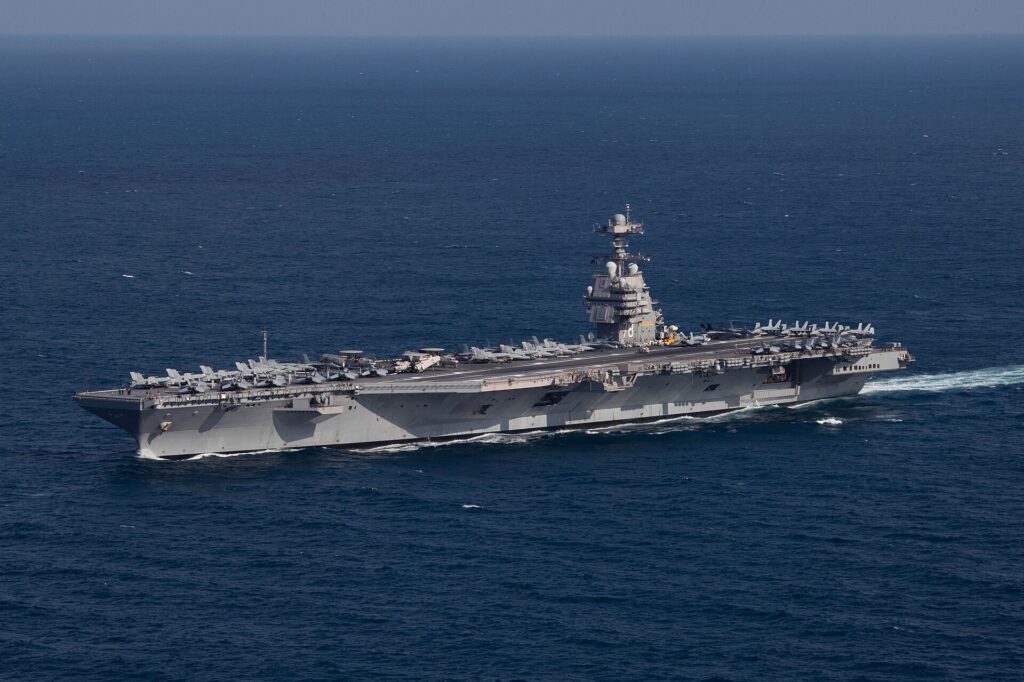
The U.S. military buildup around Iran continues. The Navy is deploying a second carrier strike group in the region and continues to add other units in expectation of a military clash with Tehran.
Indeed, approximately one-third of the Navy’s deployed warships and logistics vessels are steaming toward Iran.
Last week, reports revealed that the Navy is sending a second carrier strike group toward Iran. The USS Gerald R. Ford carrier strike group has left the Caribbean, where it participated in Operation Absolute Resolve to capture Venezuelan President Nicholas Maduro, and is now transiting to the eastern Mediterranean Sea.
Once in the region, the USS Gerald R. Ford – which the leading vessel of its namesake class – and its carrier group will join the USS Abraham Lincoln carrier strike group which has been there since January. Centered around the USS Abraham Lincoln, a Nimitz-class aircraft carrier, the carrier strike group already in the region brought powerful strike capabilities to the table.
The Navy has committed approximately one-third of its deployed warships and support vessels to supporting a potential strike against Iran. As of February, the Navy has about 100 ships deployed all over the world. This is normal for peacetime operations as the Navy conducts routine training and deterrence operations on a daily basis. Out of those 100 ships, 33 are in or heading toward the Middle East or Europe and could support military action against Iran.
In addition to the two flattops, the Navy has 15 Arleigh Burke-class missile-guided destroyers in the region, each of which is capable of carrying nearly 100 Tomahawk land-attack cruise missiles, air defense missiles, and anti-ship munitions. Moreover, there are at least two, and likely four, missile-guided submarines in the region that can add scores of Tomahawk land-attack cruise missiles to the Navy’s strike capabilities.
Finally, there are hundreds of fighter jets, including F-35C stealth fighter jets, electronic warfare aircraft, strategic bombers, and support aircraft, ready to support military action against Iran.
Protests and nuclear weapons
The crisis in Iran began in December when the Iranian people took to the streets to protest the collapse of the country’s economy. The protests quickly transformed into a public uprising against the oppression of the country’s theocratic regime. Government forces replied in force and, according to independent reporting, the Iranian government has killed and wounded thousands of its people in an attempt to quell the protests. This crackdown and the treatment of arrested protestors drew the attention of the United States.
The U.S. administration demanded that the crackdown end, threatening military force if Tehran did not stop. However, U.S. demands soon expanded to include the issue of Iran’s nuclear weapons program.
If the White House gives the green light for military action against Iran, it would be the second time in less than a year that U.S. forces attack the Middle Eastern country. In June, the U.S. conducted Operation Midnight Hammer, targeting and destroying three locations associated with Iran’s nuclear weapons program.
Ongoing negotiations between America and Iran seek to find a peaceful solution, but if they do not, the U.S. military is ready to strike.
Feature Image: The U.S. Navy aircraft carrier USS Gerald R. Ford in October 2022. ( U.S. Navy photo by Petty 2nd Class Jackson Adkins)
Read more from Sandboxx News
- US military operations heat up once again in strategically important east Africa
- Breaking down the SERE school myths: How accurate are they?
- Ukrainian F-16 shoots down Russian drone with its onboard cannon – and why this is an incredible feat
- Defending the big ship: How America protects its aircraft carriers
- NATO to increase its Arctic presence in response to Russian activity