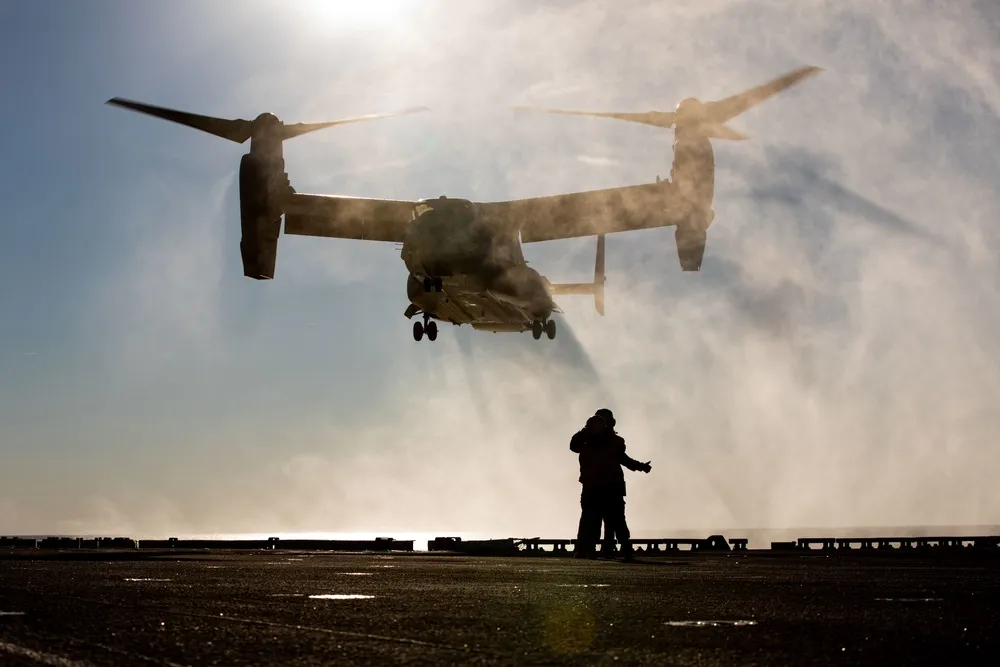
After 20 years of production and 359 aircraft the Marine Corps received its final MV-22 Osprey aircraft at the end of June.
Manufactured by Bell Boeing, the V-22 Osprey is a multi-engine, dual-piloted, self-deployable, medium-lift, vertical takeoff and landing (VTOL) tiltrotor aircraft. It has a crew of four and can carry up to 32 fully-equipped troops, which translates to nearly a full Marine rifle platoon.
The Marines’ final V-22 Osprey was received in a grand ceremony.
“The MV-22B didn’t just join our fleet; it fundamentally changed the way the Marine Air-Ground Task Force generates combat power,” Marine Corps Lieutenant General William Swan, Deputy Commandant for Aviation, said during the ceremony.
“It provides commanders with decision space that only speed and reach can provide, connecting ships, bases and distributed forces in ways previous generations could only imagine. Today, Marine commanders build operations around the assumption that the MV-22B will be there,” Swan added.
In its two decades in service with the Marines, the Osprey fleet has completed nearly 685,000 flight hours and deployed 114 separate times so far.
There are three versions of the Osprey: the MV-22 is the conventional version of the aircraft; the CMV-22 is the naval version; and the CV-22 is the special operations iteration.
The different versions can conduct a wide range of mission sets, including airlift, combat search and rescue, and special operations support. In the Marine Corps, the MV-22 replaced the CH-46E Sea Knight and CH-53D Sea Stallion medium lift helicopters.
The Air Force and Navy also operate variants of the V-22, yet the Marines have the largest Osprey fleet.
The overall Osprey program continues as the Navy keeps buying the CMV-22 version of the tiltrotor aircraft. The continued production is good news for the Marine Corps (and Air Force) Osprey fleets because it means there will be a ready supply of spare parts for maintenance.
The Marine Corps plans to fly the tiltrotor aircraft at least until 2055.
A capable but troubled platform
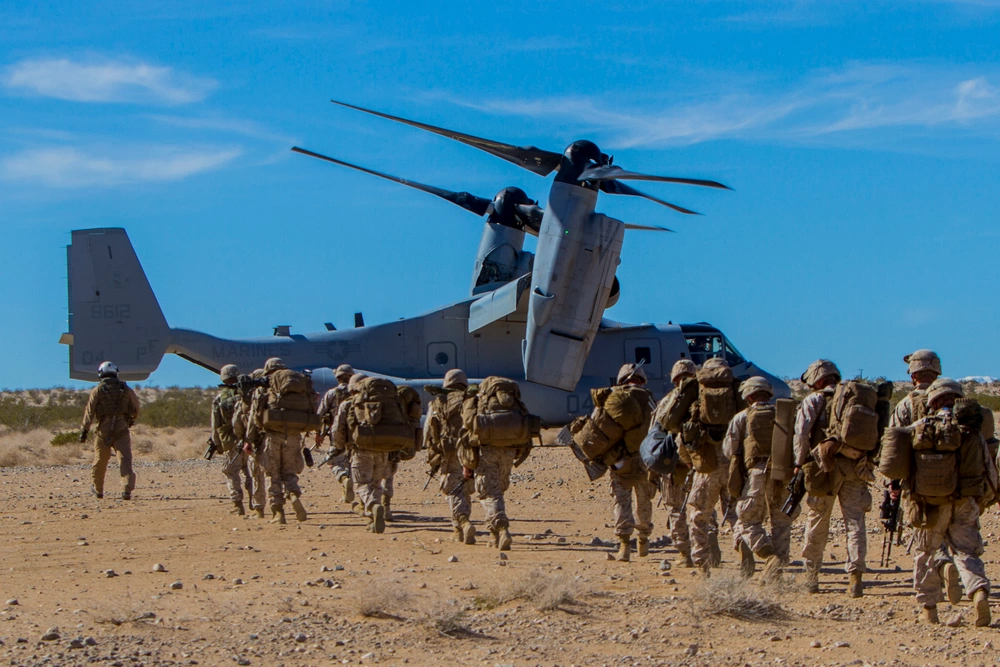
The program is not new. The U.S. military began planning and designing the tiltrotor aircraft in the early 1980s as part of the Joint Services Advanced Vertical Lift Aircraft (JSAVL) project.
However, the road to the final Marine Corps Osprey was not easy. From its inception, the tiltrotor aircraft offered considerable promise but also faced mechanical issues.
Although the first V-22 Osprey prototype flew in 1989, it was not until 2006 that the Marine Corps received its first operational aircraft. The nearly 17 years of delay were the result of continuous design and performance issues that resulted in several fatal crashes.
The grim toll of the V-22’s mechanical issues is over 60 troops and civilians killed and dozens wounded. In the past few years alone, more than 20 troops have been killed in four different accidents. The Pentagon has repeatedly grounded the entire Osprey fleet several times as a result of these mishaps.
Despite its toll, the Osprey remains an essential cog in the airlift capabilities of the U.S. military. For the Marine Corps, the MV-22 Osprey is the aircraft that ferries Marines from their ships into combat, allowing the branch to conduct its centuries-old mission with an airborne twist.
Feature Image: A U.S. Marine Corps MV-22 Osprey with Marine Medium Tiltrotor Squadron 263, lands aboard the USS Kearsarge (LHD 3) flight deck during Composite Training Unit Exercise (COMPTUEX), Jan. 30, 2022. (U.S. Marine Corps photo by Staff Sgt. Yvonna Guyette)
Read more from Sandboxx News
- To join a special operations unit you have to get used to your rucksack
- How the F-22 Raptor silenced its critics 20 years ago
- Accounts of daily life with the Delta Force through 18 months of global training
- It took more than stealth to make the F-117 Nighthawk a combat legend
- Why are officers more successful than enlisted men at becoming Navy SEALs?