GE Aerospace and Lockheed Martin recently announced the successful testing of a new kind of air-breathing jet engine capable of powering missiles to speeds well above Mach 5. And this engine will come in a smaller, cheaper, lighter, and more efficient package than the most advanced scramjets in testing today.
This engine, dubbed a rotating detonation ramjet, combines two different types of exotic jet propulsion technologies: complex dual-mode ramjets; and rotating detonation combustion engines, or RDEs. The result is an engine that could propel missiles into hypersonic speeds and offer a substantial increase in range for the same amount of fuel burned.
The “series of engine tests demonstrat[ed] the viability of a liquid-fueled rotating detonation ramjet for use in hypersonic missiles,” the two companies said in a statement.
Dual-mode ramjet engines can function as either a ramjet or a scramjet through the use of variable inlet geometry. Lockheed is no stranger to dual-mode ramjets, having successfully ground-tested a turbine-based combined-cycle engine for its now-mysteriously vanished SR-72 program. This experience, and others, all but certainly informed Lockheed’s inlet design used in this jointly built engine.
A rotating detonation engine, on the other hand, functions by having the detonation wave travel around a circular channel within the engine and out the back of the aircraft as propulsion. Fuel and oxidizers are added to the channel through small holes, which are then struck and ignited by the rapidly circling detonation waves. It’s not uncommon for a rotating detonation engine to have three to five of these detonation waves circling the chamber at once. The result is an engine that produces continuous thrust, rather than thrust in pulses, but that also provides the improved efficiency of detonation combustion, rather than the deflagration found in a conventional jet engine.
“GE Aerospace’s hypersonic capabilities continue to advance at a rapid pace, and this collaboration with Lockheed Martin is another step forward in our journey. The testing on the rotating detonation ramjet and inlet exceeded expectations, and we are excited about this collaboration to continue maturing our advanced air-breathing hypersonic propulsion technologies,” Mark Rettig, vice president and general manager of Edison Works Advanced Programs at GE Aerospace said.
Related: US Army successfully tests Dark Eagle hypersonic missile
Back in 2023, GE Aerospace had already announced its ongoing efforts to marry the combustion process of rotating detonation engines with the high-speeds made possible by dual-mode ramjets.
Because rotating detonation combustion produces more thrust for the same fuel burned, it means this new engine could allow for several big possibilities for missile delivery. If you incorporated it into a weapon design that exists today, for instance, you could cover greater distances with the fuel onboard, or swap fuel out for larger payloads without suffering a loss in range. Likewise, you could field smaller weapons that offer the same range, payload, and kinematics of today’s missiles, allowing you to carry more weapons into the fight.
Nevertheless, as advanced as a rotating detonation ramjet engine may be, it still won’t be able to function from a stop or at low speeds. So like today’s hypersonic cruise missiles in testing, a missile using this new engine would need to be launched under the power of a conventional rocket engine to gain the necessary speed and altitude for the ramjet to come online. However, this joint engine tries to overcome this limitation.
According to Lockheed Martin, its specially designed inlet, combined with GE’s rotating detonation technology, allows the engine to achieve ignition at lower speeds than today’s ramjets and scramjets, which would, in turn, allow for the use of smaller, and less expensive boosters.
It isn’t clear how low those speeds might be, but back in 2013, Lockheed’s hypersonic program manager (and lead on the SR-72 program) Brad Leland told USNI News that a focal point of Lockheed’s effort had been getting their dual-mode ramjet to function well at speeds well below Mach 3 in an attempt to bridge the velocity gap between efficiency velocities for turbofans and scramjets.
Yet, before any of that can happen, this new engine being built by Lockheed Martin and GE Aerospace needs to get off the ground. And, at least for now, it isn’t clear when we can expect that to happen.
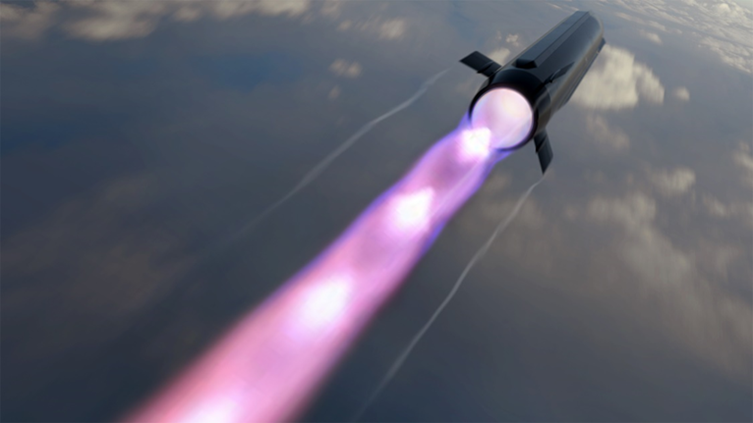
Feature Image: Concept art of a missile being powered by the new engine. (GE Aerospace)
Read more from Sandboxx News
- British Royal Marines and Army Rangers qualify to provide NATO with special operations capability
- Second US Navy carrier strike group now heading towards Iran
- US military operations heat up once again in strategically important east Africa
- Breaking down the SERE school myths: How accurate are they?
- Ukrainian F-16 shoots down Russian drone with its onboard cannon – and why this is an incredible feat