
While U.S. military leaders have been inspired by the idea of vanquishing enemies with lasers since before Star Wars first hit theaters, the reality of turning concentrated light beams into broadly deployable weapons has always been thwarted by technological challenges. But thanks to cash infusions, advocacy from top leaders, and challenges from technologically sophisticated adversaries, that reality is now closer than it’s ever been.
An overview of Pentagon’s Fiscal Year 2027 budget request, released last week, highlights investments by Scaled Directed Energy, or SCADE, to continue work on a 300-kw-class laser beam technology known as the Joint Laser Weapons System in order to “build, deliver, and demonstrate an operationally relevant capability in a platform-neutral package.”
The massive $1.5 trillion budget increases funding for high-energy laser research initiatives from across the board, bumping a line for “High Energy Laser Advanced Component Development & Prototype” from about $4.5 million to $44.5 million and increasing a request for the “High Energy Laser Advanced Technology Program” from $120.8 million to more than $201 million.
Battleship lasers
Yet, perhaps the most significant buzz around lasers surrounds the vaunted Trump-class battleship, called BBG(X) in newly released budget materials.
The new budget request allocated $596 million in concept development for the battleship, which Chief of Naval Operations Adm. Daryl Caudle has said may feature a groundbreaking gigawatt-class laser weapon.
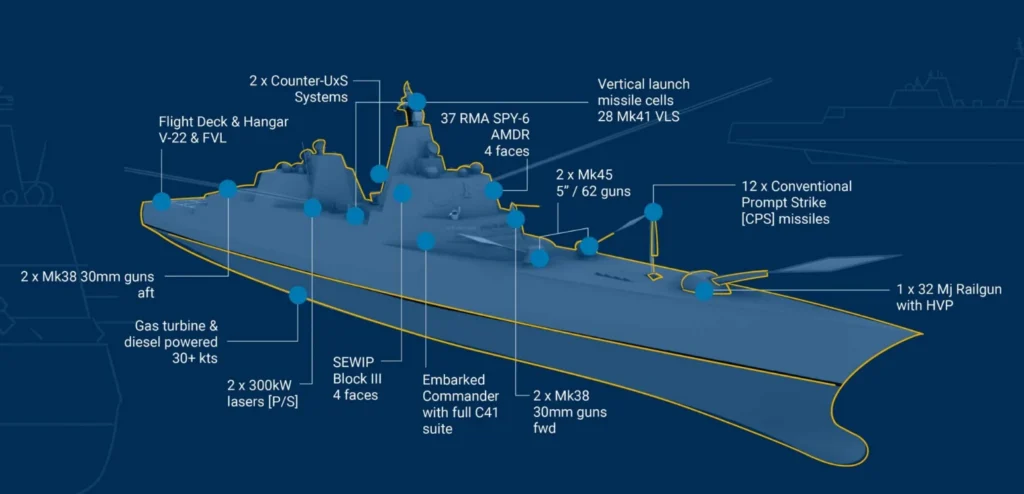
The battleship’s planned “vastly increased power generation, managed by a sophisticated integrated power system with high-capacity energy storage, will support mission-critical directed energy weapons like high-output lasers and electromagnetic railguns, reducing reliance on costly single-use munitions,” recently released Navy budget documents said.
Notably, Caudle is an avowed proponent of laser weapons and wrote his doctoral thesis at the Naval Postgraduate School on the use of lasers and directed energy. At the Sea Air Space symposium near Washington, D.C. this week, he reiterated to reporters that he believes the technology can reach maturity for military employment.
“I think we know how to laze; we know how to build coherent light. We know how to do it at very high power levels,” Caudle said. “And what’s restricted us historically are engineering challenges, not theory, and so I want to put more money toward the engineering solutions of high-powered energy and less into the theoretical.”
Construction on the Trump-class battleship is supposed to start in 2028, according to budget documents, and ship designers must demonstrate that it can be made to generate and sustain the massive power requirements of the laser weapon along with other proposed directed-energy weapons including an electromagnetic railgun.
According to the overview of the budget request, in the coming fiscal year, the program will undertake the preliminary design phase, which will include a technical assessment of operational requirements, determination of the dimensions of the ship, and the start of a 3D common design product model that will inform shipyard work.
Also next fiscal year, the Navy will “continue to demonstrate interfaces for energy storage and advanced controls capabilities that are required to support future mission system capabilities such as directed energy weapons and advanced sensors,” according to the overview.
Golden Dome lasers

The next major laser program in play is the Joint Laser Weapon System (JLWS), a component in the White House’s proposed Golden Dome missile shield that will be heavily funded through laser technology development programs.
The White House wants to deploy an initial version of Golden Dome by 2028, with full deployment the following year. JWLS, a more-than-300 kW high-energy laser weapon, will be specialized for counter-missile defense, according to plans. JWLS is a joint Army and Navy program.
In the coming year, development of JLWS, at least on the Navy side, will involve creation of a containerized, smaller version of the planned system powered at 150 kW.
Plans include “incrementally providing at least 300kW of power building on existing laser scaling efforts; development of the Joint Beam Control System (JBCS) technology capable of supporting a 300-500kW laser weapon system; and [conducting] upgrades to the High Energy Laser Counter Anti-Ship Cruise Missile Project (HELCAP) testbed as appropriate to support JLWS testing,” according to budget documents.
HELCAP, a program to build a 300kW shipboard weapon, was initiated in 2019. The testbed created for HELCAP is reportedly at White Sands Missile Range, New Mexico. And while funding for this program is relatively modest for next fiscal year at $15 million, work continues. Plans for HELCAP in FY 2027 include system-level testing and verification of the laser weapon testbed on land and at sea.
“This leveraged knowledge and new HELCAP technical solutions to the Counter Anti-Ship Cruise Missile (C-ASCM) problem will enable a fully informed decision to rapidly field an integrated, fleet ready, [High Energy Laser] Weapon,” documents state.
Related: British warships will carry DragonFire laser to shoot down drones
Drone-killing lasers
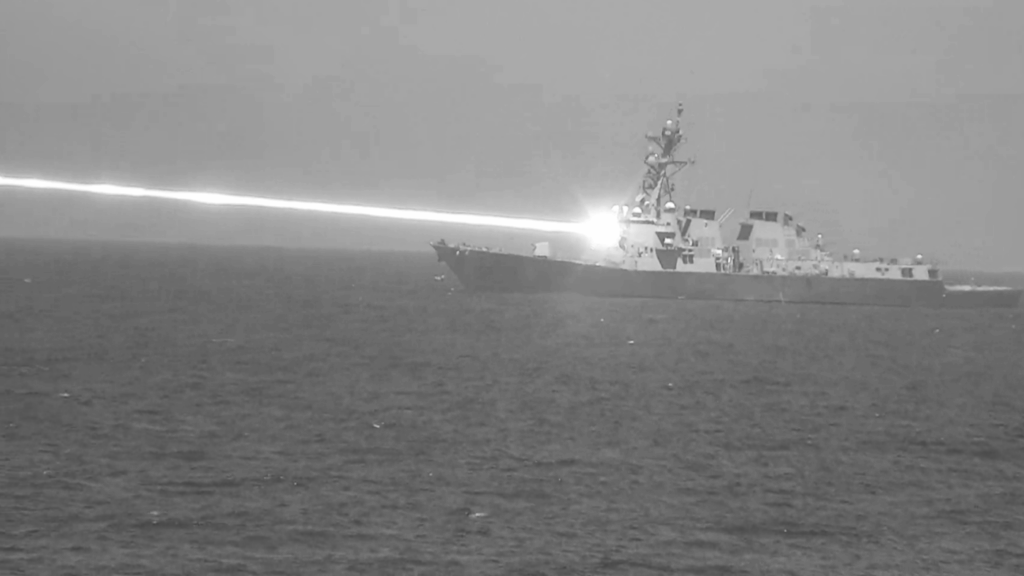
Perhaps the most advanced Pentagon laser weapons system is HELIOS, the High Energy Laser with Integrated Optical-dazzler and Surveillance, already deployed on the Arleigh-Burke-class destroyer Preble and zapping drones in testing.
While the Navy first awarded a contract for Lockheed Martin’s HELIOS in 2018, advancement of the program has been very slow. The 60 kW-class laser weapon was installed onboard Preble in 2019 and deployed with the ship a few years later. It has not been integrated on any other ships.
The newly released budget documents suggest that HELIOS was initially not expected to receive additional funding in the coming year. However, a rising interest in lasers – and the ever-growing threat from enemy drones, particularly as the U.S. wages a maritime fight in the Middle East amid conflict with Iran – may have contributed to the late additions.
HELIOS will now get $5 million for sustainment and maintenance, but no extra funding to install the weapon on additional ships will be allocated. “But HELIOS appears to be informing other weapons and requirements
“The acquisition strategy for HELIOS permitted accelerated fielding of a laser weapon system in the Fleet and was done to provide a demand signal for the industrial base to expand the capacity to develop and manufacture this advanced technology,” budget documents state, adding that the effort will inform development of that containerized 150 kW laser now being wrapped into the JWLS effort.
Increasingly, we may see existing and new laser weapon programs categorized under the Golden Dome effort, which will encompass a broad range of systems and platforms.
“In coordination with the military services and the Missile Defense Agency, begin development of a consolidated implementation plan for all Golden Dome Directed Energy projects, leveraging synergy and common weapon architectures between these efforts where possible,” documents state.
Feature Image: (May 21, 2020) The amphibious transport dock ship USS Portland (LPD 27) successfully tests a Solid State Laser – Technology Maturation Laser Weapon System Demonstrator (LWSD) Mark 2 MOD 0. (19fortyfive via U.S. Navy photo/Released)
Read more from Sandboxx News
- Air Force wants to invest nearly $2 billion to extend the service life of its B-1B and B-2 bombers
- Marines are rushing to stand up new counter-drone team as stress tests spotlight defense gaps
- How the JDAM created a revolution in bombing technology
- The highjacked aircraft hoax that alerted Delta Force
- Before the Navy SEALs came the Underwater Demolition Teams