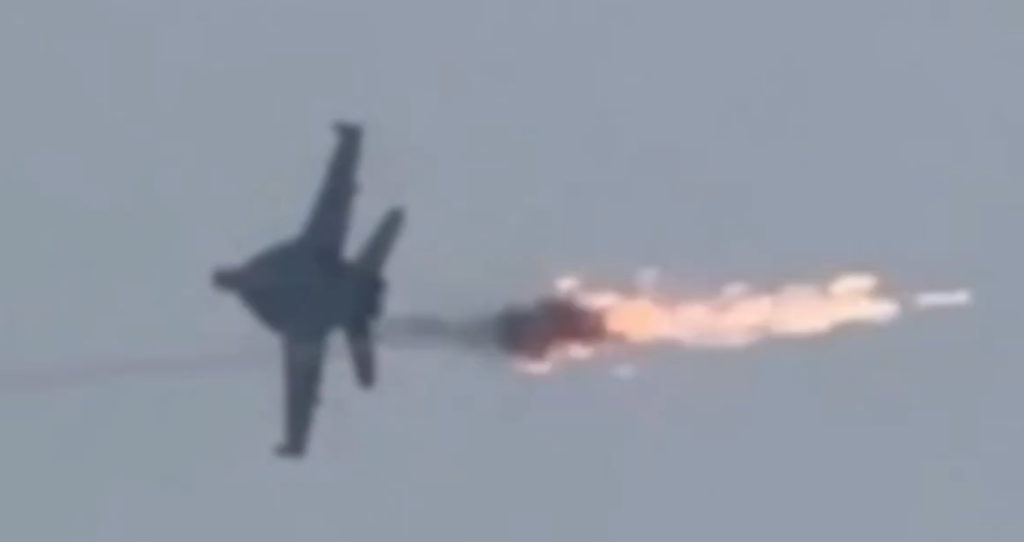
New footage that surfaced on Wednesday appears to show a U.S. Navy F/A-18 Super Hornet narrowly avoiding an inbound missile during combat operations over Iran, seemingly demonstrating the very real risk American aviators continue to face as this conflict stretches toward its fourth week.
The video, which appears to be genuine, was geolocated to the port of Chabahar in southern Iran. American forces have focused primarily on Iran’s southwest regions, as Israeli forces operate primarily in the North.
Better video of a U.S. Navy F/A-18 Super Hornet fighter jet being targeted by the Iranians with a surface-to-air missile, perhaps fired from MANPADS, over the city of Chabahar in southern Iran on Wednesday.
— Status-6 (War & Military News) (@Archer83Able) March 25, 2026
The missile didn't immediately appear to cause any significant damage to… pic.twitter.com/LrguBu7YVI
In the footage, the F/A-18 Super Hornet can be seen flying overhead at very low altitude before opening fire at an unseen target on the ground with its onboard M61A2 Vulcan 20mm cannon, which fires large, high-explosive rounds at a blinding rate of 6,000 rounds per minute. The Super Hornet carries a maximum of just 412 rounds, however, allowing for just over four seconds of sustained fire. Its cannon has a maximum range of less than 10,000 feet, but is often used at under 2,000 feet in air-to-air engagements.
While it’s surprising to see an American fighter flying this low and engaging targets with its cannon, we’ve seen multiple reports out of Iran in recent weeks of other Super Hornets doing the same.
The low speed and altitude of the Super Hornet in the video shows somewhat conclusively that the integrated air defense threat over this portion of Iran has been rendered inoperable, making it possible for non-stealth aircraft to fly stand-in (or close-range) combat operations over the area. This frees the U.S. command from having to rely on stealth aircraft and longer-ranged stand-off weapons like pricey cruise missiles. Yet, Iranian forces still operate a wide variety of short-ranged infrared-guided surface-to-air missile systems, including at least a half dozen different types of Man-Portable Air Defense Systems, or MANPADS.
MANPADS are shoulder-fired infrared-guided surface-to-air missiles that sometimes also employ laser-designators (aimed from the launcher) to help the weapon dismiss countermeasures like flares and continue toward the intended target. These weapons can be extremely dangerous at low altitudes, but struggle to identify targets any higher than 13,000 to 15,000 feet. And because of their size, these weapons carry much smaller warheads than those find in larger interceptors: Iran’s domestically produced Misagh series MANPADS carry warheads that are only about 3.3 pounds.
WATCH: Iranian MANPADS hit came very close to taking out a U.S. Navy F/A-18E/F Super Hornet jet over Iran yesterday. pic.twitter.com/GwSz9xlXQb
— Clash Report (@clashreport) March 26, 2026
In the footage, we can see the Super Hornet pilot break left shortly before the missile closes in, but we do not see the aircraft deploy flares to confuse the inbound weapon. That could suggest a very short window of time from when the pilot became aware of the threat to the weapon closing, which would make sense for a small system like a MANPAD that can be hidden away until right before launch. Because the weapon doesn’t rely on radar for targeting, there are no emissions to alert the fighter’s AN/ALR-67 Radar Warning Receiver.
From some angles, it looks as though the missile made contact with the Super Hornet, but as Stefano D’Urso pointed out for The Aviationist, the outstretched shape of the blast shows that it instead detonated behind the fighter, all but certainly via proximity fuse. It seems likely, however, that the Super Hornet was hit by shrapnel from the blast and may require some repairs. Iranian media sources, however, claimed the jet went on to crash in the Indian Ocean, but there is no evidence to support those claims.
This isn’t the first time an American fighter has been hit by Iranian missiles so far in this conflict A U.S. Air Force F-35A appeared to tank a direct hit from a MANPAD a few weeks ago, continuing on to make an emergency landing at a friendly airbase. Iranian forces have also reportedly downed at least 13 MQ-9 Reaper drones, but, thus far, Iranian fire has not been able to down any crewed American aircraft.
Read more from Sandboxx News
- Artemis II is headed to the Moon. This is how the military is helping
- Why military leaders should trust their troops with explanations
- Anduril’s AI-piloted Fury drone goes into serial production, but who will buy it?
- The Iranian general whose intel might have stopped the US from going to war in 2007
- New weapons and technologies making their debut in the war against Iran