Frank G. was a wise and kind man… he was Delta’s answer to a good solid operator. He was tall, rather stalky, and had broad square shoulders. His neck was somewhat short for his build, and somewhat stiff, as he tended to turn his body to look at things rather than just his head.
Those characteristics, as well as a play on his first name, made those who befriended and worked with him to give him the nickname “Frankenstein.” Even his Unit radio call sign was “Frankenstein” as everyone knew it. He was a noble beast; a gentle giant of a man, Frankenstein was.
With such a physique, perhaps then it was only fitting that Frank would suffer the woe I’ll describe while on a routine static line parachute operation on Ft. Lewis Washington’s Burris parachute Drop zone. Nobody would wish such a fate on a fellow paratroop, but of all jumpers this happened to Frank G.!
The jumpers that day donned their parachute equipment as with any other jump and cycled through the Jump Master Preparatory Inspection (JMPI) to make sure there were no deficiencies in their equipment and they were all safe to jump. Frank’s inspection went as per routine with no problems in the gear or the way he had put it on; Frank was ready to “put his knees in the breeze” as we termed it.
However, there were two grave errors committed on that jump aircraft that fateful day, both of which befell our poor hero Frank.
First, the jumper directly behind Frank in the jump lineup failed to notice that Frank’s static line was running under his armpit rather than over the top of his shoulder like it should have been.
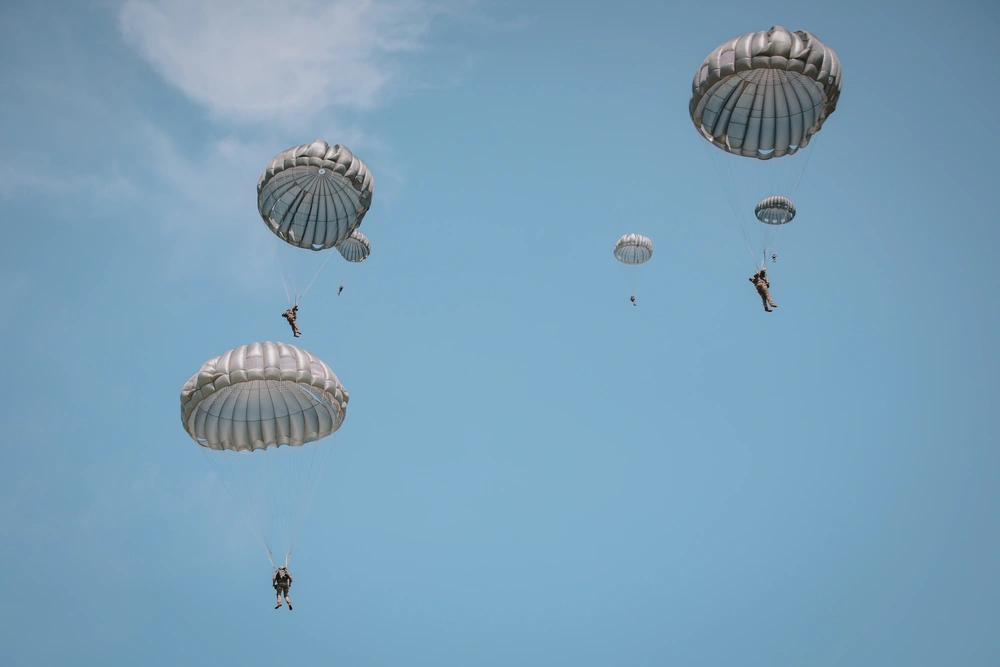
When a static line routes under the armpit like Frank’s did, it is cushioned and buffered by the arm, failing to allow full force to pull on the cotton cord that ties the parachute deployment bag securely onto the parachute packing tray. The cord is rated to break once approximately 80 pounds of pressure is applied to it. When the static line is buffered by routing under the armpit, the applied pressure is reduced to a mere 50ish pounds, which not sufficient to break the cotton cord.
The second grave error was the failure of the appointed safety official to spot Frank’s static line routed under his arm rather than over his shoulder. There is the possibility that the Jumpmaster might spot the error and stop the jumper to correct it… but typically it is hard to stop a line of paratroopers barreling out of an aircraft.
In this case, there was just a litany of errors that led to Frank exiting the airplane and being towed behind the aircraft by his static line which failed to break away and deploy his parachute. He twirled and spun around, banging several times off of the side of the aircraft. He had one hand on his reserve parachute and one hand on top of his helmet signaling the Jumpmaster that he was OK and wanted to be cut away and descend on his reserve parachute.
Related: What happened after a parachute opened accidentally during a jump operation
He didn’t have to wait long, as the 80 lb cotton cord finally broke and deployed his chute. Frank landed to the arrival of the field ambulance screaming up to him. The Drop Zone medic looked on in horror at Frank who was covered quite well in blood.
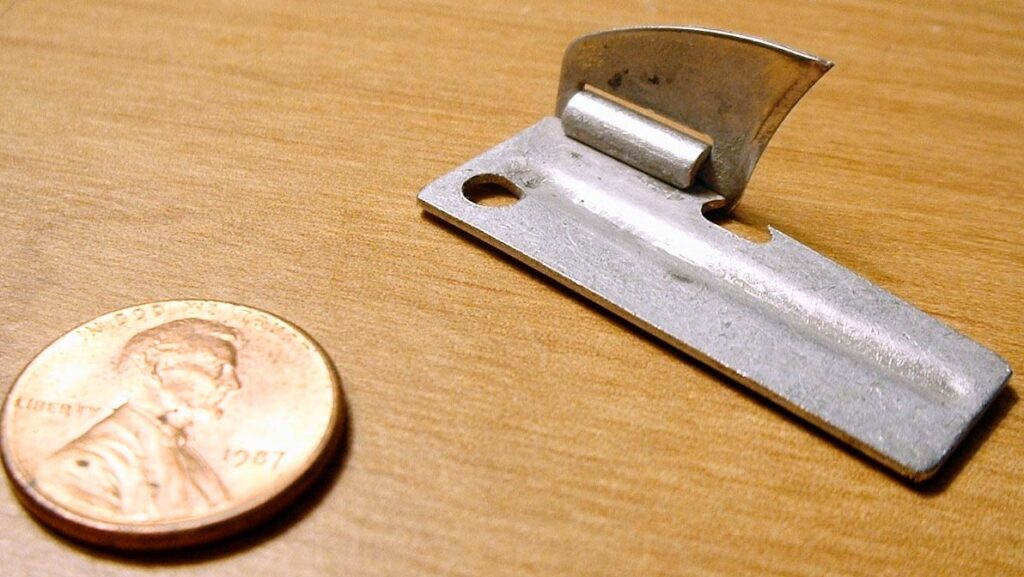
He was not gravely injured, but as bad luck would have it, because he had been wearing a P-38 – an army C-ration can opener – on a tether around his neck during the jump. In the jumble of man and equipment, as he was spinning and banging around, the P-38 hooked his neck and sliced across his throat from ear to ear. Fortunately, it was just a flesh would – but a nasty-looking wound than left a prominent scar.
That rounded off Franks image of the Frankenstein monster nicely. And henceforth, when you would ask him what he was going to be for Halloween he responded: “a devil, a ghost, Count Dracula – anything but Frankenstein!”
By Almighty God and with Honor,
geo sends
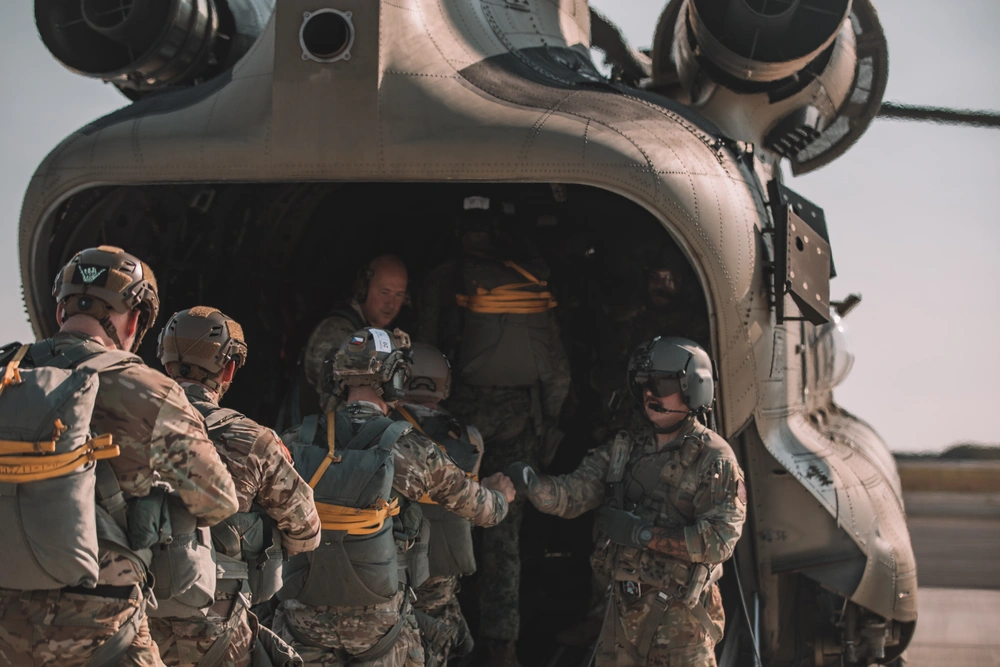
Feature Image: U.S. Army, Air Force and International Paratroopers prepare to conduct a foreign wing static line jump from a CH-47 Chinook helicopter onto Glen Rock Drop Zone during Leapfest in West Kingston, Rhode Island, July 28 to Aug. 4, 2025. U.S. Army Reserve photo by Sgt. Kelsey Kollar)