What defenses does an aircraft carrier have against incoming aircraft, missiles, and suicide drones?
Last week, a Marine Corps F-35C Lightning II stealth fighter jet onboard the USS Abraham Lincoln aircraft carrier intercepted and shot down an Iranian Shahed-129 unmanned aerial system as it was approaching the flattop.
The incident brought to the fore the issue of aircraft carrier defense from air threats.
The U.S. Navy employs a layered defense approach to ensure that its aircraft carriers are not struck and sunk in combat by enemy aircraft or incoming munitions.
To begin with, an aircraft carrier is a floating air base. The fighter jets, electronic warfare jets, early warning aircraft, anti-submarine helicopters, and unmanned aerial systems it carries act as advanced scouts ahead of the flattop. These aircraft are the first line of defense.
Then there are the warships that accompany an aircraft carrier. Each aircraft carrier goes to war leading a carrier strike group.
Although the composition of the group can vary, a flattop is usually accompanied by at least three surface combatants, such as Ticonderoga-class guided missile cruisers or Arleigh Burke-class guided missile destroyers. These warships pack big air defense firepower, including Standard Missiles 2, 3, and 6 missiles, as well as RIM-162 Evolved Sea Sparrow Missiles (ESSM). An Arleigh Burke-class destroyer, for example, can carry nearly 100 missiles and a Ticonderoga-class nearly 125. To be sure, not all missiles these warships carry are for air defense: warships tailor their arsenal depending on the mission.
Finally, aircraft carriers pack their own air defense batteries, including RIM-162s, RIM-116 Rolling Airframe Missiles, and Phalanx CIWS chain cannons.
In total, there are hundreds of air defense missiles and scores of aircraft standing between an incoming enemy fighter jet, missile, or suicide drone.
Why so much protection?
There are several reasons why aircraft carriers need so much protection.
First, aircraft carriers are of high value to foreign policy and military operations. When an aircraft carrier and its strike group show up in a hot spot around the world, people pay attention. And the flattop’s presence is often enough to diffuse a difficult situation. Excluding nuclear munitions, there is probably no other weapon system in the world that can have such an effect on foreign policy.
There is also the issue of cost and numbers. Aircraft carriers are expensive, and there are not a lot of them. By law, the Navy is required to have at least 11 operational aircraft carriers at all times. Not all 11 flattops are deployable around the year, but they still are available if the need arises.
Flattops do not come cheap. The USS Gerald R. Ford, the lead ship of the Ford-class and the newest carrier in the Navy, cost $13 billion. To be sure, the first ship of a class is always the most expensive, and costs balance out as more ships come into service. Nevertheless, the average cost for the Nimitz-class carriers was still significant at $4.5 billion per ship.
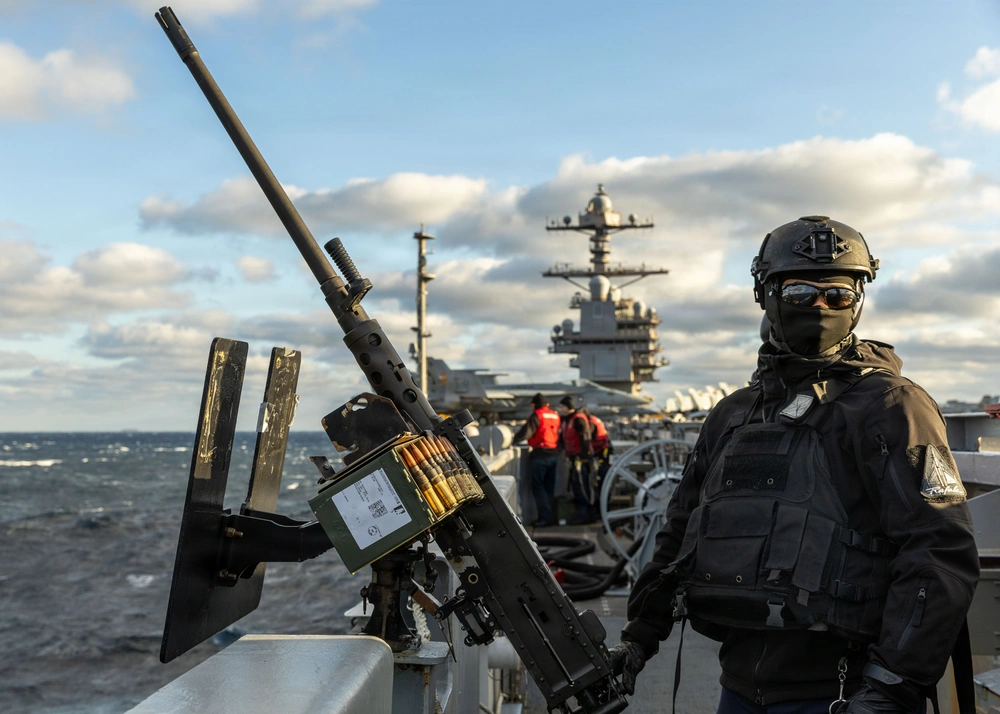
Feature Image: Aviation Ordnanceman Airman Elijah Partlow, assigned to Weapons Department aboard the world’s largest aircraft carrier, USS Gerald R. Ford (CVN 78), mans an M2 Browning machine gun on the catwalks during a crew-served weapons live-fire, March 18, 2025. (Photo by Seaman Paige Brown)
Read more from Sandboxx News
- NATO to increase its Arctic presence in response to Russian activity
- What really happened when F-22 Raptors squared off against the Eurofighter Typhoon?
- VBSS: A Navy SEAL explains how to board enemy ships
- SOCOM wants to use AI to better distinguish high value targets and intelligence during operations
- This is the system that used jet power to help overloaded aircraft take off from very short runways