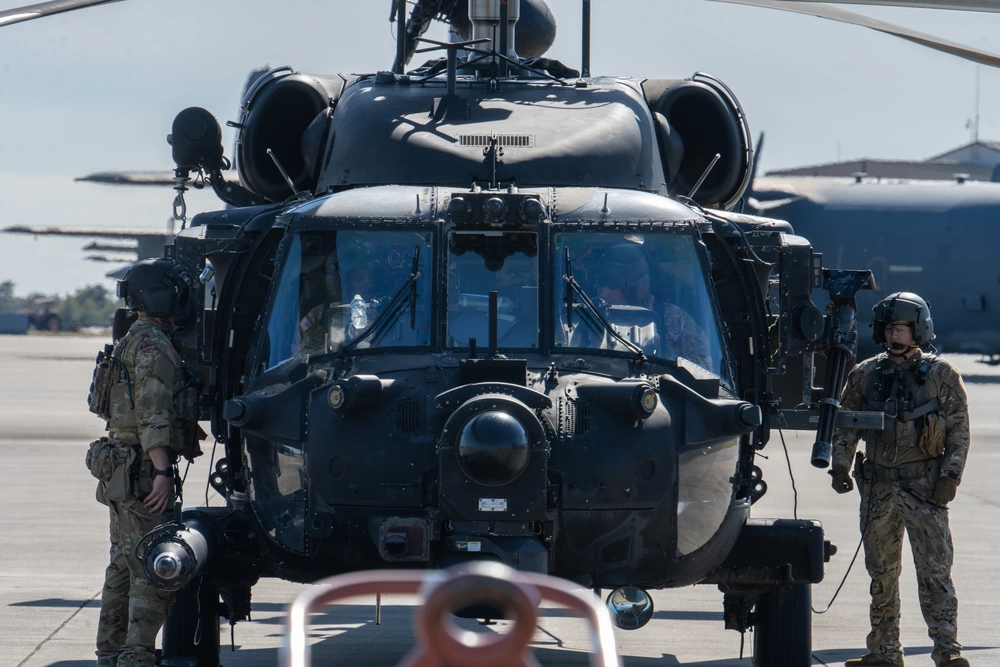
Early Saturday morning, explosions ripped through Venezuela’s capital of Caracas as a group of American special operations helicopters descended into the city. These carried members of the Army’s secretive Delta Force accompanied by law enforcement agents tasked with bringing Venezuela’s illegitimate leader, Nicolas Maduro, into custody.
What the United States military accomplished was arguably the most daring and incredible military operation we’ve seen carried out in the modern era: American forces laid waste to Russian-sourced air defenses; neutered the response of Russian-sourced fighter jets; put down literally dozens of Venezuelan and Cuban troops in direct fire fights; and captured Maduro and his wife inside a stronghold meant to prevent exactly this sort of operation… All before flying home without suffering a single American loss.
This mission began in earnest last August, when a covert group of CIA field officers entered Caracas and began compiling information about Maduro and his inner circle. This, of course, was also right around when the U.S. began to build up forces in the region.
Covert espionage on foreign soil is often carried out by CIA officers attached to the U.S. State Department and working out of American embassies. This provides operatives with secure working facilities and diplomatic cover, but for the covert team in Caracas, that wasn’t an option since the State Department had shuttered its facilities in Venezuela back in 2019, following Maduro’s first stolen election.
“The thing that people need to understand is that this isn’t Hollywood. Even though the media is reporting that the Agency personnel were part of a ‘team,’ those individuals likely had different roles (support, tech, case/operations officers, etc) and may have been physically separated while carrying out their portion of the op,” explained Jason, a former CIA officer who spoke to Sandboxx News about the raid.
“Add to that the fact that, while they likely had other external support (drones, etc.), they did not have the on-the-ground support of an embassy like operating in other countries might. They are out in the “environment” doing what they were trained to do, from conducting surveillance to meeting with assets in the area to collect and disseminate intelligence. All of these factors heighten the tension in an already stressful situation, and leaves even less room for error,” the former CIA officer added.
According to the New York Times, these operatives did indeed have overhead support in the form of stealth ISR, or intelligence, surveillance, and reconnaissance drones, operating high in Venezuelan airspace. Based on surfaced images and video of Lockheed Martin’s RQ-170 seemingly returning to base after Saturday morning’s operation, it seems likely that they were among the drones employed. They also reportedly had a source on the inside, which, combined with drone support, allowed the team to map out Maduro and his security detachment’s daily routines, including exactly where he would be at different times of the day and night.
Maduro was clearly concerned about security. The CIA team observed as he rotated between at least a half-dozen secure residences, never knowing for sure in which he’d stay each night until he arrived in the evening.
America’s Joint Special Operations Command, or JSOC, then used the details the CIA team gathered to construct an exact replica of Maduro’s primary compound in Kentucky for members of Delta Force to rehearse the extraction. According to reports, these rehearsals included, among other things, using various cutting tools and explosives to rip through reinforced steel doors at consistently fast rates.
“Normally, an operation like this would require months and weeks of preparation with multiple plan Bs ready in case something went wrong,” a retired Delta Force operator with multiple combat deployments told Sandboxx News under the condition of anonymity.
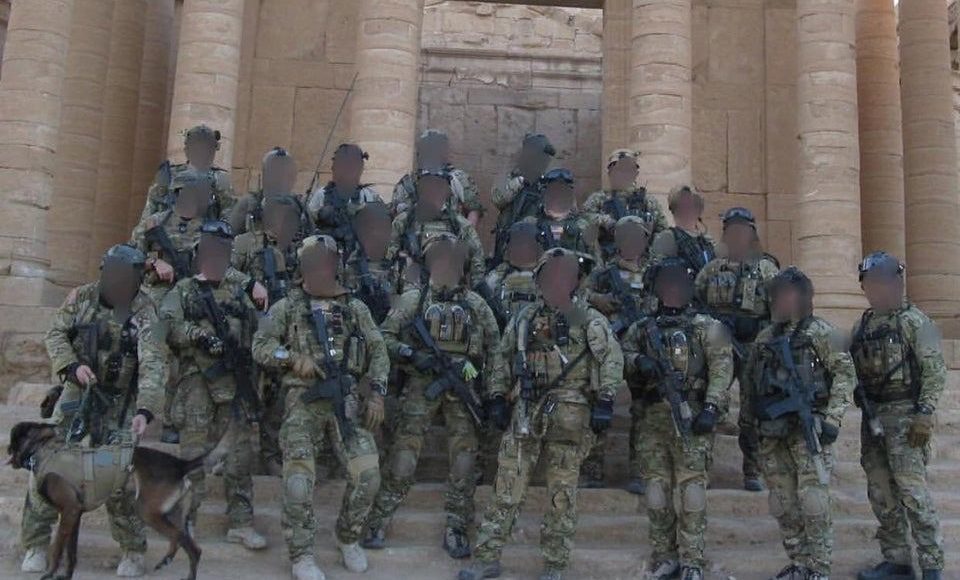
Delta Force, or the Combat Applications Group (among other potential names), is arguably the most secretive and highly trained warfighting unit ever to see the fight. Delta was founded as an elite counter-terrorism and hostage rescue unit in 1977, and today, it serves alongside SEAL Team 6 and the 24th Special Tactics Squadron at the pinnacle of the special operations pyramid. Unlike SEAL Team 6, however, which recruits solely from other SEAL teams, Delta plucks the best warfighters from across all operational specialties and even military branches – though the majority of Delta’s elite operators hail from other spec ops units, primarily Green Berets and Army Rangers. And even among such highly trained soldiers, few manage to make it through Delta selection.
As former Delta operator and Sandboxx News columnist George Hand has recounted, the first four weeks of specialized training and assessment at Camp Dawson, West Virginia, saw his 200-soldier Delta class dwindle to just 21 men who “qualified to begin the very basics of training for the Delta Force.”
Related: How pagers became a status symbol for Delta Force operators
According to reports, President Trump authorized the raid as early as Christmas Day, but left the precise timing of the mission up to Pentagon officials. From Thursday, December 25, to the following Friday, January 2, the massing U.S. forces around Venezuela waited for the variables to line up that would allow them to strike: in particular, they needed Maduro to stay in the primary compound Delta had trained for; they needed good weather; and a time of night that they knew would minimize the chances of civilian casualties. Initial plans called for launching the raid amid the holidays while many Venezuelan servicemembers were on leave, but bad weather kept pushing the mission back.
At around 4:30 pm on January 2, the pieces were beginning to fall into place. The inclement weather was dissipating, and U.S. forces confirmed Maduro was at his primary compound. This prompted the deployment of more undisclosed intelligence-gathering assets, which U.S. officials say monitored Maduro’s location and the conditions on the ground for the following six hours. At approximately 10:46 pm, with the situation unchanged in Caracas, President Trump gave the final authorization for the mission.
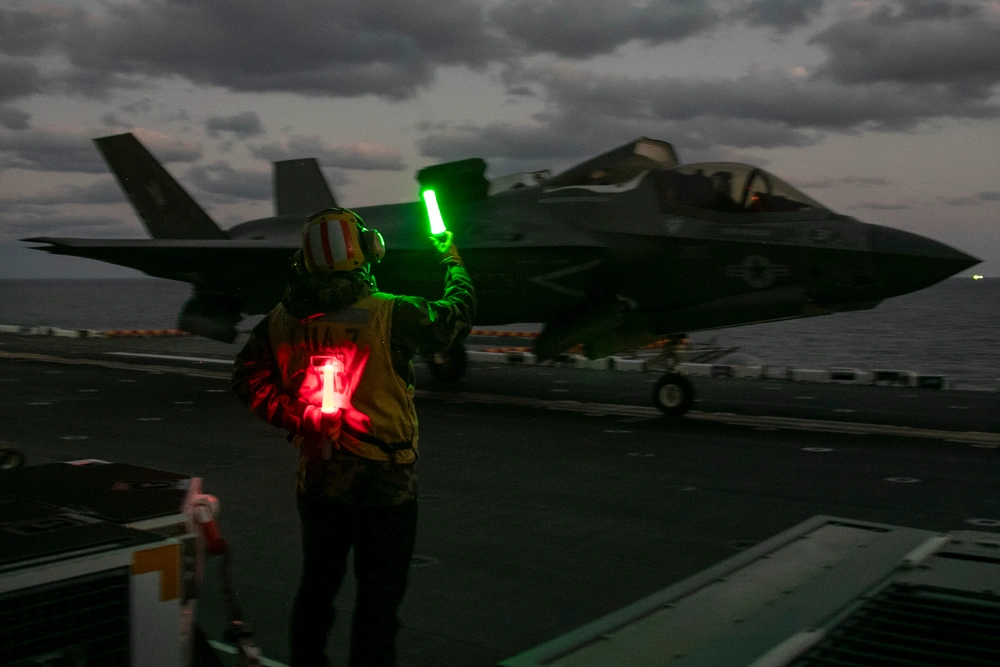
At that moment, troops from every branch of the American Armed Forces sprang into action, starting with a cyber attack on Caracas’ energy grid that blanketed whole swaths of the city in darkness as more than 150 aircraft, including Air Force F-35As, Marine Corps F-35Bs, F-22 Raptors, F/A-18 Super Hornets, EA-18G Growlers, E-2 Hawkeye early warning aircraft, and B-1B Lancer bombers, approached the Venezuelan coast from 20 different military bases and U.S. Navy vessels.
“The word integration does not explain the sheer complexity of such a mission,” said Gen. Dan Caine, Chairman of the Joint Chiefs of Staff. “An extraction so precise it involved more than 150 aircraft launching across the western hemisphere in close coordination, all coming together in time and place to layer effects for a single purpose, to get an interdiction force into downtown Caracas while maintaining the element of tactical surprise. Failure of one component of this well-oiled machine would have endangered the entire mission.”
Related: This is FBI’s elite team that joined Delta Force in Venezuela
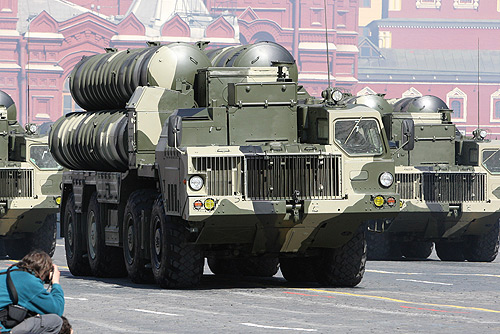
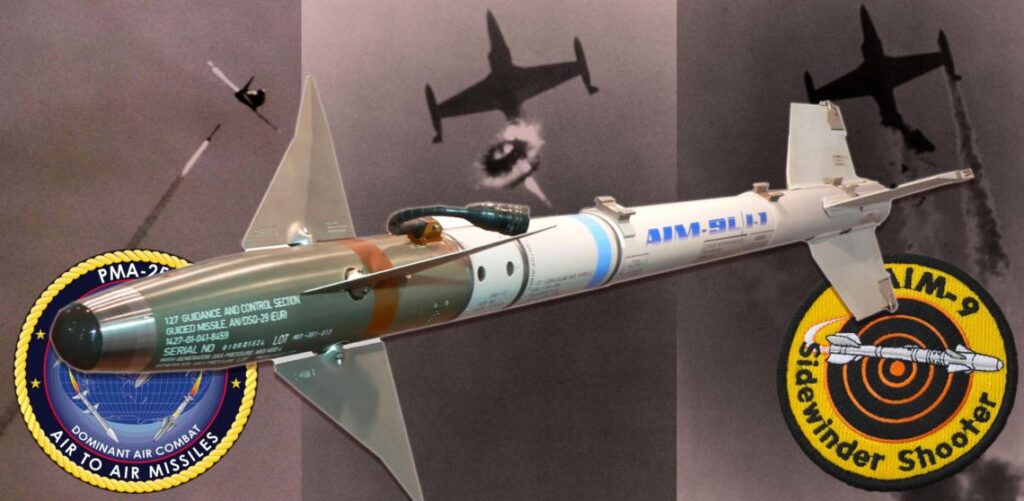
One of the first tasks was the suppression and destruction of enemy air defenses, which is among the most complex and dangerous fighter operations a pilot can take on. In effect, the job is to fly into enemy airspace, waiting for enemy air defense radars to power up and try to shoot you down. The pilot then launches anti-radiation, or radar-hunting, missiles in an attempt to destroy the air defense array before it can guide a missile into the fighter.
Venezuela operates Russian-sourced air defense systems, including what may be two or more modernized S-300 systems (S-300VMs), at least 44 older (but heavily upgraded) S-125 short range surface-to-air missile systems (the same platform used in 1999 to down an American F-117), and at least nine highly mobile, more modern Buk-M2E Grizzly medium-range missile systems that have proven very effective against Ukrainian fighters in Europe. While Russian air defense capabilities are often exaggerated, this combination of older and more modern systems should be able to create an effective, if piecemeal, integrated air defense net capable of identifying, tracking, and engaging targets ranging from sea-skimming cruise missiles, to fighters and bombers, and even some ballistic missiles.
Another immediate task was striking El Libertador Air Base in Maracay, about 60 miles from Caracas, both to stymie Venezuelan command and control and to prevent any of its 31 or so Su-30 fighters from getting airborne to give the nearby Raptors something to write home about.
These Su-30MK2 Flankers boast 12 hardpoints and can be armed with, among other weapons, R-77 radar-guided air-to-air missiles with a range of around 50 miles, not to mention several shorter-ranged air-to-air options. (Venezuela also has a handful of operational F-16s though they represent little more than a token capability at this point.)
It was right around 1:30 am local time, or 2:30 am in Washington, when the first explosions were reported in Venezuela, as air defense radar arrays went up in flames around Caracas, destroyed by 150-pound high-explosive blast-fragmentation warheads carried by radar-hunting missiles launched from fighters ripping through the sky overhead. Thousands of feet below, soaring through the inky darkness just 100 feet above the waves, MH-47 Chinooks and MH-60 Black Hawks from the Army’s legendary 160th Special Operations Aviation Regiment, more commonly known as the Night Stalkers, departed the USS Iwo Jima and made their way to Maduro’s compound.
These helicopters carried the Delta operators who had trained extensively on the replica of Maduro’s compound, as well as members of the FBI’s elite HRT, or Hostage Rescue Team, which trains extensively for direct-action counter-terror and hostage rescue operations. Combined, this ground force was said to be made up of some 200 operators and agents, including at least one FBI hostage negotiator in the event that Maduro managed to secure himself inside a safe room that the operators couldn’t penetrate.
Despite the suppression of air defense operations going on overhead, these helicopters were still in very real danger. Aside from radar-guided surface-to-air missile systems, Venezuela also has at least 440 Russian-sourced twin-barreled 23mm anti-aircraft guns capable of tearing a Chinook or Black Hawk to shreds. It also has hundreds, if not thousands, of SA-24 Grinch MANPADS, or shoulder-fired infrared-guided missile systems, that would make easy work of most low-flying helicopters.
Risks be damned, the helicopters were closing on Maduro’s compound by 2:00 am. As they arrived, one of the helicopters took fire and was hit, though it isn’t clear by what. We do know, however, that the helicopter was able to return fire, eliminate the threat, and continue on with the mission.
The Delta and HRT operators disembarked the helicopters and used explosives to breach the compound doors, where they were then engaged by Maduro’s security detachment as he and his wife attempted to flee to a more secure safe room. The helicopters, rather than remaining there, which could have resulted in them being engaged by local forces, immediately departed.
Related: Using roleplayers to train for hostage-rescue operations with Delta Force
According to U.S. officials, Delta was able to breach the building, eliminate Maduro’s security, and reach their target in under three minutes. When the dust settled, an unknown number of Venezuelan soldiers had been killed, as well as another 32 Cuban soldiers, said to be a part of Maduro’s security detail.
“No other organization besides the Unit could have pulled this off,” explained the former Delta operator. “We are talking about surgical precision combined with speed and violence of action in the heart of an enemy state. Maduro tried to flee to a safe room but the guys were so fast he didn’t have the time. That’s not easily done in a palace full of hostiles.”
Within five minutes of Delta’s boots hitting the ground, they radioed in that they had secured Maduro and his wife and were awaiting extraction, but the fighting wasn’t over. According to General Cain, multiple “self-defense engagements” continued as the team loaded their prisoners onto the helicopters and departed. By 3:29 am in Caracas, the team – and its prisoners – were already over the water, making their way back to the USS Iwo Jima.
In just under two hours, the United States military combined cyber, air, and surface strikes to enter the capital of a foreign country more than a thousand miles from its own shores, capture its leader, and depart without suffering a single American loss. The operation saw the seamless real-time coordination of U.S. SOCOM, the Air Force, the Space Force, the Navy, the Marine Corps, the CIA, the FBI, the NSA, and the National Geospatial-Intelligence Agency.
In the scope of geopolitics and even the history of modern warfare, few single operations have ever so thoroughly demonstrated such a complete tactical, strategic, technological, and capability overmatch between forces. And that’s something that other governments, adversary and otherwise, are sure to stop and take note of – especially now that America has demonstrated a willingness to undertake such an operation.
Feature Image: U.S. Army Soldiers, assigned to the 160th Special Operations Aviation Regiment, prepare to take off on board an MH-60M Black Hawk helicopter at Hurlburt Field, Florida, Jan. 10, 2024. (U.S. Air Force photo by Senior Airman Hussein Enaya)
Read more from Sandboxx News
- Project JEDI and the Air Force’s left field attempt to improve training
- Army receives first new prototype tank in 30 years
- US cyberattack may have taken out Caracas’ power grid for Operation Absolute Resolve
- B-52s to receive new engines as Air Force wants to keep its legendary bomber competitive
- CIA spies in Venezuela used high tech drones and insider info to map Maduro’s compound and movements