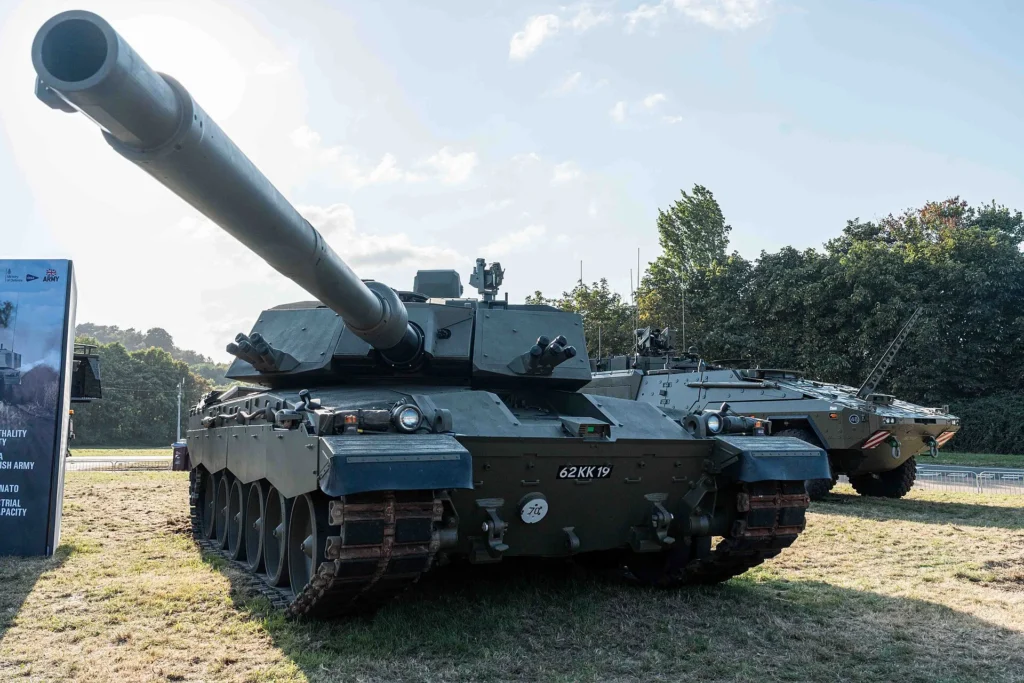
The British Army recently displayed the latest prototype of the Challenger 3 main battle tank, offering a glimpse inside the United Kingdom’s next-generation armor.
British Army officials showed the newest prototype of the new tank at the Defense Vehicle Dynamics 2026 at UTAC Millbrook.
Developed by Rheinmetall BAE Systems Land, the latest version of the Challenger is intended to elevate British armor capabilities to the next level with greater firepower, protection, and battlefield connectivity.
Rheinmetall BAE Systems Land is a joint venture between U.K.-based BAE Systems and Rheinmetall Defence U.K.
According to the British Army, the Challenger 3 is currently in the demonstration phase; the new hardware and software that will be incorporated into the production units is being developed and tested.
There are several prototype vehicles participating in trials around the United Kingdom.
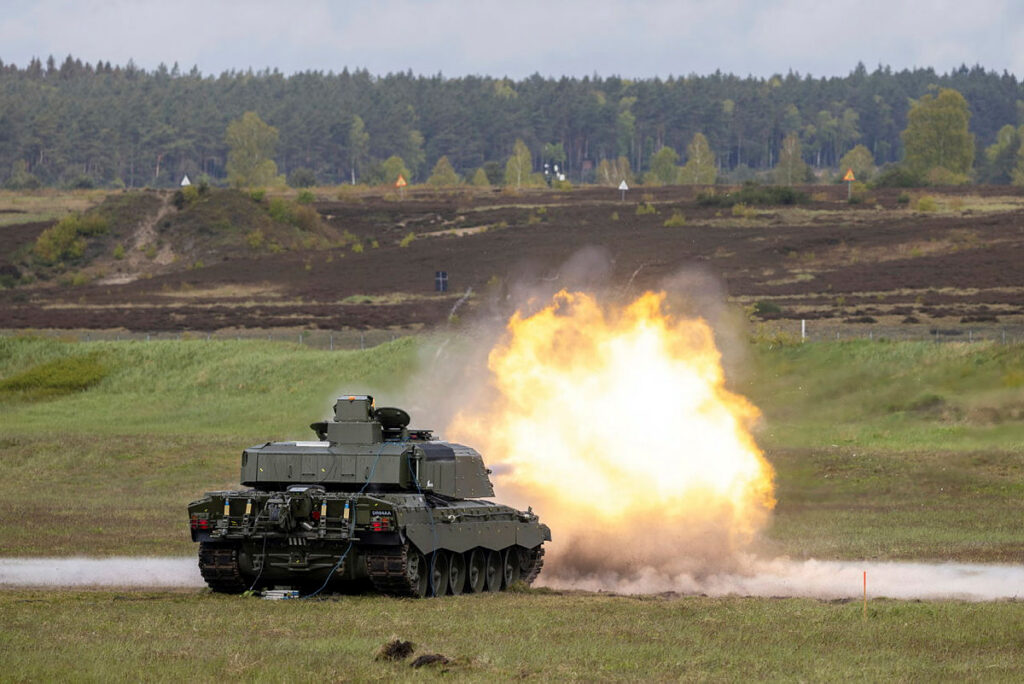
One of the tank’s main new features is the L55A1CR3 120mm smoothbore main cannon, which will be able to fire conventional, armor-piercing, and high-explosive rounds.
In terms of weight, the tank will weigh a burly 66 tons, which, all things considered, is on the heavier side of main battle tanks; the Russian T-90, for example, weighs about 20 tons less. Despite its heavy bulk, the Challenger 3 will be able to hit a max speed of about 37 miles per hour (60 kilometers per hour) with a new suspension system and upgraded engine.
As far as survivability and protection go, the Challenger 3 will have an active protection system, enhanced armor, and a laser warning system to caution against incoming munitions and other threats, such as suicide drones.
Moreover, the tank will have a fully digitized architecture that will allow it to better communicate with other assets and facilitate a more effective kill chain on the battlefield.
The Challenger 3 will have the standard four-man crew (commander, driver, gunner, and loader).
Related: Army receives first new prototype tank in 30 years
Modern tank warfare
The war in Ukraine showcased that armor warfare is still very much part of modern warfare.
While pundits – including former British Prime Minister Boris Johnson – predicted that advances in cyber warfare would make traditional warfighting tools obsolete, nearly five years of hard fighting in the fields of Ukraine have shown that tanks are still playing an important role in offensive and defensive operations.
Both the Ukrainian and Russian forces are using main battle tanks profusely.
To be sure, the tank does not have the dominant role it had in conflicts of the past. There will be no other Prokhorovka with some hundreds of tanks clashing under the blazing sun. The prevalence of one-way attack unmanned aerial systems, also known as suicide drones, and advances in artillery fire mean that large concentrations of tanks are suicidal.
Nevertheless, main battle tanks are the connecting link between mechanized infantry and long-range fires, using their protection and firepower to support advances or defensive actions against an adversary.
The Challenger 3 will give the British Army a reliable armor capability to counter the threats of the modern battlefield.
Feature Image: Earlier prototype of the Challenger 3 Main Battle Tank on display at the DVD2024 exhibition. (Photo by Jack Eckersley/British Ministry of Defence)
Read more from Sandboxx News
- Dr. Robot will see you now: DARPA seeks robotic trauma surgeons to partner with humans
- The Littoral Combat Ship should serve as a warning to the US Navy
- Marine Corps document points to autonomous robots, drones, and basic soldiering skills for Marines’ future
- ‘Time is a weapon:’ Former fighter, bomber pilots deliver report card on Operation Epic Fury
- Anduril is working to make its FQ-44 Fury fighter drone lethal against ground targets too