Did E3 and E4s name the Army’s latest ammo can? Because it certainly seems so. The Army has unveiled the first new type of ammo can since World War II and they call it the “SixPAC”
The SixPAC gained its name from the 6.8 mm round it’s destined to carry. The round will be used by the Army’s latest infantry rifle, the SIG MCS SPEAR. New rifle, new cartridge, new ammo can.
When you hear “ammo can,” you likely picture an olive drab metal box often used to store various knick-knacks. These steel cans were just one part of a two-part system. The cans were packed inside wooden crates bound by wire. You opened the crates, turned the wood into dunnage, and removed your ammo cans.
Developed by the Army’s Combat Capabilities Development Command Armaments Center, the new SixPAC will ingeniously use metal for the external containers and polymer for the ammo cans, themselves.
“The new SixPAC system marks a groundbreaking leap in small‑caliber ammunition packaging, one intended to reshape how munitions are used by Soldiers,” the center wrote in its press release.
Two polymer cans holding the ammunition will be sitting inside each container, likely packed in bandoliers and cardboard.
The previous wooden containers had the advantage of allowing you to reuse them. However, they broke fairly often. Further, when they would get wet, they could mold, get slimy, and become a hassle. Wood is also more supply-chain dependent than the new metal outer cans, which will be mass-produced.
Additionally, the steel outer containers will offer additional protection to the internal ammo than the wooden containers of the past. They are also durable and extensively reusable – unless someone hits them with a sledgehammer or thermite grenade – and they can be repeatedly recycled.
“Supply chain vulnerabilities, rising costs, and a need to prepare for tomorrow’s military operations in varied climates necessitated a re-evaluation of current munitions packaging,” the center said.
Hit ‘em with polymer
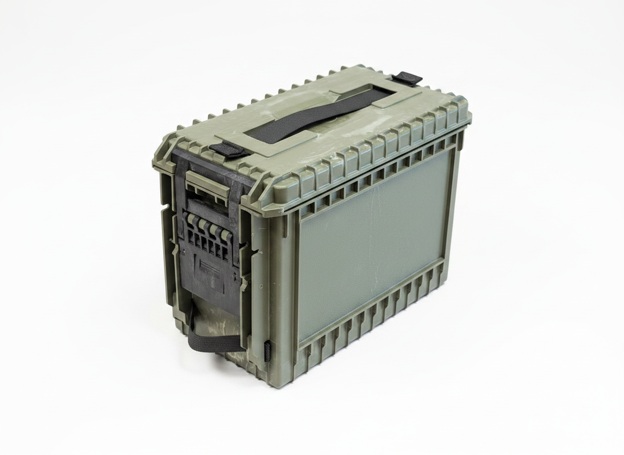
The polymer cans, themselves, are water-resistant, flexible, and unlikely to break without deliberate effort. Sportsmen moved to polymer cans decade\s ago, and there haven’t been any major problems with the material.
Polymer is cheap and, most importantly, lightweight.
We often overlook the benefits of saving a little weight here and there. The new polymer ammo cans weigh about half as much as the previous steel cans.
Troops aren’t typically carrying ammo cans on patrol, but when you save weight, you can load more on planes, watercraft, and helicopters – and helicopters and some watercraft can be fairly weight-sensitive. Troops unloading trucks have less weight to deal with and, therefore, less likelihood of an injury.
I carried a lot of ammo on my deployments and training operations, so I can appreciate even slight reductions in weight. We used to cut our toothbrushes in half to save weight and space. That sounds nuts, but if you reduce the weight of everything just a little, it adds up.
Related: Caseless ammo could be the future of cartridges
Nevertheless, polymer is always a touchy subject. Although the material isn’t as strong as steel, but it can be modified much more easily.
“It’s a developing field, and polymers are unique – you can modify them, include additives that improve impact performance, stiffness or dimensional stability,” said Edward Lucas, a mechanical engineer and polymer designer at the Combat Capabilities Development Command Armaments Center.
“You can add more ingredients to the cauldron, and your potion will come out different, trading some characteristics for others,” he added.
Thanks to injection molding polymer cans can be mass-produced quickly and efficiently.
With that said, the SixPAC design is still work in progress. Thanks to field testing that took place in 2024 and 2025, the Army Armaments Center is making changes and evolving to the design, but the overall goal is a metal outer container with polymer inner containers. .
While the setup is currently aimed at the 6.8mm cartridge, it is also planned for other cartridges down the line.
The SixPAC also looks pretty rad. It will be some time before they leak into the surplus market, but once they do, I’m snagging one up for my knick-knacks.
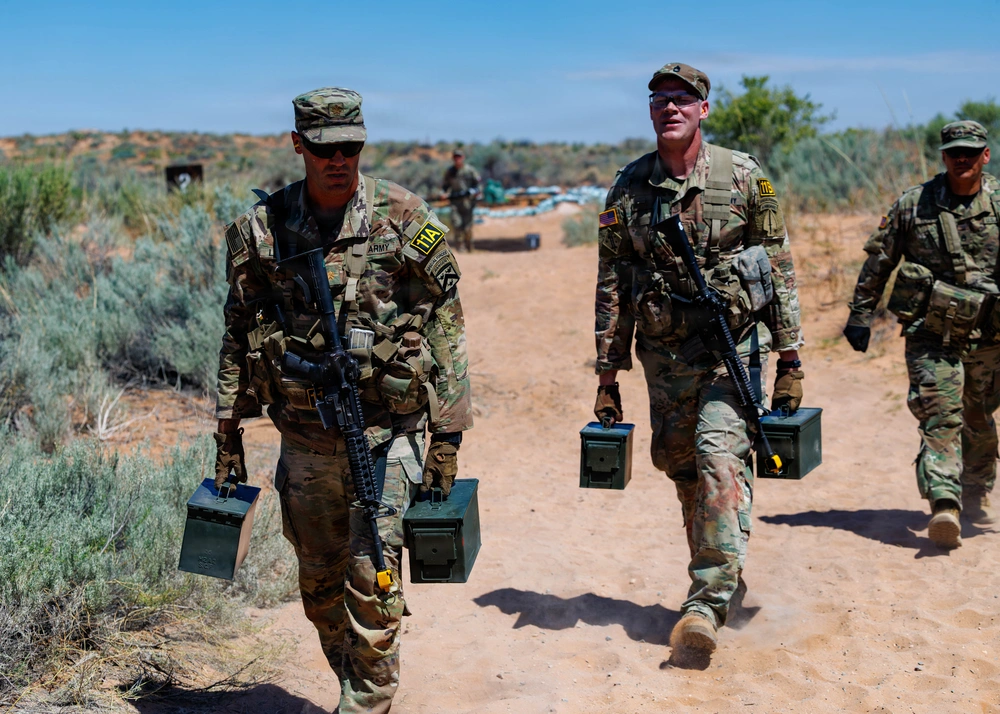
Feature Image: Maj. Jason Landis and Sgt. 1st Class John Metcalf, both with the Mission Command Training Program, approach the task finish line carrying ammo cans during the Pershing Cup three‑gun competition at McGregor Range Complex, New Mexico, Aug. 23, 2026. (U.S. Army photo by Sgt. Phyleicia‑Nicole Dais)
Read more from Sandboxx News
- How an F-15E scored its only air-to-air kill… with a bomb
- Could Russia attack a NATO member in the near future?
- Air Force wants to extend the service life of B-1 Lancers and B-2 Spirit bombers
- F-35A finds new home in Massachusetts as 104th Fighter Wing welcomes the stealth jet
- The time when a nearly perfect Delta Force sniper made a hilarious mistake