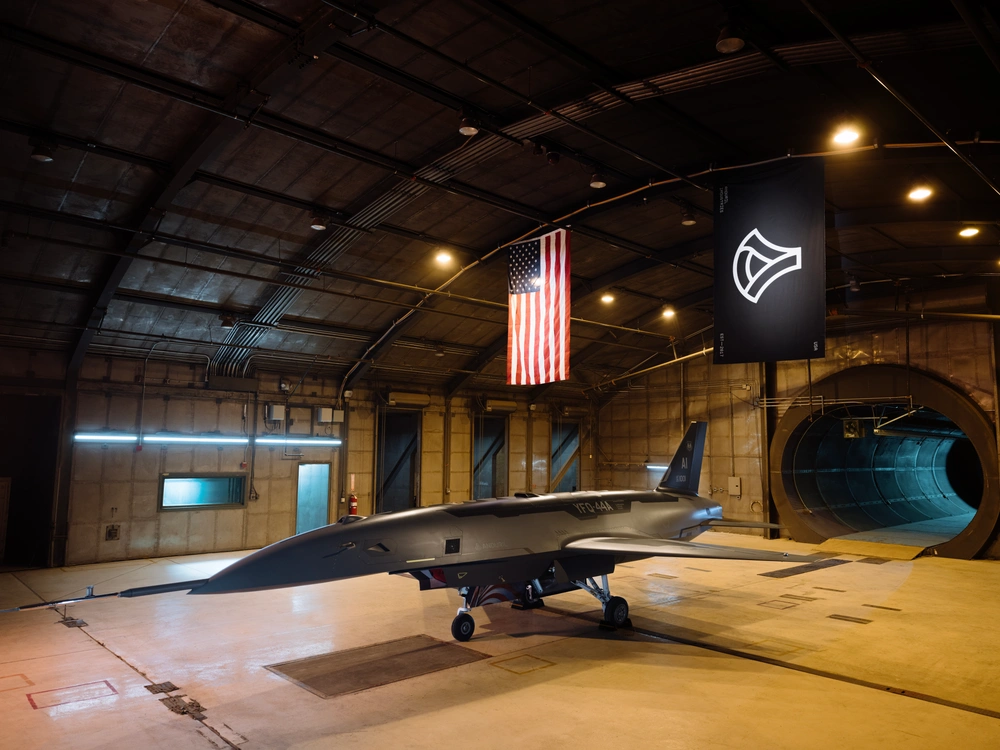
For the first time in history, an AI-piloted fighter drone – Anduril’s YFQ-44 Fury – has entered serial production. The company aims to produce 50 Furies per year in its new Arsenal-1 factory with a target of 150 jets per year in the not-too-distant future.
While this does mean Anduril’s Fury is beating a long list of other drone fighters in the race to production, it isn’t exactly clear to whom these fighters will be delivered. Anduril is currently competing with General Atomics and its YFQ-42 Dark Merlin fighter drone for Increment One of the Air Force’s Collaborative Combat Aircraft (CCA) contract. Additionally, to date, there has been no official word on any country intending to order Anduril’s Fury drones en masse.
The Air Force has stated that it may not choose one outright winner for the increment one production contract, and may instead opt to buy some number of each drone platform. Further, several allied countries are eager to get into the drone fighter space. So, Anduril could be rolling the dice on potential orders, or they might be working on the basis of expected or even placed orders that have just yet to be announced to the public.
The YFQ-44 Fury began development as a surrogate aggressor drone from Blue Force Technologies. Designed to emulate the performance of top-tier adversary fighters for complex air combat exercises, it gave American fighter pilots a realistic and highly capable opponent to train against. In 2023, however, Anduril purchased the firm and its aggressor drone, recognizing that it had more value as a fighter rather than as training aid.
Anduril’s newly redesigned Fury made its first flight on Halloween Day in 2025, and by February 2026 it was spotted flying with intert AIM-120 AMRAAM air-to-air missiles tucked underwing for the first time. The following month, Fury reportedly flew under the control of both Shield AI’s Hivemind AI autonomy system and Anduril’s Lattice AI system on the same day, showing how quickly and easily the platform can transition between autonomy systems regardless of vendor. This is a vital aspect of the CCA effort, which aims to ensure these fighter drones aren’t tied to a specific vendor for software updates, sustainment, and upgrades in the future.
Anduril’s new Arsenal-1 factory, located in Ohio, is said to be a bare-bones facility with no big machines or advanced robotics meant to support production. Fury’s portion of the vast facility includes just 22 workstations and a handful of cubicles where much of the aircraft is assembled by hand using 94% commercially available off-the-shelf components. The idea is to keep assembly simple and straightforward so it can be rapidly scaled when necessary, while also allowing for quick and easy changes in production.
As Anduril’s co-founder Matt Grimm explained to Air and Space Forces Magazine, if the company had chosen to build a massive robot that could install Fury’s wings, it might speed up the production process for an immense upfront cost; however, the company would then be stuck with that wing design and layout for the lifetime of the machine. Instead, Anduril wants to take a much more modular and iterative approach, with Fury continuing to improve over time.
It’s worth noting that Increment One of the CCA program is focused specifically on air-to-air combat. The Air Force’s priorities is to get CCA platforms into service and begin maturing new air warfare tactics and doctrine, while simultaneously improving autonomy control systems as it fields subsequent increments of CCA drones for other specialized roles. In effect, Increment One is about air combat mass and basic competencies, while each subsequent increment will build upon the last.
So, don’t fret about Fury carrying its weapons externally or not being stealthy enough for highly contested airspace — to some extent, the CCA drones heading for service today could be seen as stepping stones toward future iterations… they’re just stepping stones that can perform complex air combat maneuvers while toting rails full of air-to-air missiles.
Feature Image: A YFQ-44A production representative test vehicle is staged in a testing chamber at Costa Mesa, Calif. (Secretary of the Air Force Public Affairs)
Read more from Sandboxx News
- The Iranian general whose intel might have stopped the US from going to war in 2007
- New weapons and technologies making their debut in the war against Iran
- The Navy is on a mission to recover one of its worst warplanes from the ocean floor
- The Air Force made Lockheed’s Skunk Works design a stealth pole
- The ADE 651 bomb detector was one of the worst cases of fraud in military history