The U.S. Air Force was hiding the B-2 Spirit’s maximum payload capacity for decades, until just a few months ago, when it very quietly acknowledged that the bomber can actually carry way more ordnance than initially admitted.
It’s no secret that the U.S. regularly understates the technical capabilities of its military systems – whether we’re talking about the disclosed top speed of the SR-71or the unclassified dive depth of the Ohio-class ballistic missile submarine. In both cases, like many more, the military looks at the range of capabilities its platforms can offer, and usually chooses to disclose only the bare minimum.
But there’s more to this disclosure philosophy than just rounding down on a spec sheet, because the actual capabilities of complex systems are entirely circumstance- and environment-dependent: the Air Force finally admitting the B-2 can carry a lot more hate than they previously claimed is a perfect example of that.
When the B-2 was first unveiled in 1988, the Air Force didn’t disclose much about its combat capabilities. Yet, after a few years, it finally released a maximum payload figure of 40,000 pounds which was also the figure cited in the branch’s first official B-2 Fact Sheet in 2017.
That 40,000-pound figure stuck all the way until May of this year, when the Air Force, without any press release or announcement, very quietly increased the B-2’s max payload figure by an incredible 50%, now showing that the bomber is capable of carrying 60,000 pounds of munitions.
It is likely that this silent acknowledgement was a result of several journalists pointing out that the B-2s that flew in Operation Midnight Hammer were carrying 20,000 pounds of ordnance more than their unclassified maximum payloads.
But this wasn’t an outright lie about the bomber’s capability, so much as it was an intentional decision about what to disclose.
That is to say that the B-2’s max payload may genuinely be 40,000 pounds with a maximum fuel load, but by carrying less than its maximum fuel capacity of 167,000 pounds, it can increase the amount of ordnance it carries as long as it’s got sufficient internal volume for the added firepower. In other words, it can trade maximum range for maximum payload, making neither truly static figures.
And because these figures aren’t static, governments have to make decisions about how they present their platforms’ capabilities.
Some countries, like Russia, will promote their most extreme cases, saying their technology can do things that it could maybe theoretically do under the perfect conditions and with luck. Sometimes, the misrepresentation is even more egregious, as for example when Russia claimed its Kinzhal missile had a range of 3,000 kilometers, only to later acknowledge that the combat radius of the launching bomber was included in that figure, and that the weapon itself only has a range of about 500 kilometers.
The U.S., on the other hand, usually discloses as the final product’s actual specifications the minimum required capabilities it had dictated for that program, even if the final product vastly outperformed these specs in testing.
And that’s not just about understating the specs, but also about setting expectations. If the U.S. says a missile can fly 500 miles, you can rest assured that it can fly at least 500 miles. But if Russia says a missile can fly 500 miles… you better check the fine print.
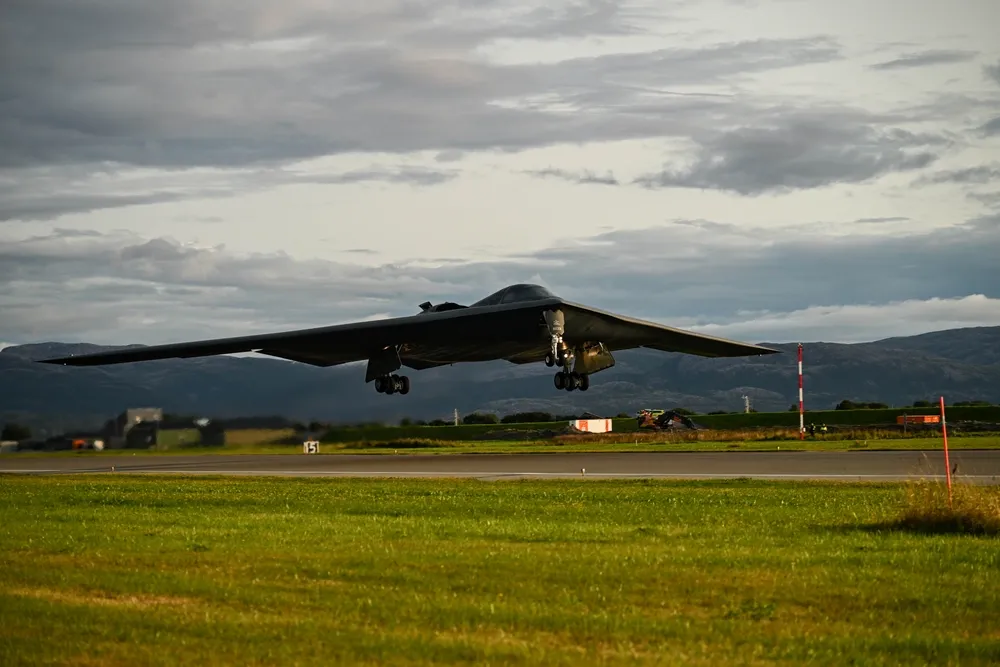
Feature Image: A B-2 Spirit assigned to Whiteman Air Force Base, Mo., takes off after hot pit refueling at Ørland flystasjon, Brekstad, Norway, Aug. 29, 2023. (U.S. Air Force photo by Tech. Sgt. Heather Salazar)
Read more from Sandboxx News
- Government subpoenas journalist over sensitive Navy SEAL-North Korea operation
- Marine Corps receives its final MV-22 Osprey in grand ceremony
- To join a special operations unit you have to get used to your rucksack
- How the F-22 Raptor silenced its critics 20 years ago
- Accounts of daily life with the Delta Force through 18 months of global training